
Hi Fmf,So, just having a deeper look at the recent CVEDIA partnership to try understand it a bit better.
From the release blurb, if I understand it correctly, the objective is to integrate and package CVEDIA RT & AKIDA into one deployable package on the users "chosen platform".
Happy to be corrected if I misunderstand?
Release snippets below and then something from CVEDIA website I find interesting.
I'm wondering, that if given the CVEDIA support for these various "platforms" they work with, if the package of CVEDIA & AKIDA combined will be a package that can be implemented quite easily without any additional integration or testing work?
If so, imo could ooen a bunch of different side doors to some specific names via the video analytics and easier training via their "synthetic data" solution if that's part of the mandate.
Thoughts?
Other source page links below.

BrainChip and CVEDIA Team to Advance State-of-the-Art Edge AI and Neuromorphic Computing
BrainChip and CVEDIA Team to Advance State-of-the-Art Edge AI and Neuromorphic Computingwww.businesswire.com
The focus of the partnership will be on the integration of the CVEDIA-RT platform for video analytics running on BrainChip’s Akida™ neuromorphic IP. The CVEDIA-RT platform enables rapid creation and development for video analytics for security and surveillance, transportation, ITS, and retail applications. By combining the two technologies, the companies can create and train AI models that are optimized for event-based processing and inference at the edge without relying on cloud connectivity or high-power consumption. This addresses some of the most challenging problems in edge AI, such as perception, cognition, security and privacy.
“We’re excited to partner with BrainChip to bring the benefits of CVEDIA-RT’s analytics to Akida enabled Edge AI devices enabling developers to scale much faster without needing the cloud,” said Arjan Wijnveen, CEO of CVEDIA. “Analyzing and tuning the complete solution at the edge, on the target platform that optimizes the applications and accelerates time to market, propels value added devices and services in AIoT.”
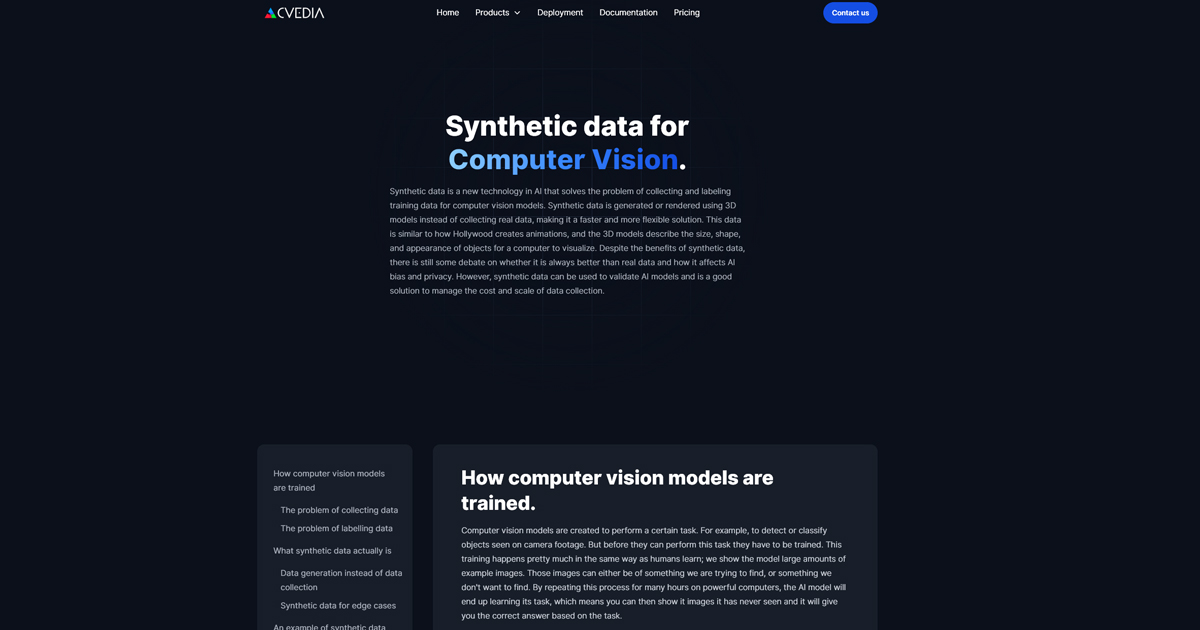
What is Synthetic Data | CVEDIA | AI Video Analytics for any hardware
Train computer vision models faster and more efficiently with Synthetic Data. This new AI technology uses 3D models instead of real data for training, making it a flexible and cost-effective solution. Learn about the benefits of synthetic data and how it solves the challenges of data collection...www.cvedia.com
Synthetic data for Computer Vision.
Synthetic data is a new technology in AI that solves the problem of collecting and labeling training data for computer vision models. Synthetic data is generated or rendered using 3D models instead of collecting real data, making it a faster and more flexible solution. This data is similar to how Hollywood creates animations, and the 3D models describe the size, shape, and appearance of objects for a computer to visualize. Despite the benefits of synthetic data, there is still some debate on whether it is always better than real data and how it affects AI bias and privacy. However, synthetic data can be used to validate AI models and is a good solution to manage the cost and scale of data collection.
Dashboard - CVEDIA RT Portal
rt.cvedia.com

CHOOSE YOUR PLATFORM
Version 2023.3.0 Date June 02 2023 Release notes link

Download

Download

Download

Download
CHIPSETS









CLOUD



2023.3.0 - CVEDIA-RT
docs.cvedia.com
Cvedia have algorithms and models, which are basically software/data.
Their models could be deployed on Akida. This would require conversion to Akida-friendly format.
Remembering that Akida is processor agnostic, the algorithms could be deployed on whatever processor Akida is integrated with.
Akida needs a co-processor for configuration, the original version used an ARN cortex processor, but Akida can be used with any processor (SiFive, Intel, Nvidia, ...)
I note Cvedia list Hailo and Qualcomm as suitable processors for deploying their products. I recall seeing a figure of 2.5 W for Hailo.

 ,
, , good point, unless the German version is inferior initially?