
Tothemoon24
Top 20
To me Both your balls are crystalSorry, I've run out of shilling pieces for the meter on my crystal ball.


To me Both your balls are crystalSorry, I've run out of shilling pieces for the meter on my crystal ball.

I was just going to edit that it is probably a wallaby rather than a roo!Akida would say it's a wallaby...


Edit: Right after hitting the send button, it occurred to me that this might be a wallaby rather than a roo… Sorry!Mmmh, I wonder why, of all animals, iniVation would pick an image of kangaroo to illustrate the key features of their all-new Aeveon sensor technology…
For a company based in Switzerland, obvious choices would have been a dairy cow, an Alpine ibex, a chamois, an Alpine marmot or a golden eagle.
Of course it could be mere coincidence or even a red herring. But how probable is that?
Edit: Right after hitting the send button, it occurred to me that this might be a wallaby rather than a roo… Sorry!

Technology
Technology Pioneers in neuromorphic vision The founders of iniVation invented the field of neuromorphic vision, which mimics key features of the human visual system. Our patented Dynamic Vision Sensor (DVS) transmits binary pixel-level change events, at microsecond time resolution. This...inivation.com
Pioneers in neuromorphic vision
The founders of iniVation invented the field of neuromorphic vision, which mimics key features of the human visual system. Our patented Dynamic Vision Sensor (DVS) transmits binary pixel-level change events, at microsecond time resolution. This approach is equivalent to a high-speed camera at thousands of frames per second – but with far less data. The advantages include:
High speed (equivalent 10k+ fps) and very low latency (< 1 ms)
High dynamic range (over 120 dB)
Longer battery life
Reduced data rate


Aeveon™ – Redefining vision sensing
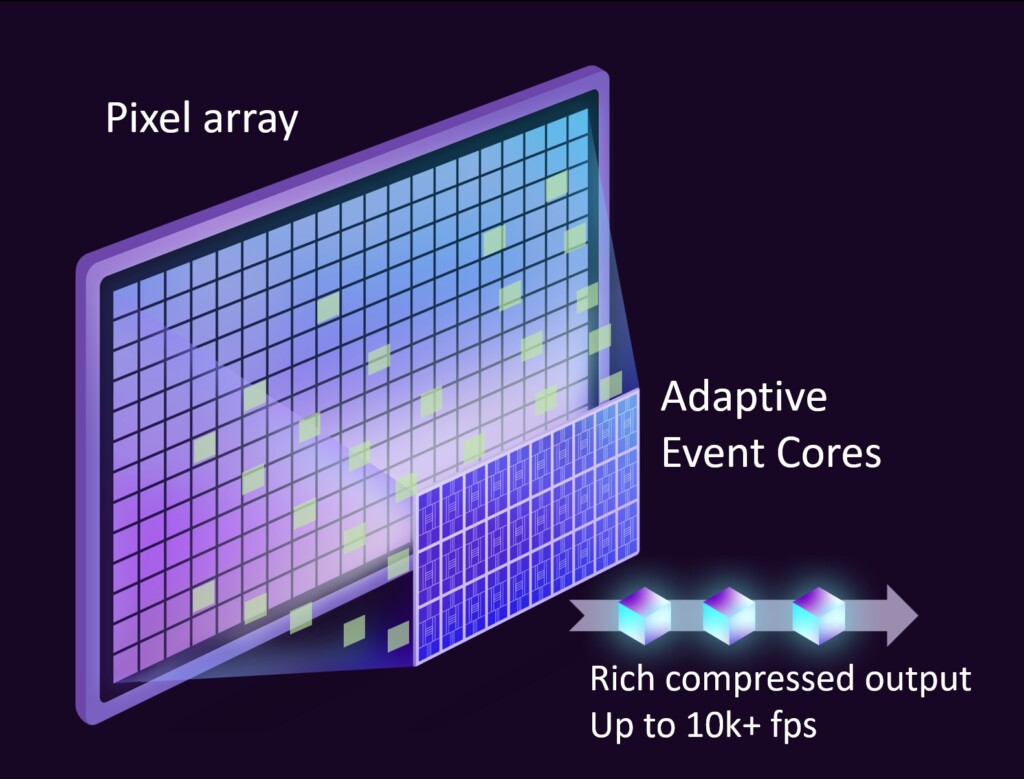
With our all-new Aeveon™technology, we are changing the game again. A new Adaptive Event Vision™ unified pixel architecture enables every pixel to generate multiple types of events:
Binary change events as with the legacy DVS
Multi-bit change events
Full frame readout
Region events
A state-of-the-art stacked sensor design with massively parallel Adaptive Event Cores produces a rich, highly compressed output stream. It combines the speed advantages of legacy DVS with the high fidelity of frame-based sensors.
Key Features
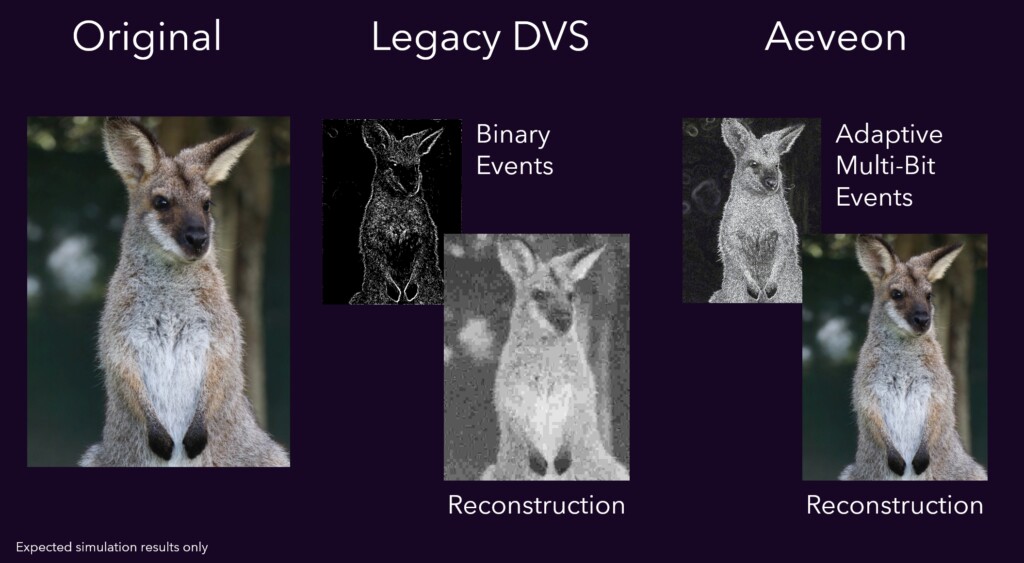
Lossless image reconstruction using adaptive multi-bit events.
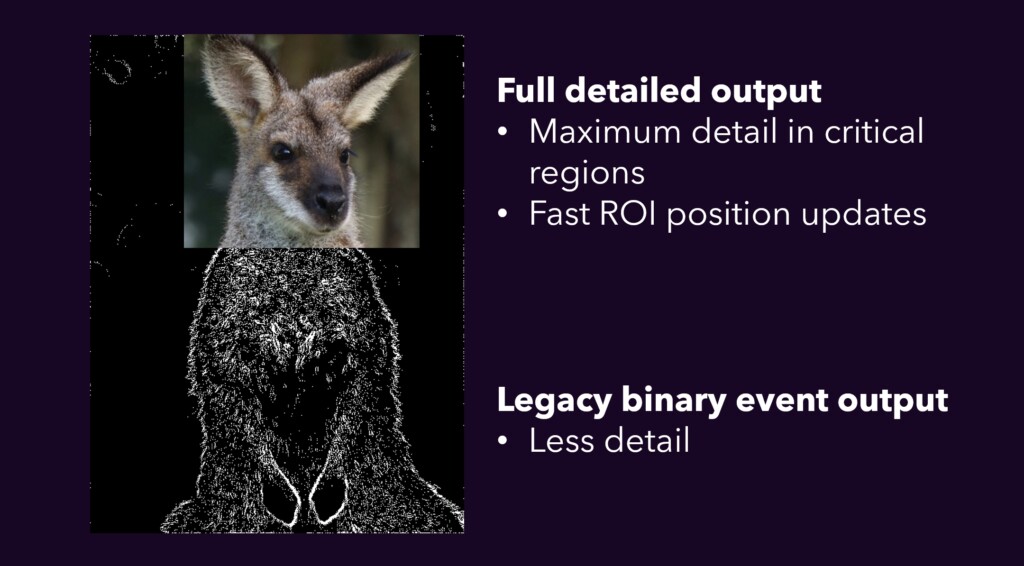
Multiple dynamic regions of interest (ROIs) enable valuable bandwidth to be focused on the most critical regions of the scene, and updated on-the-fly.
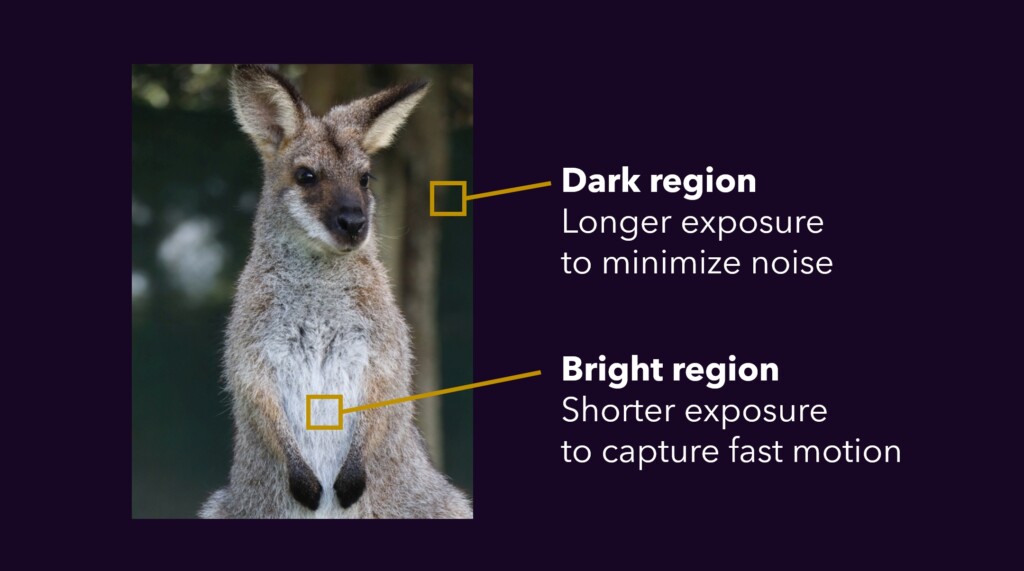
On-sensor fast lossless compression, based on regions and motion information, saving up to 80% data.
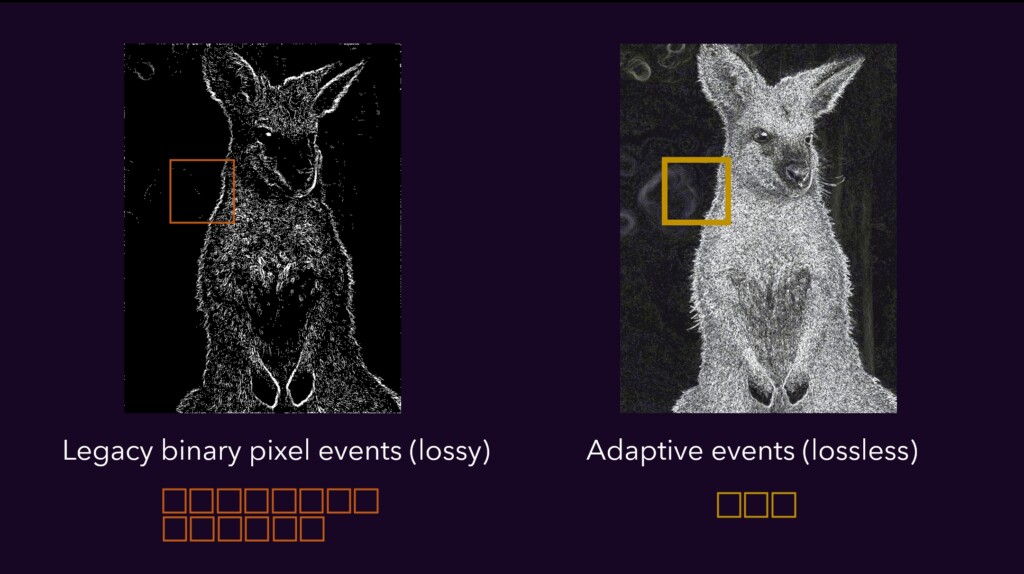
Self-adapting smart pixels provide native high-dynamic range (HDR) output and minimize noise, particularly in low light.
Real world integration features
Anti Flicker
Remove artefacts caused by illumination variation
Improve quality for consumer imaging and automotive
Small pixel size enables high resolution
Stacked design enables pixels down to 1.5 µm or less
Full 1:1 events or frames from every pixel
Flexible architecture
Can be used directly with custom pixels (infrared, automotive, etc.)
Software compatibility
Works with all existing frame-based and event-based vision software
Protect your software investment
Aeveon application benefits
Automotive
Low-latency HDR vision
In-cabin observation
AR/VR
Low-latency fast scene camera
Fast, low-power eye tracking
SLAM

Mobile
HDR imaging, anti-blur
Ultra-high-speed video

Mobile robotics
Low-latency HDR vision
Fast SLAM, tracking

The Euro was originally going to be called the EMU (European Monetary Union) but it was to Australian so they decided on the Euro without knowing that was an aussie wallaby.Edit: Right after hitting the send button, it occurred to me that this might be a wallaby rather than a roo… Sorry!
Probably a EURO


Mmmh, I wonder why, of all animals, iniVation would pick an image of kangaroo to illustrate the key features of their all-new Aeveon sensor technology…
For a company based in Switzerland, obvious choices would have been a dairy cow, an Alpine ibex, a chamois, an Alpine marmot or a golden eagle.
Of course it could be mere coincidence or even a red herring. But how probable is that?
Edit: Right after hitting the send button, it occurred to me that this might be a wallaby rather than a roo… Sorry!
Technology
Technology Pioneers in neuromorphic vision The founders of iniVation invented the field of neuromorphic vision, which mimics key features of the human visual system. Our patented Dynamic Vision Sensor (DVS) transmits binary pixel-level change events, at microsecond time resolution. This...
Pioneers in neuromorphic vision
The founders of iniVation invented the field of neuromorphic vision, which mimics key features of the human visual system. Our patented Dynamic Vision Sensor (DVS) transmits binary pixel-level change events, at microsecond time resolution. This approach is equivalent to a high-speed camera at thousands of frames per second – but with far less data. The advantages include:
High speed (equivalent 10k+ fps) and very low latency (< 1 ms)
High dynamic range (over 120 dB)
Longer battery life
Reduced data rate
Aeveon™ – Redefining vision sensing
With our all-new Aeveon™technology, we are changing the game again. A new Adaptive Event Vision™ unified pixel architecture enables every pixel to generate multiple types of events:
Binary change events as with the legacy DVS
Multi-bit change events
Full frame readout
Region events
A state-of-the-art stacked sensor design with massively parallel Adaptive Event Cores produces a rich, highly compressed output stream. It combines the speed advantages of legacy DVS with the high fidelity of frame-based sensors.
Key Features
Lossless image reconstruction using adaptive multi-bit events.
Multiple dynamic regions of interest (ROIs) enable valuable bandwidth to be focused on the most critical regions of the scene, and updated on-the-fly.
On-sensor fast lossless compression, based on regions and motion information, saving up to 80% data.
Self-adapting smart pixels provide native high-dynamic range (HDR) output and minimize noise, particularly in low light.
Real world integration features
Anti Flicker
Remove artefacts caused by illumination variation
Improve quality for consumer imaging and automotive
Small pixel size enables high resolution
Stacked design enables pixels down to 1.5 µm or less
Full 1:1 events or frames from every pixel
Flexible architecture
Can be used directly with custom pixels (infrared, automotive, etc.)
Software compatibility
Works with all existing frame-based and event-based vision software
Protect your software investment
Aeveon application benefits
Automotive
Low-latency HDR vision
In-cabin observation
AR/VR
Low-latency fast scene camera
Fast, low-power eye tracking
SLAM
Mobile
HDR imaging, anti-blur
Ultra-high-speed video
Mobile robotics
Low-latency HDR vision
Fast SLAM, tracking


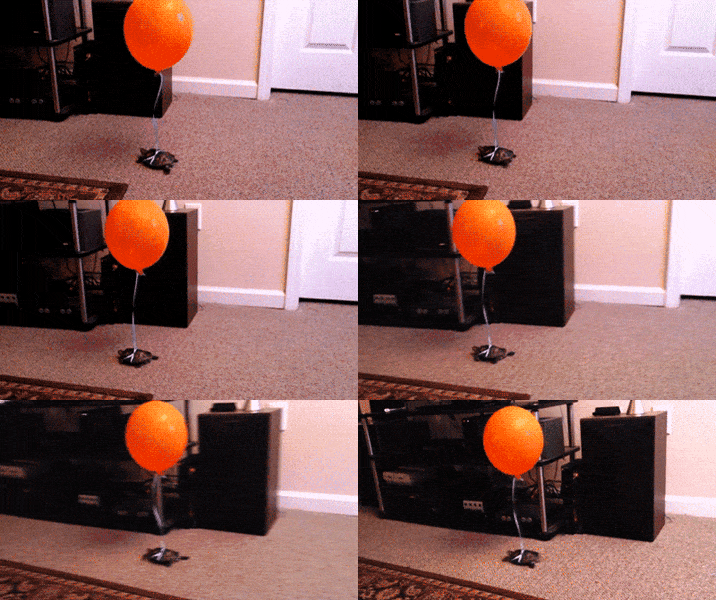
Helium in action, sure makes this tortoise outperform though.As far as AI goes, Helium is very light weight compared to Akida.
Arm has previously built some test chips with partners including Samsung and Taiwan Semiconductor Manufacturing Co, largely aimed at enabling software developers to gain familiarity with new products. However, multiple industry executives told the FT that its newest chip — on which it started work in the past six months — is “more advanced’ than ever before.
Akida is "more advanced" than Helium.
BrainChip joined ARM's Partner Program 11 months ago, so they have been sitting on their hands for 5 months.
Rumblings about Arm’s chipmaking moves have stoked fears in the semiconductor industry that if it makes a good enough chip, it could seek to sell it in the future and thereby become a competitor to some of its biggest customers, such as MediaTek or Qualcomm. People close to Arm insist there are no plans to sell or license the product and that it is only working on a prototype. Arm declined to comment. Any move to build chips for wider commercial sale would undermine Arm’s position as the “Switzerland” of the semiconductor industry, selling designs to almost all mobile device chipmakers while not directly competing with them. Its neutral model has led to its products being found in more than 95 per cent of smartphones, with customers including Qualcomm, MediaTek and Apple. “Working on intellectual property is one thing but really designing and working with production partners to turn those efforts into physical chips is a totally different arena. It’s more capital intensive,” a former Arm executive with knowledge of the effort told the FT. “At some point in the future [Arm] will definitely need returns to justify that massive investment.”
... and where are all the "former ARM executive(s)" working?

Coincidence Toshiba has popped up a couple times this weekend.https://www.linkedin.com/posts/jaso...2-Jtvn?utm_source=share&utm_medium=member_ios
View attachment 34882
Brainchip not specifically mentioned in the article itself, but this guy who is director of engineering at TOSHIBA mentioned us in his post.
 innovolo-group.com


Check out this link:
Next-Level Neuromorphic Computing: Intel Lab's Loihi 2 Chip
Intel Lab’s Loihi 2 chip delivers outstanding performance & new features, including an open-source, community-driven neuromorphic computing framework.www.intel.com
It's nice to get a mention here but it's interesting how IBM's chip and Intel's Loihi 2 get kudos over AKIDA (I recall posters suspecting that Intel was perhaps deferring to AKIDA as the superior chip). Do we actually have a 3 year lead because it raises the old fear that one of the big companies will run over us with neuromorphic technology.
Is it possible that potential customers are waiting until the last minute to see which horse to back in the neuromorphic race?
Some of their coin may be coming from the takeover?Coincidence Toshiba has popped up a couple times this weekend.
I read a blog article by this company a couple days ago and didnt think too much about it other than interesting....after seeing the Toshiba Dir of Engineering comment, thought I find the blog again and post as a little more relevant.
My bold....they certainly got some coin haha
How Toshiba Invests in Research and Development to Drive Innovation
Toshiba is a global leader in various technology fields, such as energy, infrastructure, electronics and digital solutions. The company's success is based on
How Toshiba Invests in Research and Development to Drive Innovation
- BRADLEY PALLISTER
- MARCH 27, 2023
- INNOVATION INSIGHTS
Toshiba is a global leader in various technology fields, such as energy, infrastructure, electronics and digital solutions. The company’s success is based on its continuous investment in research and development (R&D) to create innovative products and services that meet the needs of customers and society.
According to its financial data, Toshiba spent approximately 1.5 trillion Japanese yen (about 13 billion US dollars) on R&D in the fiscal year 2021, which accounted for 4.9% of its sales. This ratio is higher than the average R&D expenditure as % of the revenue of other major Japanese companies in the ICT industry, which was 3.8% in the fiscal year 2020.
Toshiba’s R&D strategy focuses on three key areas: core, growth, and frontier technologies. Core technologies are the foundation of Toshiba’s business domains, such as power systems, industrial systems, electronic devices and storage devices. Growth technologies are the drivers of Toshiba’s future growth, such as artificial intelligence (AI), the internet of things (IoT), robotics and quantum cryptography. Frontier technologies are the exploratory fields that Toshiba aims to create new value and markets, such as biotechnology, neuromorphic computing and fusion energy.
Toshiba conducts its R&D activities through various channels, such as its own research laboratories, joint research with universities and other institutions, collaboration with customers and partners, and participation in national and international projects. Some of the recent achievements of Toshiba’s R&D include:
See also What are the benefits of using a licensing revenue model?
- Developing a high-performance AI processor that can perform complex deep learning tasks at high speed and low power consumption.
- Launching a new generation of NAND flash memory that can store up to 1 terabyte of data in a single chip.
- Establishing a world record for continuous operation of a nuclear fusion reactor for 20 seconds at a plasma temperature of over 100 million degrees Celsius.
- Introducing a digital transformation platform that can integrate data from various sources and provide advanced analytics and solutions for various industries.
Toshiba’s R&D efforts are aimed at enhancing its competitiveness and profitability and contributing to social good and environmental sustainability. Toshiba’s vision is to become a “cyber-physical systems (CPS) technology company” that can create value by connecting the physical and digital worlds. By investing in R&D, Toshiba hopes to realize this vision and achieve its corporate motto: “Committed to People, Committed to the Future.”

WWWWWHHHAATTT??? Tell me me more MC!
Suggest it would be these guys.
Oh! You peeked!To me Both your balls are crystal

Could be a Tammar Wallaby. Native to WA...Akida would say it's a wallaby...
According to Sean anything neuromorphic is power efficient.Toahiba also involved in the Japanese NEDO project with a few others.
I posted some thoughts on NEDO, Socionext and some others back in Dec
HERE
Here's some snips from their report in Oct last year.
See if notice a couple of familiar names in the entrusted partners box I highlighted.
View attachment 34906
View attachment 34907
View attachment 34898 View attachment 34899 View attachment 34900 View attachment 34901
I wouldn't be concerned about Intel and IBM, as they probably won't sell their technology as IP.According to Sean anything neuromorphic is power efficient.
In the recent Investor presentation he went through the major Neuromorphic competitors.
BRN ticked all the boxes. The others did not.
IBM was still a research chip. None were commercially available.
Appears that this one is still in the research stage.
Not sure how close to us this chip is??
Don't bother with these cry babies, they will only cry more when you give them attention. It's much simpler just to put them on ignore and they will eventually grow tired of crying when nobody is listening.Sorry @caroorac, but you sound like the baby because you have not once bothered answering one question I've directed politely to you. Maybe you're the baby?
View attachment 34865


