Hi @rgupta
I’m hoping it’s more than 2.5% to be honest. If their product doesn’t work without us then their revenue becomes zero.
Whoever does the contract negotiations (Rob T) is vital. A small percent off can make a massive difference over the life of the agreement.
Hopefully as a partnership we have managed to achieve more in which case we will become a going concern very quickly when revenue kicks in!

The Valeo deal is a joint development, where normally remuneration is based on sales, each party's share being calculated based on their contribution.
From the technical aspect, Akida has made a major contribution, but unfortunately it is more likely the contribution is measured in terms of dollars and euros. The power saving provides the auto makers with a strong selling point in addressing range anxiety.
However, we need to remember we were not negotiating from a position of strength in 2020. Our finances were not the best because we did not have any customers.
As our friends at MF constantly remind us, our R&D spend is miniscule compared with the big boys, but we could expect a lot better than 2.5%. Again, I assume that figure is just cited to show the bottom end of what we could expect.
PS: For those who bought in on the Valeo news, there is little to complain about.
https://smallcaps.com.au/brainchip-joint-development-agreement-akida-neuromorphic-chip-valeo/
BrainChip signs joint development agreement for Akida neuromorphic chip with Valeo
By George Tchetvertakov -June 9, 2020
Artificial intelligence device company BrainChip Holdings (ASX: BRN) has taken an affirmative step towards integrating its Akida neuromorphic chip into autonomous vehicles after signing a binding joint development agreement with European automotive supplier Valeo Corporation.
The agreement means both companies will collaborate to develop a new wave of tech solutions based on artificial intelligence (AI) and reduced power consumption within the overarching theme of miniaturisation that’s taking the tech industry by storm.
...
In a statement to the market this morning, BrainChip said Valeo will utilise Akida and collaborate on the development of neural network processing solutions, for integration in autonomous vehicles (AVs).
The terms of the deal stipulate that both companies must reach specific performance milestones, with BrainChip stating it expects to receive payments to cover its expenses, subject to the completion of, as yet, undisclosed milestones.
Neuromorphic engineering was first developed by US scientist Carver Mead in the 1980s and refers to the use of very-large-scale integration (VLSI) systems containing electronic analogue circuits to mimic neuro-biological architectures present in the nervous system.
According to BrainChip, by combining the Akida neural network processor with sensors, the resulting system can achieve ultra-low power, minimum latency, maximum reliability and incremental learning.
“This is a major advancement over current architectures which require large amounts of data to be transmitted to a CPU or GPU, which has the burden of processing all data from all sensors and then combining the results to make a decision or retrain the network for new classifiers,” the company said.
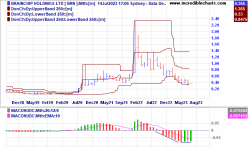
Today’s news pushed BrainChip shares up by 36% to $0.12 per share in morning trade.









 . Too my people are jumping at shadows.