Pom down under
Top 20
Well another week passes without any real news and the silence coming from the company has gone beyond deafening. Have a great weekend everyone and maybe this time next year we will all be millionaires


Impressive. Now SUT$FF.
I have updated my list of Brainchip Engagements as at 1 August, 2025. I use this list for the purpose of ongoing research to keep track of existing projects or to pick up any new projects. Needless to say the list is now quite long so if anyone wants use it for their research activities they are quite welcome:
1. FORD
2. VALEO
3. RENESAS
4. NASA
5. TATA Consulting Services
6.MEGACHIPS
7. MOSCHIP
8.SOCIONEXT
9.PROPHESEE
10. VVDN
11. TEKSUN
12. Ai LABS
13. NVISO now BeEMOTION
14. EMOTION3D
15. ARM
16. EDGE IMPULSE
17. INTEL
18. GLOBALFOUNDRIES
19. BLUERIDGE ENVISIONEERING
20. MERCEDES BENZ
21. ANT 61
22. QUANTUM VENTURA
23.INFORMATION SYSTEM LABORATORIES
24.INTELLISENSE SYSTEMS
25. CVEDIA
26. LORSER INDUSTRIES
27. SiFIVE
28. IPROSILICONE
29.SALESLINK
30. NUMEM
31. VORAGO
32. NANOSE
33. BIOTOME
34. OCULI
35. CIRCLE8 CLEAN TECHNOLOGIES
36. AVID GROUP
37. TATA ELXSI
38. NEUROBUS
39. EDGX
40. EUROPEAN SPACE AGENCY
41 UNIGEN
42. iniVation
43. SAHOMA CONTROLWARE
44. MAGIKEYE
45. MYWAI
46. INFINEON
47. ERICSSON
48. MICROCHIP
49. ONSEMI
50. IPSOLON RESEARCH
51. UBH - HELLAS
52. ACCENTURE
53. FRONTGRADE GAISLER
54. DELL Technologies
55. BOSTON DYNAMICS
56. AIRBUS
57. PARSONS CORPORATION
58. BASCOM HUNTER
59. ExeLANCE IT
60. US AIRFORCE RESEARCH LABORATORY
61. ONSOR
62. ANDES TECHNOLOGY
63. DEGIRUM
64. VEDYA
65. MULTICOREWARE
66. ARQUIMEA
67. LOCKHEED MARTIN
68. RTX - RAYTHEON & COLLINS
69. Nurjana Technologies
70. Chelpis Quantum GROUP
71. MiRLE GROUP
72. BOSCH
73. RENAULT
74. ST MICROELECTRONICS
75. University of Virginia
76. University of Oklahoma
77. Arizona State University
78. Carnegie Mellon University
79. Rochester Institute of Technology
80. Drexel University
81. Cornell Tech - founded by Cornell University & Technion - (Israel Institute of Technology and sponsor of Nanose)
82. University of Western Australia
83. Penn State University
My opinion only DYOR
Fact Finder


 autogpt.net
Parsons acquired Blacksignal last year:FF.
I have updated my list of Brainchip Engagements as at 1 August, 2025. I use this list for the purpose of ongoing research to keep track of existing projects or to pick up any new projects. Needless to say the list is now quite long so if anyone wants use it for their research activities they are quite welcome:
1. FORD
2. VALEO
3. RENESAS
4. NASA
5. TATA Consulting Services
6.MEGACHIPS
7. MOSCHIP
8.SOCIONEXT
9.PROPHESEE
10. VVDN
11. TEKSUN
12. Ai LABS
13. NVISO now BeEMOTION
14. EMOTION3D
15. ARM
16. EDGE IMPULSE
17. INTEL
18. GLOBALFOUNDRIES
19. BLUERIDGE ENVISIONEERING
20. MERCEDES BENZ
21. ANT 61
22. QUANTUM VENTURA
23.INFORMATION SYSTEM LABORATORIES
24.INTELLISENSE SYSTEMS
25. CVEDIA
26. LORSER INDUSTRIES
27. SiFIVE
28. IPROSILICONE
29.SALESLINK
30. NUMEM
31. VORAGO
32. NANOSE
33. BIOTOME
34. OCULI
35. CIRCLE8 CLEAN TECHNOLOGIES
36. AVID GROUP
37. TATA ELXSI
38. NEUROBUS
39. EDGX
40. EUROPEAN SPACE AGENCY
41 UNIGEN
42. iniVation
43. SAHOMA CONTROLWARE
44. MAGIKEYE
45. MYWAI
46. INFINEON
47. ERICSSON
48. MICROCHIP
49. ONSEMI
50. IPSOLON RESEARCH
51. UBH - HELLAS
52. ACCENTURE
53. FRONTGRADE GAISLER
54. DELL Technologies
55. BOSTON DYNAMICS
56. AIRBUS
57. PARSONS CORPORATION
58. BASCOM HUNTER
59. ExeLANCE IT
60. US AIRFORCE RESEARCH LABORATORY
61. ONSOR
62. ANDES TECHNOLOGY
63. DEGIRUM
64. VEDYA
65. MULTICOREWARE
66. ARQUIMEA
67. LOCKHEED MARTIN
68. RTX - RAYTHEON & COLLINS
69. Nurjana Technologies
70. Chelpis Quantum GROUP
71. MiRLE GROUP
72. BOSCH
73. RENAULT
74. ST MICROELECTRONICS
75. University of Virginia
76. University of Oklahoma
77. Arizona State University
78. Carnegie Mellon University
79. Rochester Institute of Technology
80. Drexel University
81. Cornell Tech - founded by Cornell University & Technion - (Israel Institute of Technology and sponsor of Nanose)
82. University of Western Australia
83. Penn State University
My opinion only DYOR
Fact Finder

Wow. What a small world. As a high school student during the late 1980s, I worked as a student programmer for Parsons Engineering Science in Atlanta (they had acquired the small civil engineering firm in 1981).Parsons acquired Blacksignal last year:
https://www.parsons.com/2024/07/parsons-to-acquire-blacksignal-technologies/
Blaclsignal lists Blue Ridge as one of its companies:
https://www.blacksignal.tech/our-companies
Parsons lists a lot of AI applications:
https://www.parsons.com/ai/
Explore All Of Our AI Capabilities
- Idea Conception
- Requirements Analysis
- AI Cloud/Edge Architectures
- AI HW/SW Design and Dev
- R&D Prototyping
- Large Scale Data Collection
- Data Preprocessing/Preparation
- Model Verification and Validation
- Model Security
- AI Solution Field Testing
- AI Solution Deployment
- Runtime Environment O&M
- AI Solution Risk Mitigation
- AI Ethics/Privacy/Anti-Bias
- AI Recruiting
- AI Staff Training
- AI Technology Surveillance
- AI Technology T&E (Paladin)
- Data Decommissioning
- AI System Decommissioning
- Synthetic Data Generation
The 2023 Blue Ridge/Brainchip announcement makes reference to Akida 2 technology:
https://www.edgeir.com/brainchip-bl...am-up-to-build-tactical-edge-devices-20230416
BrainChip, a provider of neuromorphic processors for edge AI on-chip processing, has teamed up with Blue Ridge Envisioneering. Blue Ridge Envisioneering will integrate BrainChip Akida processors into Blue Ridge’s designs for tactical edge devices used by defense and intelligence agencies.
The co-developed tactical edge devices will deploy in harsh, resource-constrained environments with limited power access and strict thermal requirements. The BrainChip Akida platform’s proficiency in functioning effectively in extreme situations and its ability to offer advanced artificial intelligence capabilities at the edge makes it suitable for military applications.
...
BrainChip recently announced the development of its latest Akida platform, which is designed for embedded edge AI applications and features 8-bit processing. The new system utilizes vision transformers and Temporal Event Based Neural Nets (TENN) spatial-temporal convolutions to improve performance and power efficiency.
The Brainchip/Blue Ridge partnership should be a neat fit, or rather a significant technical advancement, for Parsons.


100%.Hi again smooth.
None of it bothers me, actually sounds pretty good if turns out true. Maybe there was another collaboration or details of partnership announced that I haven't seen, but the red flag for me was the GPT comment "given the strategic nature of the partnership announced in late 2023" when we know the actual IP Licence announcement Dec 2020. The other concern is the formal announcement talks about Renesas required to pay for ongoing support after 2 yrs (paraphrasing), and as you know, engineering revenue (or any revenue) hasn't been great, so I'm a 50/50 on Renesas. Not being a downer by any means, just voicing my thoughts. Conversely, there is obviously lots going on behind the curtains, so I am hopeful, we will all see the tide to turn soonish????
I think GPT is great in many ways, but at the moment, I don't completely trust.
Wow. What a small world. As a high school student during the late 1980s, I worked as a student programmer for Parsons Engineering Science in Atlanta (they had acquired the small civil engineering firm in 1981).
Those were some of the most enjoyable projects I've worked on in my professional career, including hardware and software solutions for remote monitoring and control of tank pumps, remote calibration and measurement of rainwater levels, or simplifying calculations for treatment plant operations. Most of what they did was very innovative, integrating off-the-shelf components to create very unique automated solutions for their customers.
I can see how Parsons' subsidiaries and companies would benefit from using BrainChip's technology in their solutions, specifically for smart infrastructure projects. While they were a team that focused on Civil Engineering, they would usually contract out to Electrical Engineers for solutions that would make MacGyver proud.
While things are probably very different from what they were in the 80s, back then, I could envision someone using Akida (if it were available at that time) and cobbling together a custom solution for a client. By the way, most of their clients were large corporations and sometimes involved multi-year contracts regulated by government entities.
Thanks for that trip down memory lane!

When googling for “Brainchip Akida” the other day, I stumbled across an Interesting Engineering article titled “Can an AI chip that mimics the brain beat the data deluge?”, but couldn’t access it at the time, because it was behind a paywall. (IMO it makes far more sense to spend the equivalent of that 1 US$ on half a dozen BRN shares right now…)
View attachment 89044
Today I discovered a link on the BrainChip website under Investor Relations that will take you to a PDF document created by Sarah Marker from Bospar (our new PR & Marketing Agency), which contains screenshots of that same article:

BrainChip’s Neuromorphic Energy-Efficient Computing
Explore BrainChip’s neuromorphic Akida™ processor, delivering ultra-low power, event-based AI for efficient edge computing applications.investor.brainchip.com
“Brain-inspired chips slash AI power to micro-joules, but 8-bit limits and tooling gaps keep neuromorphic tech niche, for now.”
Learn more
…which links to…
She (or whoever else took those screenshots) unfortunately cut off some lines of text on each page, so in case we have any IE subscribers here on TSE, they may want to double-check whether we missed out on anything important.
View attachment 89045
View attachment 89027
View attachment 89028 View attachment 89029 View attachment 89030
View attachment 89031 View attachment 89032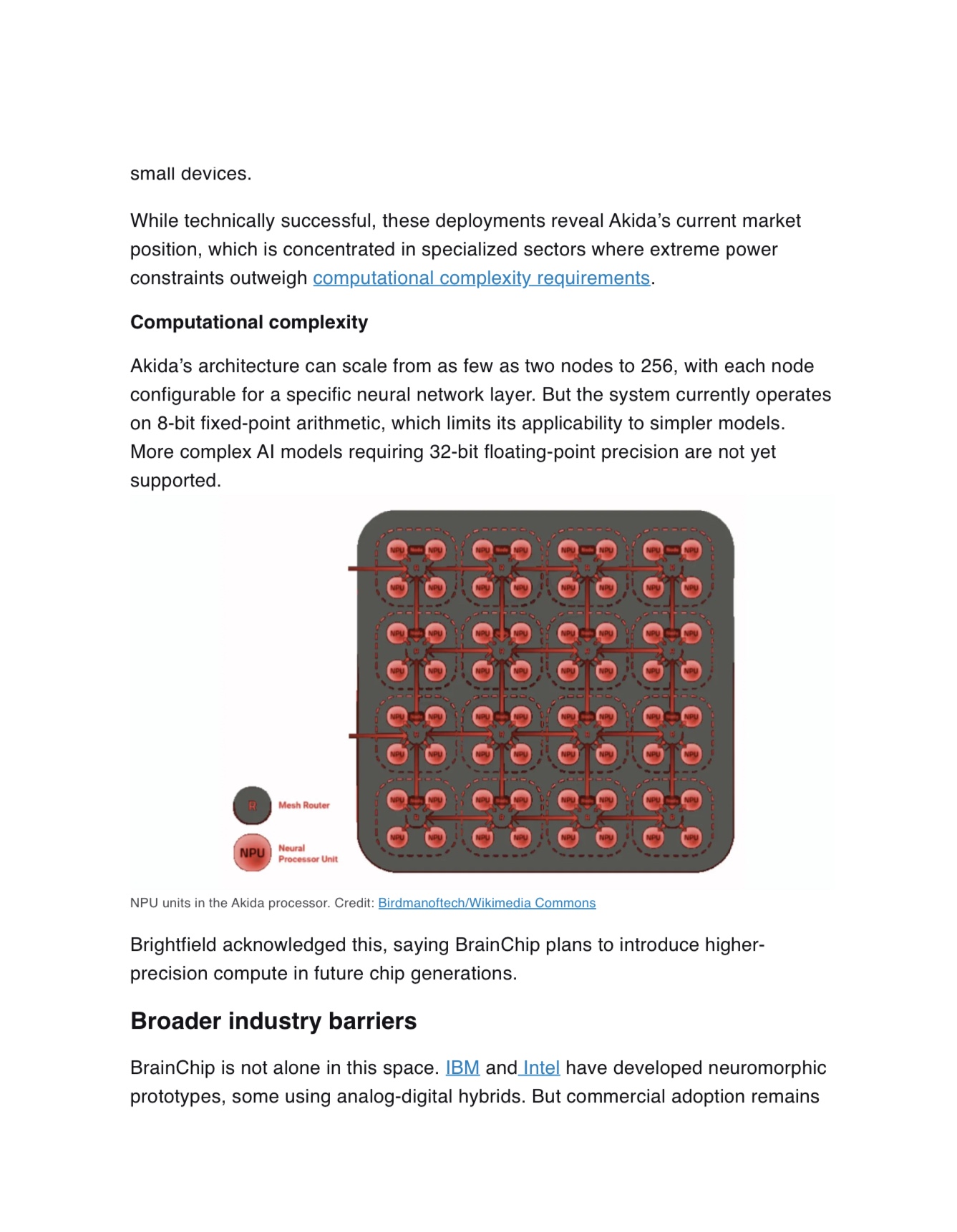
View attachment 89034
This article - based on an interview with our CMO Steve Brightfield - should serve as a reality check to those shareholders who see virtually everything about BRN through rose-coloured glasses.
One challenge relating to the adoption of neuromorphic technology is that certain applications benefit more than others:
“It is important to note that the power savings are dramatic only in high sparsity scenarios such as static security cameras, sparse sensor data, and anomaly detection. ‘If the scene is a very active video feed with significant motion, resulting in low sparsity, you can expect considerably less savings,’ Brightfield cautioned.”
The last paragraph, where Steve Brightfield is quoted as saying “We’re still in the early stages of understanding how to best leverage neuromorphic architectures”,
might also be rather sobering for quite a few (especially long-term) shareholders. Our CMO then added: “The real test will be whether these efficiency gains can translate into broader applications as the technology matures.”
Now does that sound like our Chief Marketing Officer were talking about our company as being entirely de-risked and about imminent “generational wealth” for shareholders? Or is it rather an honest and realistic assessment of BrainChip’s current market position?


With those kind of "tools" when you ask a question, the way the answer is given, depends a lot on how the question is asked, especially when you are seeking "its" opinion.Hi Smoothsailing 18.
Im just not completely trusting of Chat GPT or others, though obviously very good tools in the right context. See the Renesas announcement from december 2020.
First Akida IP License Agreement
cheers


 www.eenewseurope.com

View attachment 89251
In this article from EE Times, BrainChip Scientific Advisory Board Member, Dr. | BrainChip
In this article from EE Times, BrainChip Scientific Advisory Board Member, Dr. Jason Eshraghian, explores how researchers are combining the strengths of deep learning with neuromorphic computing to create more efficient, brain-inspired AI systems. https://lnkd.in/gdDyYbBU #Neuromorphic...www.linkedin.com