

Frangipani
Top 20
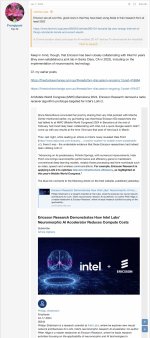
Ericsson’s Ahsan Javed Awan continues to be enamoured with Intel, although I noticed a slight change in his slide, where “neuromorphic hardware” is no longer followed by “(Loihi 2)”. Interesting, given that “Lava is platform-agnostic, so that applications can be prototyped on conventional CPUs/GPUs and deployed to heterogeneous system architectures spanning both conventional processors as well as a range of neuromorphic chips such as Intel’s Loihi.”
(https://lava-nc.org/)
Could that signify he is also trying out other processors these days?
June 2024
View attachment 65075
https://thestockexchange.com.au/threads/brn-discussion-ongoing.1/post-418864
compare to July 2023
View attachment 65074
Dylan Muir from SynSense gave a remote presentation on Speck:
View attachment 65067
And I also spotted the SpiNNaker and IBM logos on the opening slide of the online presentation by Jörg Conradt (KTH Stockholm) - no surprise here.
View attachment 65098
Hopefully, researchers in Jörg Conradt’s Neuro Computing Systems lab that moved from Munich (TUM) to Stockholm (KTH), will give Akida another chance one of these days (after the not overly glorious assessment of two KTH Master students in their degree project Neuromorphic Medical Image Analysis at the Edge, which was shared here before: https://www.diva-portal.org/smash/get/diva2:1779206/FULLTEXT01.pdf), trusting the positive feedback by two more advanced researchers Jörg Conradt knows well, who have (resp soon will have) first-hand-experience with AKD1000:
When he was still at TUM, Jörg Conradt was the PhD supervisor of Cristian Axenie (now head of SPICES lab at TH Nürnberg, whose team came runner-up in the 2023 tinyML Pedestrian Detection Hackathon utilising Akida) and co-authored a number of papers with him, and now at Stockholm, he is the PhD supervisor of Jens Egholm Pedersen, who is one of the co-organisers of the topic area Neuromorphic systems for space applications at the upcoming Telluride Neuromorphic Workshop, that will provide participants with neuromorphic hardware, including Akida. (I’d venture a guess that the name Jens on the slide refers to him).
Let’s savour once again the above quote by Rasmus Lundqvist, who is a Senior Researcher in Autonomous Systems at RISE (Sweden’s state-owned research institute and innovation partner), with a focus on drones and innovative aerial mobility.

LinkedIn Login, Sign in | LinkedIn
Login to LinkedIn to keep in touch with people you know, share ideas, and build your career.www.linkedin.com
“And mark my words; there is no more suitable AI tech for low-power low-latency than SNNs and neuromorphic chips to run them.”
RISE’s ongoing project Visual Inspection of airspace for air traffic and SEcuRity (a collaboration with SAAB, https://www.saab.com/) sounds like a perfect use case for Akida:
View attachment 65118
View attachment 65119

Visual Inspection of airspace for air traffic safety and SEcuRity | RISE
With a growing number of drones in the lower airspace, it becomes important to be able to, in a cost-efficient way, identify the drones that do not cooperate with U-Space Service Providers (USSP). This is especially important in areas nearby critical infrastructure.www.ri.se
View attachment 65121
One of Ericsson’s Stockholm-based neuromorphic researchers, Ahsan Javed Awan, who describes himself on LinkedIn as “Technology Specialist - Emerging Compute Algorithms” is looking for 3 Master students to work on “Brain-Inspired Algorithms for Telecom Networks” relating to RAN (Radio Access Network) workloads:
Sign Up | LinkedIn
500 million+ members | Manage your professional identity. Build and engage with your professional network. Access knowledge, insights and opportunities.
As per my June 2024 post above, Ahsan Javed Awan had been very enamoured with Loihi over the past few years, but may possibly be open to evaluate other neuromorphic processors as well.
The job ad posted on LinkedIn doesn’t specify what specific neuromorphic hardware the algorithms would be implemented on:
Ericsson hiring Master Thesis: Brain-Inspired Algorithms for Telecom Networks in Stockholm, Stockholm County, Sweden | LinkedIn
Posted 7:17:52 PM. Join our TeamAbout this opportunity:With the rapid adoption of machine learning in…See this and similar jobs on LinkedIn.
Ericsson
Share
Show more options
Master Thesis: Brain-Inspired Algorithms for Telecom Networks
Stockholm, Stockholm County, Sweden · 19 hours ago · 4 people clicked apply
Promoted by hirer · Responses managed off LinkedIn
Full-time
Apply
Master Thesis: Brain-Inspired Algorithms for Telecom Networks at Ericsson
About the job
Join our TeamAbout this opportunity:
With the rapid adoption of machine learning in telecommunication networks, the energy consumption associated with the training of cognitive algorithms and inference engines is of increased concern. Bio-inspired computing architectures such as Neuromorphic systems could process cognitive tasks in an energy-efficient manner, thereby yielding the networks sustainable. A variety of tasks such as deep learning inference, dynamic programming, quadratic unconstrained binary optimization etc... can exploit the neuromorphic hardware by reformulating the problem to the brain-inspired neural network architecture. To harness the potential of neuromorphic hardware in the telco networks, it is imperative to understand how brain-inspired neural networks can solve relevant computational problems in energy efficient manner.
This master thesis aims at developing brain-inspire neural networks (SNN, BCPNN, etc..) for certain telco use cases and demonstrating the potential energy efficiency gains.
What you will do:
- Understand Radio Access Network workloads that need to be energy efficient.
- Reformulate the RAN workloads into customized brain-inspired neural network architecture and validate the functionality using neuromorphic simulator.
- Devise technique to estimate the energy efficiency gains of the brain-inspired neural network for the RAN workloads.
- Documentation of the solution and evaluation.
- MSc Student in Physics/Computer Science/Mathematics/Embedded Systems or other related fields
- Proficient in Probability Theory, Deep Neural Networks, Spiking Neural Networks.
- Understanding of Neuromorphic Computing hardware and software stacks
- Good programing skills are required, knowledge of C++, Python, Linux.
Your application should include: CV, Cover letter, Transcripts of studies (both B.Sc. and up-to-date M.Sc.).
Why join Ericsson?
At Ericsson, you´ll have an outstanding opportunity. The chance to use your skills and imagination to push the boundaries of what´s possible. To build solutions never seen before to some of the world’s toughest problems. You´ll be challenged, but you won’t be alone. You´ll be joining a team of diverse innovators, all driven to go beyond the status quo to craft what comes next.
What happens once you apply?
Click Here to find all you need to know about what our typical hiring process looks like.
Encouraging a diverse and inclusive organization is core to our values at Ericsson, that's why we champion it in everything we do. We truly believe that by collaborating with people with different experiences we drive innovation, which is essential for our future growth. We encourage people from all backgrounds to apply and realize their full potential as part of our Ericsson team. Ericsson is proud to be an Equal Opportunity Employer. learn more.
Primary country and city: Sweden (SE) || Stockholm
Req ID: 773239
I’m of course aware of the December 2023 paper “Towards 6G Zero-Energy Internet of Things: Standards, Trends and Recent Results” paper, in which six Ericsson researchers had experimented with Akida for a ZE-IoT device…(https://d197for5662m48.cloudfront.n...rint_pdf/dfcbe2c260b5426434db681b0f637243.pdf)
…but this is a different area of research, in which Ericsson has been collaborating with Intel for years:
https://thestockexchange.com.au/threads/brn-discussion-ongoing.1/post-446092
Attachments
Last edited:




 $4.99 USD a share sounds very nice at this moment in time




 Maybe they delivered less than what was agreed.
