
Frangipani
Top 20
Wow! STMicroelectronics on a big edge AI push!
Video posted a couple of days ago.
"This is AI directly at the edge on a miriad of tiny devices running innumerable applications. This is edge AI. And it's powered by a very different set of chips and software stack to what is used in the data centre today. We are litterally on the brink of this new era that will bring about a massive wave of smart devices representing a huge opportunity. In the coming years we see billions of microcontrollers and smart sensors shipping with AI functionality."
- 30 seconds
Predicting and detecting faults in HVACs
- 5.30 mins
On-device learning?
- 17.43 mins
Two new products (STM32N6 & STM32) that integrate powerful neural acceleration cores that bring processing capabilities and algorithms that not so long ago were reserved for CPUs that are in the hands of selects customer now and are going into product development for launch next year.
- 22 mins
Real time object detection using STM32N6
- 23.21 mins
View attachment 51813
View attachment 51807
Good work Bravo with STMicroelectronics.
On their website, looks like they're pretty keen on Edge AI https://www.st.com/content/st_com/e...logy/artificial-intelligence-at-the-edge.html
"Moving intelligence from the cloud to the edge
AI is used today in an ever-wider range of applications. It impacts the services we use as well as the devices and machines we interact with every day. Much of this AI relies on cloud computing, using powerful remote data centers, which process the data collected by local devices.
Edge AI deploys AI algorithms and models directly on devices such as Internet of Things (IoT) devices and embedded industrial and automotive systems. This approach enables real-time processing and analysis of data at the source. It paves the way for genuinely autonomous intelligent devices, capable of rapidly deciding and acting in an adaptive way.
Deploying AI at the edge offers several advantages over the cloud approach. It provides speed and ultralow latency, much lower data transmission loads, and significantly improved security. It significantly reduces power thanks to inference algorithms running at milliwatts, or even microwatts, on edge devices vs watts in the cloud. And it preserves privacy.
Edge AI opens many new possibilities for device and service creators across all markets enabling new applications at a fraction of the cost of using the cloud."
Also, having a browse through Remi's LinkedIn feed, a lot to like there as well. Not sure how to find Anil's comment when Remi announced he got the President position back in Dec 2021, but I remember that they seem to know each other quite well. If someone can help me out there, would be great
More Edge AI news from STMicroelectronics:
“STMicroelectronics has announced its second-generation STM32 microprocessors, promising improved performance and acceleration for edge artificial intelligence (AI) and machine learning workloads — and a move to 64-bit processors cores for the first time in the range's history.”
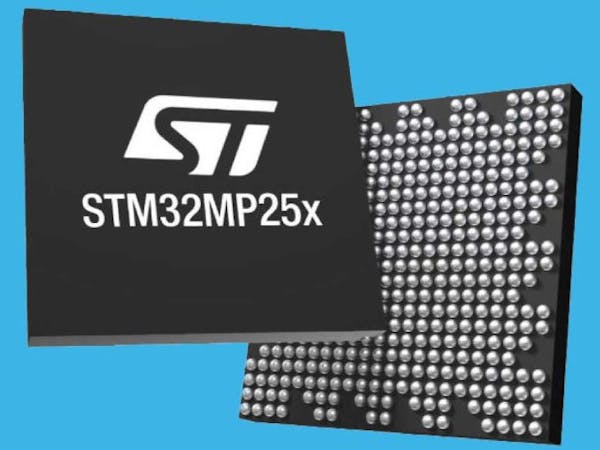
STMicro's STM32 Family Makes the 64-Bit Jump with New Edge AI, 3D-Capable STM32MP Parts
Retaining the STM32 name despite a shift to the 64-bit Arm Cortex-A35 core, STMicro's latest STM32 parts pack in the power.
www.hackster.io
STMicro's STM32 Family Makes the 64-Bit Jump with New Edge AI, 3D-Capable STM32MP Parts
Retaining the STM32 name despite a shift to the 64-bit Arm Cortex-A35 core, STMicro's latest STM32 parts pack in the power.
Gareth HalfacreeFollow
1 day ago • HW101 / Internet of Things / Machine Learning & AI
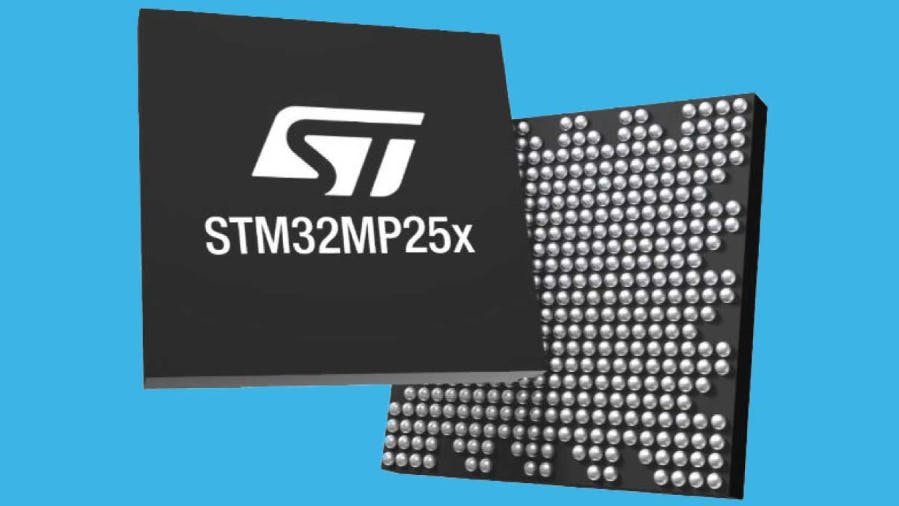
"Our embedded MPUs address the trend that’s pushing more workloads and greater demands to smart devices, often deployed at the IoT [Internet of Things] edge, for faster response and increased efficiency," says STMicro's Stephane Henry of the company's new processors.
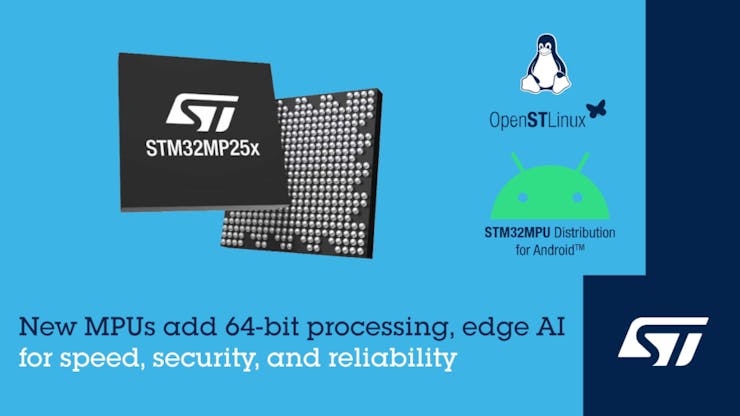
STMicro has announced new parts in the STM32 range, and they're the company's most powerful yet. (
 : STMicroelectronics)
"The new STM32MP2 devices we are announcing today," Henry continues, "extend the performance trajectory, introducing our most powerful processing engine, now adding edge AI, and supported by the STM32 ecosystem to accelerate product development."
The first surprise in the new chip range: a move to 64-bit processor cores, despite retaining the STM32 name. The STM32MP2 chips are the company's first to use the Arm Cortex-A35 core, running at speeds of up to 1.5GHz, alongside a 32-bit Arm Cortex-M33 microcontroller core running at up to 400MHz, a dedicated graphics processing unit (GPU) with 3D acceleration and support for 1080p displays, a video processing unit (VPU), and a neural processing unit (NPU) designed to accelerate on-device edge AI and machine learning work.
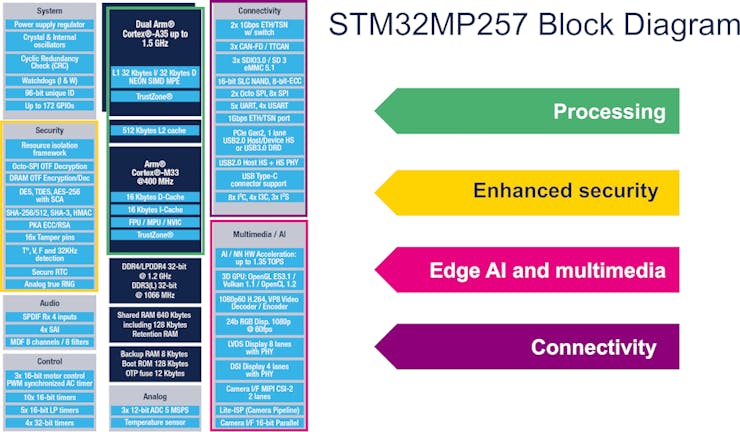
The new parts include up to two 64-bit Arm Cortex-A35 cores running at up to 1.5GHz, but keep the "STM32" name. (
: STMicroelectronics)This NPU, STMicro claims, can deliver up to 1.35 tera-operations per second (TOPS) of compute, with workloads able to run on the Cortex-A35, Cortex-M33, GPU, VPU, or NPU cores as-required. It's not present in all models, however: only the STM32MP257, STM32MP255, and STM32MP23x chips include the AI co-processor and 3D GPU; the remainder of the range stick with one or two Cortex-A35 cores and a single Cortex-M33.
STMicro is making much of the parts' industrial qualifications: the company says the chips can run 24 hours a day for 10 years, with a junction temperature rated at -40°C to 125°C (-40°F to 257°F). The new parts also come with the promise of Security Evaluation Standard for IoT Platforms (SESIP) Level 3 certification, readying them for the US Cyber Trust Mark announced back in July last year — along with the company's recently-unveiled 32-bit STM32WBA55 and STM32WBA54 chips.
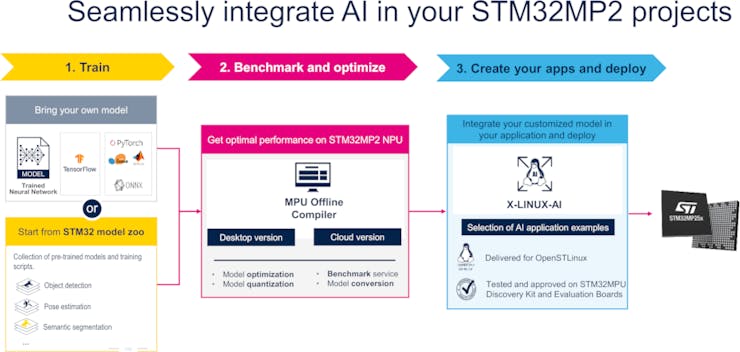
Some, but not all, models in the range include 3D-capable GPUs and a 1.35 TOPS neural network coprocessor. (
: STMicroelectronics)Other features of the parts include up to three gigabit Ethernet ports through the use of a two-port switch, support for Time Sensitive Networking (TSN), PCI Express Gen. 2, USB 3.0, and up to three CAN-FD buses, RGB, LVDS, and MIPI Display Serial Interface (DSI) video outputs with H.264 video acceleration on the GPU-equipped models, and a MIPI Camera Serial Interface 2 (CSI-2) input with image signal processor.
While STMicro is unveiling the parts now, however, it is not quite ready to take orders: the parts are due to enter volume production in June this year, with a development board to follow in due course.
More information is available on the STMicro website.
microcontroller
internet of things
machine learning
artificial intelligence
computer vision
Gareth HalfacreeFollow
Freelance journalist, technical author, hacker, tinkerer, erstwhile sysadmin. For hire: freelance@halfacree.co.uk.


 Join the Fastest Growing AI Research Newsletter Read by Researchers from Google + NVIDIA + Meta + Stanford + MIT + Microsoft and many others...


 ..
..