BRN Discussion Ongoing

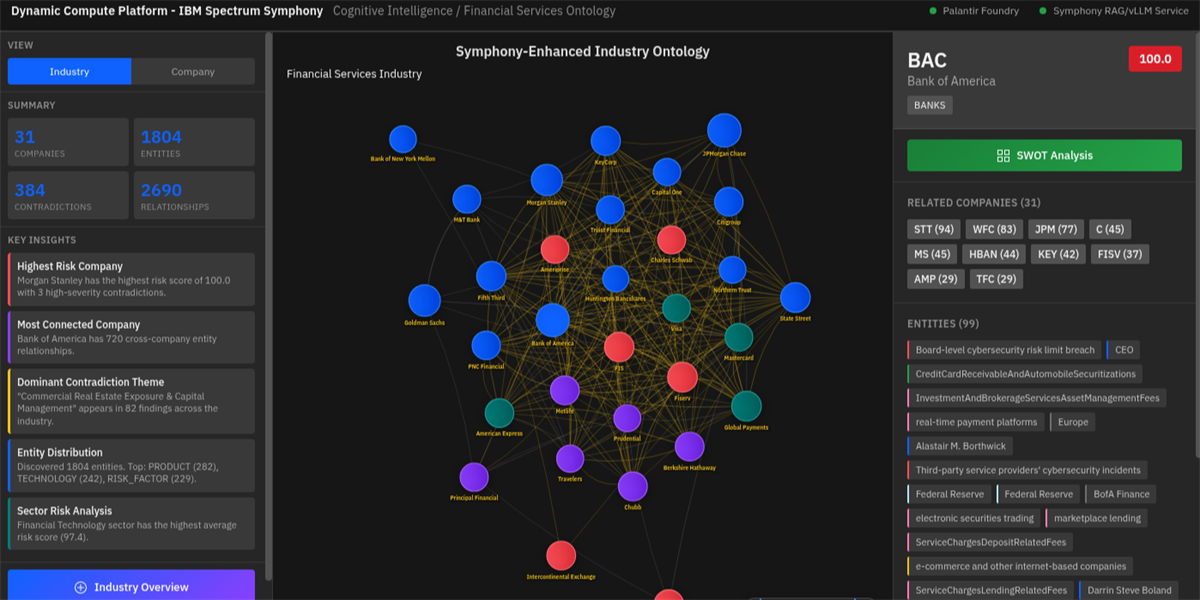
Banks and financial services companies that have been identified as users or partners in specific projects involving IBM Spectrum Symphony or other IBM technologies include:
ANZ Bank (Australia and New Zealand Banking Group): Has a long-standing partnership with IBM, leveraging various technologies including AI, Security, Business Automation, and Mainframe systems.
Barclays: Listed as a user of IBM Spectrum Symphony.
BBVA en México: Listed as a user of IBM Spectrum Symphony.
BNP Paribas: Collaborated with IBM to establish a dedicated cloud environment, leveraging the IBM Cloud for Financial Services.
Credit Suisse: Listed as a user of IBM Spectrum Symphony.
Deutsche Bank: Partnered with IBM to accelerate digital transformation using IBM's software portfolio and has backed the blockchain platform We.Trade along with IBM.
HSBC: Uses Symphony's (the company) collaboration platform which integrates with IBM solutions, and also backed the We.Trade platform.
Morgan Stanley: Listed as a user of IBM Spectrum Symphony.
PNC Bank: Partnered with IBM on a hybrid cloud approach to modernize applications and improve customer experience.
Unity Small Finance Bank: Collaborated with IBM to centralize and secure its API ecosystem using IBM Cloud Pak for Integration.
Other banks such as Lloyds Banking Group, Standard Chartered, Commonwealth Bank of Australia, Westpac, BMO (Bank of Montreal), and Bradesco have also used various IBM products and services, including mainframes and blockchain projects.
 
  • Like
  • Fire
Reactions: 16 users

MegaportX

Regular
  • Like
  • Fire
  • Love
Reactions: 10 users

7für7

Top 20

Kevin D. Johnson • Following
Field CTO – HPC, AI, LLM & Quantum Computing | Principal HPC Cloud Technical Specialist at IBM | Symphony • GPFS • LSF
30m •
Feeding live market data to BrainChip's Akida 1000 and doing regime classification, cranking through 500 stock tickers at ~620-700μs (<1ms) via WebSocket, Python adds a bit more at ~1.8ms total. Working great! I'll let it burn through market close, then we will work on putting Symphony/Akida together.


GO BRAINCHIP
 
  • Like
  • Fire
  • Love
Reactions: 8 users
FF


“…Overall, the confirmed superior energy efficiency of Spiking Neural Networks is of extreme interest for applications limited in terms of power and energy, which is typical of the space environment, and SNN are a competitive candidate for achieving autonomy in space systems.
Ethics declarations
This work was founded by the European Space Agency (contract number: 4000135881/21/NL/GLC/my) in the framework of the Ariadna research program. The authors declare that they have no known competing financial interests or personal relationships that are relevant to the content of this article. The EuroSAT dataset used in this activity is publicly available at [43].”

This ESA study was carried out using Brainchip’s AKD1000 which is fully disclosed in the body of the document. The conclusion makes clear that Starlink would have every reason beyond the Sun to explore the use of Brainchip’s AKIDA Technologies.
 
  • Like
  • Fire
Reactions: 9 users

keyeat

Regular
Sean Hehir LinkedIn activity : https://www.linkedin.com/in/seanhehir/recent-activity/all/

Coby Hanoch LinkedIn activity : https://www.linkedin.com/in/coby-hanoch-85a3271/recent-activity/all/


1770075171577.png


1770075247510.png


1770075270599.png
 
  • Like
  • Love
Reactions: 3 users
Doz

 
  • Like
  • Love
  • Fire
Reactions: 13 users

7für7

Top 20
  • Haha
Reactions: 2 users

7für7

Top 20
  • Haha
Reactions: 1 users

itsol4605

Regular
Unlocking the Neuromorphic Edge:
Verifying Akida's Integration in SpaceX's Orbital Missions

Wow!!

 
  • Like
  • Fire
  • Love
Reactions: 21 users

itsol4605

Regular
  • Like
  • Love
  • Fire
Reactions: 14 users

jtardif999

Regular
Does anyone know which neuromorphic chips might be being referred to here?

Starlink and neuromorphic chips ...?

IPO later this year for all Musk’s space related companies including Starlink under one umbrella. Huge news if we turn out to be involved with Starlink. The merger company according to Bloomberg could be valued at around 1.5 trillion making it the biggest IPO in history.

 
  • Like
  • Wow
  • Fire
Reactions: 8 users

Bravo

Meow Meow 🐾
I just saw this article highlighting a new edge-AI tech from Brisbane-based startup Cortisonic, which is backed by Lockheed Martin. It sounds like it's a completely different technology to BrainChip’s Akida.

It says in the article " Unlike other experimental computing efforts, Cortisonic’s chips are compatible with existing semiconductor manufacturing.The team has already fabricated a 10,000-node phonon-based processor using standard tools."

It says "Edge devices such as autonomous drones, satellite systems, wearables and embedded cameras demand real-time processing but lack the power budgets of server racks. Cortisonic sees a clear path to market by targeting these constraints rather than competing head-on with existing GPU manufacturers."

Fortunately Cortisonic seem a bit further behind us because they're still in demonstration phase. It says "Cortisonic’s acoustic computing chips are still in the demonstration phase, but the company believes it has the technical and commercial backing to move from prototype to product, with ambitions to become a foundational player in next-generation AI deployments across defence, aerospace and embedded systems."

It also says they're not seeking to to displace incumbent chips but rather "the startup sees its platform as a complementary tool that extends where AI can be deployed, especially in constrained edge environments." Sounds similar to how Akida is being pitched as a complementary coprocessor.

I don't think it means BrainChip has lost a potential Lockheed-related partnership. It's probably more likely to reflect broader innovation and competition in the ultra low-power edge AI space.


Cortisonic Launches Lockheed Martin-Backed Sonic Chip For Edge AI In Harsh Environments
Cortisonic Launches Sonic Chip For Edge AI In Harsh Environments

Cortisonic Launches Lockheed Martin-Backed Sonic Chip For Edge AI In Harsh Environments​

Nick Ross February 2, 2026 News
Brisbane-based startup Cortisonic has stepped out of stealth mode with a new computing architecture that swaps electrons for sound waves, targeting the energy limitations of traditional AI hardware.

Its Sonic Processing Unit (SPU) replaces electrical signals with phonons – quantised sound waves – to conduct computations in silicon, offering ultra-low-power AI performance suitable for space-constrained edge devices like drones, wearables and satellites.

A Push Against AI’s Power Wall​

“AI’s energy consumption is rising sharply, creating a major bottleneck for deployment,” said Dr Glen Harris, Chief Executive of Cortisonic.
“Data centres are consuming power at the scale of entire nations. We’re not pursuing incremental improvements to existing chips – we’re introducing an entirely new computational element to the mix.”
While GPUs and photonic chips have long been viewed as the workhorses of AI workloads, their power draw and thermal limits prevent broad deployment in edge scenarios. Phononic computing sidesteps the same energy thresholds that cap performance in electron- and photon-based systems.
“Our acoustic platform uses phonons to fill the gaps where electronics and photonics hit power constraints, unlocking sophisticated AI in environments where it’s been impossible until now,” Harris said.

Backed By Defence, Built With Silicon Tools​

Cortisonic’s entry comes with backing from CSIRO-linked venture fund Main Sequence and Lockheed Martin. The company has secured a $3.2 million contract under the Department of Defence’s Advanced Strategic Capabilities Accelerator (ASCA), in partnership with Lockheed Martin Australia.
Unlike other experimental computing efforts, Cortisonic’s chips are compatible with existing semiconductor manufacturing. The team has already fabricated a 10,000-node phonon-based processor using standard tools.
“Cortisonic is not inventing new materials or requiring cryogenic systems,” said Dr Tony Lindsay, Director of Advanced Systems & Technologies at Lockheed Martin Australia. “The acoustic wave platform offers a completely new approach with strong potential to deliver mission-critical capability with exceptional efficiency, which is vital for space-based and tactical edge assets.”
The startup aims to demonstrate a minimum viable capability (MVC) within two years.

Targeting The Edge, Not The Data Centre​

Despite AI infrastructure concerns typically focusing on data centre expansion, Cortisonic is zeroing in on edge computing – a market forecast to grow to $270 billion by 2032.
“You can’t put a data centre on a drone or into a wearable device,” said Harris. “Any portable, low-power application where you don’t have abundant resources is where we excel.”
Edge devices such as autonomous drones, satellite systems, wearables and embedded cameras demand real-time processing but lack the power budgets of server racks. Cortisonic sees a clear path to market by targeting these constraints rather than competing head-on with existing GPU manufacturers.

Years In The Making​

The technology builds on eight years of foundational research conducted with the University of Queensland’s School of Mathematics and Physics, with commercialisation handled through UniQuest. Cortisonic was spun out under Main Sequence’s Venture Science model.
Its leadership team includes Dr Chris Baker as Chief Scientist and Dr Michael Harvey as Chief Technology Officer.

Alex Romero, Investment Manager at Main Sequence, said the company’s approach reflects a shift toward physics-led innovation in AI.
“The combination of foundational IP, commercially scalable manufacturing, early validation from Lockheed Martin, and dedicated government funding gives them unique credibility as they emerge from stealth to reshape the future of edge computing.”

Sonic Processing Unit: A New Architecture​

Cortisonic describes its architecture as an SPU – a Sonic Processing Unit – distinguishing it from more traditional GPUs, CPUs and TPUs.
“We’re introducing phonons into the mix of computational elements,” Harris said. “It’s about using all the particles at your disposal – electrons, photons and now phonons – to do computing more efficiently.”
Rather than seeking to displace incumbent chips, the startup sees its platform as a complementary tool that extends where AI can be deployed, especially in constrained edge environments.
Cortisonic’s acoustic computing chips are still in the demonstration phase, but the company believes it has the technical and commercial backing to move from prototype to product, with ambitions to become a foundational player in next-generation AI deployments across defence, aerospace and embedded systems.


Last edited:
  • Like
  • Fire
  • Wow
Reactions: 9 users

Diogenese

Top 20
I just saw this article highlighting a new edge-AI tech from Brisbane-based startup Cortisonic, which is backed by Lockheed Martin. It sounds like it's a completely different technology to BrainChip’s Akida.

It says in the article " Unlike other experimental computing efforts, Cortisonic’s chips are compatible with existing semiconductor manufacturing.The team has already fabricated a 10,000-node phonon-based processor using standard tools."

It says "Edge devices such as autonomous drones, satellite systems, wearables and embedded cameras demand real-time processing but lack the power budgets of server racks. Cortisonic sees a clear path to market by targeting these constraints rather than competing head-on with existing GPU manufacturers."

Fortunately Cortisonic seem a bit further behind us because they're still in demonstration phase. It says "Cortisonic’s acoustic computing chips are still in the demonstration phase, but the company believes it has the technical and commercial backing to move from prototype to product, with ambitions to become a foundational player in next-generation AI deployments across defence, aerospace and embedded systems."

It also says they're not seeking to to displace incumbent chips but rather "the startup sees its platform as a complementary tool that extends where AI can be deployed, especially in constrained edge environments." Sounds similar to how Akida is being pitched as a complementary coprocessor.

I don't think it means BrainChip has lost a potential Lockheed-related partnership. It's probably more likely to reflect broader innovation and competition in the ultra low-power edge AI space.


Cortisonic Launches Lockheed Martin-Backed Sonic Chip For Edge AI In Harsh Environments
Cortisonic Launches Sonic Chip For Edge AI In Harsh Environments

Cortisonic Launches Lockheed Martin-Backed Sonic Chip For Edge AI In Harsh Environments​

Nick Ross February 2, 2026 News
Brisbane-based startup Cortisonic has stepped out of stealth mode with a new computing architecture that swaps electrons for sound waves, targeting the energy limitations of traditional AI hardware.

Its Sonic Processing Unit (SPU) replaces electrical signals with phonons – quantised sound waves – to conduct computations in silicon, offering ultra-low-power AI performance suitable for space-constrained edge devices like drones, wearables and satellites.

A Push Against AI’s Power Wall​

“AI’s energy consumption is rising sharply, creating a major bottleneck for deployment,” said Dr Glen Harris, Chief Executive of Cortisonic.
“Data centres are consuming power at the scale of entire nations. We’re not pursuing incremental improvements to existing chips – we’re introducing an entirely new computational element to the mix.”
While GPUs and photonic chips have long been viewed as the workhorses of AI workloads, their power draw and thermal limits prevent broad deployment in edge scenarios. Phononic computing sidesteps the same energy thresholds that cap performance in electron- and photon-based systems.
“Our acoustic platform uses phonons to fill the gaps where electronics and photonics hit power constraints, unlocking sophisticated AI in environments where it’s been impossible until now,” Harris said.

Backed By Defence, Built With Silicon Tools​

Cortisonic’s entry comes with backing from CSIRO-linked venture fund Main Sequence and Lockheed Martin. The company has secured a $3.2 million contract under the Department of Defence’s Advanced Strategic Capabilities Accelerator (ASCA), in partnership with Lockheed Martin Australia.
Unlike other experimental computing efforts, Cortisonic’s chips are compatible with existing semiconductor manufacturing. The team has already fabricated a 10,000-node phonon-based processor using standard tools.
“Cortisonic is not inventing new materials or requiring cryogenic systems,” said Dr Tony Lindsay, Director of Advanced Systems & Technologies at Lockheed Martin Australia. “The acoustic wave platform offers a completely new approach with strong potential to deliver mission-critical capability with exceptional efficiency, which is vital for space-based and tactical edge assets.”
The startup aims to demonstrate a minimum viable capability (MVC) within two years.

Targeting The Edge, Not The Data Centre​

Despite AI infrastructure concerns typically focusing on data centre expansion, Cortisonic is zeroing in on edge computing – a market forecast to grow to $270 billion by 2032.
“You can’t put a data centre on a drone or into a wearable device,” said Harris. “Any portable, low-power application where you don’t have abundant resources is where we excel.”
Edge devices such as autonomous drones, satellite systems, wearables and embedded cameras demand real-time processing but lack the power budgets of server racks. Cortisonic sees a clear path to market by targeting these constraints rather than competing head-on with existing GPU manufacturers.

Years In The Making​

The technology builds on eight years of foundational research conducted with the University of Queensland’s School of Mathematics and Physics, with commercialisation handled through UniQuest. Cortisonic was spun out under Main Sequence’s Venture Science model.
Its leadership team includes Dr Chris Baker as Chief Scientist and Dr Michael Harvey as Chief Technology Officer.

Alex Romero, Investment Manager at Main Sequence, said the company’s approach reflects a shift toward physics-led innovation in AI.
“The combination of foundational IP, commercially scalable manufacturing, early validation from Lockheed Martin, and dedicated government funding gives them unique credibility as they emerge from stealth to reshape the future of edge computing.”

Sonic Processing Unit: A New Architecture​

Cortisonic describes its architecture as an SPU – a Sonic Processing Unit – distinguishing it from more traditional GPUs, CPUs and TPUs.
“We’re introducing phonons into the mix of computational elements,” Harris said. “It’s about using all the particles at your disposal – electrons, photons and now phonons – to do computing more efficiently.”
Rather than seeking to displace incumbent chips, the startup sees its platform as a complementary tool that extends where AI can be deployed, especially in constrained edge environments.
Cortisonic’s acoustic computing chips are still in the demonstration phase, but the company believes it has the technical and commercial backing to move from prototype to product, with ambitions to become a foundational player in next-generation AI deployments across defence, aerospace and embedded systems.


But in space, no one can hear your phonics.
 
  • Haha
  • Like
Reactions: 8 users

Mazewolf

Regular
Th
Thanks for posting this. I read the whole thing, and agree it makes some very good points, essentially mapping the path to 1. Growth of neuromorphics and 2 mapping the paradigm shift, redesigning the whole computing ecosystem from first principles for optimum AGI, which would happen to have neuromorphics at the core. Some very good prompting on display, worth the read.
 
  • Like
  • Fire
Reactions: 3 users

Mazewolf

Regular
Th
Thanks for posting this. I read the whole thing, and agree it makes some very good points, essentially mapping the path to 1. Growth of neuromorphics and 2 mapping the paradigm shift, redesigning the whole computing ecosystem from first principles for optimum AGI, which would happen to have neuromorphics at the core. Some very good prompting on display, worth the read.
 
  • Like
Reactions: 2 users

7für7

Top 20
I just saw this article highlighting a new edge-AI tech from Brisbane-based startup Cortisonic, which is backed by Lockheed Martin. It sounds like it's a completely different technology to BrainChip’s Akida.

It says in the article " Unlike other experimental computing efforts, Cortisonic’s chips are compatible with existing semiconductor manufacturing.The team has already fabricated a 10,000-node phonon-based processor using standard tools."

It says "Edge devices such as autonomous drones, satellite systems, wearables and embedded cameras demand real-time processing but lack the power budgets of server racks. Cortisonic sees a clear path to market by targeting these constraints rather than competing head-on with existing GPU manufacturers."

Fortunately Cortisonic seem a bit further behind us because they're still in demonstration phase. It says "Cortisonic’s acoustic computing chips are still in the demonstration phase, but the company believes it has the technical and commercial backing to move from prototype to product, with ambitions to become a foundational player in next-generation AI deployments across defence, aerospace and embedded systems."

It also says they're not seeking to to displace incumbent chips but rather "the startup sees its platform as a complementary tool that extends where AI can be deployed, especially in constrained edge environments." Sounds similar to how Akida is being pitched as a complementary coprocessor.

I don't think it means BrainChip has lost a potential Lockheed-related partnership. It's probably more likely to reflect broader innovation and competition in the ultra low-power edge AI space.


Cortisonic Launches Lockheed Martin-Backed Sonic Chip For Edge AI In Harsh Environments
Cortisonic Launches Sonic Chip For Edge AI In Harsh Environments

Cortisonic Launches Lockheed Martin-Backed Sonic Chip For Edge AI In Harsh Environments​

Nick Ross February 2, 2026 News
Brisbane-based startup Cortisonic has stepped out of stealth mode with a new computing architecture that swaps electrons for sound waves, targeting the energy limitations of traditional AI hardware.

Its Sonic Processing Unit (SPU) replaces electrical signals with phonons – quantised sound waves – to conduct computations in silicon, offering ultra-low-power AI performance suitable for space-constrained edge devices like drones, wearables and satellites.

A Push Against AI’s Power Wall​

“AI’s energy consumption is rising sharply, creating a major bottleneck for deployment,” said Dr Glen Harris, Chief Executive of Cortisonic.
“Data centres are consuming power at the scale of entire nations. We’re not pursuing incremental improvements to existing chips – we’re introducing an entirely new computational element to the mix.”
While GPUs and photonic chips have long been viewed as the workhorses of AI workloads, their power draw and thermal limits prevent broad deployment in edge scenarios. Phononic computing sidesteps the same energy thresholds that cap performance in electron- and photon-based systems.
“Our acoustic platform uses phonons to fill the gaps where electronics and photonics hit power constraints, unlocking sophisticated AI in environments where it’s been impossible until now,” Harris said.

Backed By Defence, Built With Silicon Tools​

Cortisonic’s entry comes with backing from CSIRO-linked venture fund Main Sequence and Lockheed Martin. The company has secured a $3.2 million contract under the Department of Defence’s Advanced Strategic Capabilities Accelerator (ASCA), in partnership with Lockheed Martin Australia.
Unlike other experimental computing efforts, Cortisonic’s chips are compatible with existing semiconductor manufacturing. The team has already fabricated a 10,000-node phonon-based processor using standard tools.
“Cortisonic is not inventing new materials or requiring cryogenic systems,” said Dr Tony Lindsay, Director of Advanced Systems & Technologies at Lockheed Martin Australia. “The acoustic wave platform offers a completely new approach with strong potential to deliver mission-critical capability with exceptional efficiency, which is vital for space-based and tactical edge assets.”
The startup aims to demonstrate a minimum viable capability (MVC) within two years.

Targeting The Edge, Not The Data Centre​

Despite AI infrastructure concerns typically focusing on data centre expansion, Cortisonic is zeroing in on edge computing – a market forecast to grow to $270 billion by 2032.
“You can’t put a data centre on a drone or into a wearable device,” said Harris. “Any portable, low-power application where you don’t have abundant resources is where we excel.”
Edge devices such as autonomous drones, satellite systems, wearables and embedded cameras demand real-time processing but lack the power budgets of server racks. Cortisonic sees a clear path to market by targeting these constraints rather than competing head-on with existing GPU manufacturers.

Years In The Making​

The technology builds on eight years of foundational research conducted with the University of Queensland’s School of Mathematics and Physics, with commercialisation handled through UniQuest. Cortisonic was spun out under Main Sequence’s Venture Science model.
Its leadership team includes Dr Chris Baker as Chief Scientist and Dr Michael Harvey as Chief Technology Officer.

Alex Romero, Investment Manager at Main Sequence, said the company’s approach reflects a shift toward physics-led innovation in AI.
“The combination of foundational IP, commercially scalable manufacturing, early validation from Lockheed Martin, and dedicated government funding gives them unique credibility as they emerge from stealth to reshape the future of edge computing.”

Sonic Processing Unit: A New Architecture​

Cortisonic describes its architecture as an SPU – a Sonic Processing Unit – distinguishing it from more traditional GPUs, CPUs and TPUs.
“We’re introducing phonons into the mix of computational elements,” Harris said. “It’s about using all the particles at your disposal – electrons, photons and now phonons – to do computing more efficiently.”
Rather than seeking to displace incumbent chips, the startup sees its platform as a complementary tool that extends where AI can be deployed, especially in constrained edge environments.
Cortisonic’s acoustic computing chips are still in the demonstration phase, but the company believes it has the technical and commercial backing to move from prototype to product, with ambitions to become a foundational player in next-generation AI deployments across defence, aerospace and embedded systems.


What I can read from various articles involved new startups in this field, if Brainchip don’t move it’s a..s immediately, we will be f…ed…
I have the feeling while other companies make real world progress , catching up our partner’s silently, our company is eating popcorn and drinking beer In terms of sales …. WTF
leonardo dicaprio mental illness GIF
 
  • Like
  • Fire
Reactions: 2 users

Boab

I wish I could paint like Vincent
Th

Thanks for posting this. I read the whole thing, and agree it makes some very good points, essentially mapping the path to 1. Growth of neuromorphics and 2 mapping the paradigm shift, redesigning the whole computing ecosystem from first principles for optimum AGI, which would happen to have neuromorphics at the core. Some very good prompting on display, worth the read.
Yes, interesting article but I'm thinking we hitched a ride under the ANT61 banner rather than a direct request from SpaceX🤷🤷
Hope I'm wrong.
Cheers
 
  • Fire
  • Love
  • Like
Reactions: 4 users

Guzzi62

Regular
What I can read from various articles involved new startups in this field, if Brainchip don’t move it’s a..s immediately, we will be f…ed…
I have the feeling while other companies make real world progress , catching up our partner’s silently, our company is eating popcorn and drinking beer In terms of sales …. WTF
leonardo dicaprio mental illness GIF
Are you surprised?

Where there is money involved, there will always be somebody trying getting a piece of the pie.

When you consider buying a new car, how many dealerships do you visit? Okay, I know some that are brand bitches and buy the same brand over the years. I always laugh at them and calls them narrow-minded.

If Akida in its different alterations are competitive on features and price, BRN will get a piece of the pie, no doubt.
 
  • Like
  • Love
Reactions: 3 users
Key Entities and Technologies Involved
The following entities are central to the implementation of neuromorphic computing within the SpaceX ecosystem:

BrainChip: Provides the Akida neural processor, which utilizes event-based processing to minimize power consumption.[4] [7]
Accenture Labs: Collaborates with SpaceX and BrainChip to evaluate neuromorphic applications for satellite health monitoring and situational awareness.[4]
Intel: While SpaceX has launched various payloads, Intel's Loihi neuromorphic processor has also undergone space validation, paving the way for asynchronous artificial neural networks in orbital mechanics.[1] [4]
Prophesee & ESA: These organizations work alongside the broader aerospace industry to develop event-based vision sensors (neuromorphic cameras) that SpaceX missions may utilize for autonomous docking and debris avoidance.[6] [8]
Applications for SpaceX Autonomy
The transition to neuromorphic compute allows SpaceX to pursue several advanced objectives:

Autonomous Landing and Docking: Real-time, low-latency processing of visual data for Starship or Dragon modules.[8]
Cognitive Radio: Optimizing satellite communications by adapting to signal interference in real-time.[4]
Radiation Resilience: Neuromorphic architectures are inherently more fault-tolerant; if a single "neuron" is damaged by cosmic radiation, the distributed nature of the SNN allows the system to continue functioning.[3] [7]
 
  • Like
Reactions: 1 users
Top Bottom