(…)
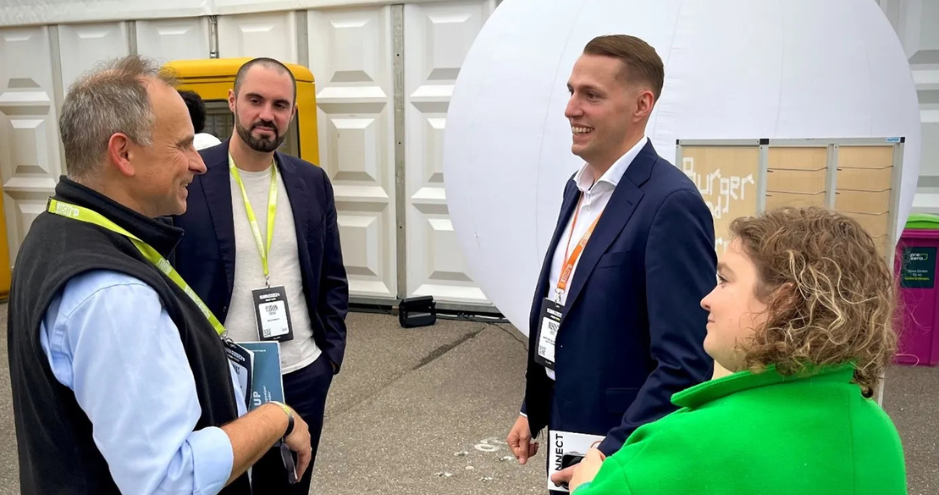
As I mentioned in my above post last night, fortiss and neuroTUM (TU München) jointly organised a Neuromorphic Hackathon in mid-November, where a student team mentored by Jules Lecomte (fortiss), Gregor Lenz (Neurobus) and Arunkumar Rathinam (University of Luxembourg) won the challenge using Akida.
Note, though, that fortiss have also newly partnered with Innatera alongside us.
View attachment 79266
View attachment 79267
(brochure in German only)
Research partnerships:
View attachment 79268
View attachment 79269
One and a half years after Karl Vetter, previously with Uni Tübingen’s Cognitive Systems Lab (
https://thestockexchange.com.au/threads/brn-discussion-ongoing.1/post-437994), joined BrainChip partner Neurobus, another neuromorphic researcher with first-hand experience of Akida (as well as other neuromorphic processors) has done likewise: Jules Lecomte, previously with fortiss, also a BrainChip partner.
I am glad to start this new year as a research engineer at Neurobus! After more than 3 years working as an applied researcher at the Bavarian sofware research institute fortiss ,in the neuromorphic department, I have the opportunity to keep working on topics that I found most interesting and...

www.linkedin.com
[Screenshot taken about 10 hours ago]
Although for some weird reason, to this day fortiss still does not show up on the BrainChip Partners website.
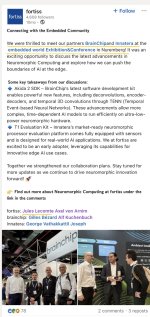
𝗖𝗼𝗻𝗻𝗲𝗰𝘁𝗶𝗻𝗴 𝘄𝗶𝘁𝗵 𝘁𝗵𝗲 𝗘𝗺𝗯𝗲𝗱𝗱𝗲𝗱 𝗖𝗼𝗺𝗺𝘂𝗻𝗶𝘁𝘆 We were thrilled to meet our partners BrainChip and Innatera at the embedded world Exhibition&Conference in Nuremberg! It was an exciting opportunity to discuss the latest advancements in Neuromorphic Computing and explore how we can push the boundaries of...
www.linkedin.com
In November, Jules Lecomte took part in the European Defense Hackathon in Paris, where their team - that came in 3rd place - was provided with hardware and guidance by Neurobus, who were also sponsors of the whole event:
This weekend I took part in the European Defense Tech Paris 2025 hackathon! Together with my great teammates Tobias Rothlin Shannah Santucci and Charles Schleich we developed a defense prototype against enemy drones and ranked 3rd of this edition ! This intense weekend was the opportunity to...
www.linkedin.com
One teammate, Shannah Santucci, had already won 1st place in the December 2024 European Defense Tech Hackathon with - among others - Florian Corgnou, Gregor Lenz and Karl Vetter, all from Neurobus (Gregor Lenz has since left the Paris and Toulouse-based startup and joined Paddington Robotics in London).
https://thestockexchange.com.au/threads/brn-discussion-ongoing.1/post-442810
Gregor Lenz, Florian Corgnou and Karl Vetter from BrainChip’s partner Neurobus were part of a team that came in first

at the
European Defense Tech Hackathon, which took place in Paris over the weekend.
Their winning solution titled
Automatic event-based detection and tracking of UAVs and Shahed drones in challenging lighting conditions “showcased the ground-breaking potential of neuromorphic event-based cameras (…) paving the way for smarter, faster and more efficient defense-systems”.
As you may have guessed from the mentioning of the Iranian-designed Shahed drones (which are also known by their Russian designation Geran-2), the 34 projects in total were far from being destined for storage in an ivory tower of academia: European defense company Helsing AI was a key partner of that hackathon, which was also supported by the
Ministry of Defence of Ukraine.
“
The challenges were based on real-world problems gathered from our partners, who have delivered solutions to the frontline, from building underwater reconnaissance systems
to the interception of Shahed drones and helicopters and swarm coordination in GPS-denied environments.”

en.m.wikipedia.org
View attachment 73720
View attachment 73721

brave1.gov.ua
View attachment 73723
The inaugural European Defense Tech Hackathon took place in June 2024 in Munich, and since then many more have followed, supported by the Ukrainian Government and their Brave1 defence accelerator platform, which was launched in April 2023 in reaction to Russia’s invasion of Ukraine the previous year.
It is therefore not surprising that some of the the winning entries’ prototypes have been/are being tested by Ukraine. Among them the drone solution developed by the above-mentioned team around Neurobus in December 2024:
Our mission is to bring more talent into Europe’s defense technology sector, accelerate defense innovation, and foster collaboration

eurodefense.tech
“Neurobus – At the Paris hackathon, they integrated their neuromorphic chip with a camera to detect Shahed drones in low-light conditions—and won first place. They’ve since started working with BRAVE1 to test their prototype under real-world conditions.”
Neurobus CEO Florian Corgnou (at least I strongly assume it is him) even registered a second LinkedIn account in Kyiv sometime before September last year:
Speaking of Neurobus CEO Florian Corgnou.
I discovered this by chance the other day:
View attachment 90905
The second LinkedIn account was registered in July 2025 - so far “Nothing to see here”, though…
View attachment 90906
Highly unlikely it merely happens to be a namesake, especially given the company’s expertise in the drone sector…
The above paragraph on Eurodefense.tech is not entirely accurate, though, as it sounds as if Neurobus had developed their own neuromorphic chip, and the author also failed to mention that the camera was an event-based one, a neuromorphic sensor, rather than a regular frame-based camera.
What Neurobus does is explained very well in this April 2025 article I shared last year:
Combining Deep Tech and Sustainability is the winning bet of Neurobus, an innovative startup founded by Florian Corgnou, an entrepreneur whose successive periods at HEC Paris have greatly impacted Neurobus's trajectory.

www.hec.edu
NEUROBUS, A SOLUTION THAT COMBINES ENERGY EFFICIENCY AND INTELLIGENCE
By observing technological advances at Tesla and SpaceX, and then participating in the Airbus Defense Space program, Florian established the groundwork for Neurobus. Immersion with engineers and space experts allowed him to pinpoint market trends and unmet needs, needs Neurobus was determined to address.
So, what does Neurobus offer? It's an embedded, frugal Artificial Intelligence – specifically, an AI engineered for minimal energy consumption and direct integration into host systems like drones and satellites. Data processing occurs locally, eliminating the costly energy expenditure of transferring data to centers.
Neurobus's initial focus was the space sector, a field inherently linked to defense, with partners like Airbus Defense and Space, the European Space Agency, and the French Space Agency. However, the company adroitly adapted its promising technology to the drone sector, a rapidly expanding market with more immediate demands. Winning a European defense innovation competition further validated the potential of their solution for drone detection.
The core of Neurobus's innovation lies in its biologically-inspired approach: the neuromorphic system. This disruptive technology draws inspiration from the human brain and retina to create processors and sensors that are remarkably energy-efficient. For Florian, the human brain serves as an unparalleled source of inspiration:
"The brain is one of the best computers that exists today because it delivers immense computing power with extremely low energy consumption."
DRONES: A TESTED AND VALIDATED FIELD OF APPLICATION TESTED AND VALIDATED
Neurobus sidesteps the capital-intensive manufacturing of components like processors and sensors. Instead, its value proposition lies in assembling these components and developing tailored software layers to meet specific manufacturer needs. This positions the startup as both an integrator and a software publisher, streamlining the adoption of this cutting-edge technology.
As Florian Corgnou explains, "Neurobus operates precisely between the manufacturer and the industrialist. We don't create the hardware, but we assemble it into a product that specifically addresses our customers' requirements and develop software layers that cater to the unique applications of that industrialist."
Though Space remains a core sector for Neurobus, its technology's practical application in the drone sector unlocks compelling possibilities for autonomy. Drones equipped with Neurobus's frugal AI can execute missions more independently, making real-time decisions with minimal human oversight. While human validation remains crucial for strategic actions, tasks like area surveillance can be managed autonomously.
For instance, a drone could autonomously evade an oncoming object at high speed. However, directing itself toward a target would require prior human authorization.
Although the present application is primarily focused on defense, driven by the current geopolitical climate and pressing demands, Neurobus also foresees a future in the civilian domain, particularly in applications like autonomous drone delivery services.
As far as I’m aware, we do not know for sure whether this particular drone solution that won 1st place at the 2024 European Defense Hackathon in Paris used Akida as a neuromorphic processor, although it seems reasonable to assume so, given that Neurobus was partnered with Prophesee, BrainChip as well as Intel at the time (and Loihi not yet being commercially available) and was already working with BrainChip and other partners on the NEURAVIS project.
Maybe we’ll find out more in March, when “Brave1, Ukraine’s defense innovation cluster, will conduct a US Roadshow — a two-week investment tour across several American cities aimed at presenting Ukrainian drone technologies and defense tech solutions to U.S. venture capital funds, corporations, family offices, and policymakers (…) According to Brave1, Ukraine’s defense tech ecosystem now includes thousands of companies and solutions, with up to 95% of battlefield engagements relying on domestically developed technologies.” (
https://digitalstate.gov.ua/news/te...inian-drones-and-defense-tech-to-us-investors)
Well, we’ll see, maybe the Neurobus solution will also be presented, as a promising technology developed outside Ukraine?
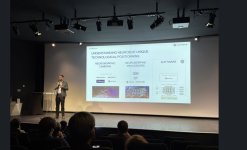
Meanwhile Neurobus appear to have widened their collaboration with companies offering neuromorphic processors to also include IBM and SynSense - cf. this photo of a Neurobus presentation slide taken at the Future of Computing Conference in Paris, which took place on 6 November:
🧠 Shaping the Future of Computing Neurobus was pleased to speak at #FutureOfComputing2025. We shared our vision for how neuromorphic processors and event-based vision can power low-power, intelligent systems for critical missions in aerospace and defense. Grateful to the brilliant community...
www.linkedin.com
Last but not least, here is a two month old interview with Florian Corgnou about Neurobus that I believe hasn’t been shared here before:
P.S.: Alf Kuchenbuch loves today’s post by Jules Lecomte and commented: “Wow, good choice, Jules!!”


apnews.com
" President Donald Trump signed an executive order in September that authorized the Department of War as a secondary title for the Pentagon. At the time, Trump said the switch was intended to signal to the world that the U.S. was a force to be reckoned with, and he complained that the Department of Defense’s name was “woke.”
www.cbsnews.com


 :
: 
 ️
️





 Wont be in his lifetime. 1 million robo taxis operating by 2020