
You are using an out of date browser. It may not display this or other websites correctly.
You should upgrade or use an alternative browser.
You should upgrade or use an alternative browser.
BRN Discussion Ongoing
- Thread starter TechGirl
- Start date

Hi Doz,
Yes, smartphones are absolutely a potential application for Akida/TENNs + GNNs, but ChatGPT says "not with the same Alif board-level E8 + Akida integration we’ve been describing for IoT/edge devices".
It says "For smartphones → yes, Akida/TENNs + GNNs could bring unique “always-on + adaptive + graph reasoning” benefits, but it would require tight silicon integration (either IP licensing or chiplet form) to make sense in that ecosystem."
And this where Arm comes back into the picture!
If Arm offered a Corstone platform that bundles Cortex-A/M cores, Ethos-U85, and an Akida-style SNN block, that would make it easier for SoC vendors to adopt. Arm’s business model is already about licensing IP blocks - so a U85+Akida “chiplet” or IP package could be the right vehicle.
As I say, I don't know how plausible any of this is, but it sounds really good, so I sincerely hope it's right!
My Question:
When you say Akida/TENNs + GNNs could bring unique “always-on + adaptive + graph reasoning” benefits to smartphones, what does that look like? What sort of things could it do?
ChatGPT said:
Great question — let’s make it tangible. If Akida/TENNs + GNNs were integrated into a smartphone SoC (alongside the usual CPU/GPU/NPU), you’d unlock a class of features that today’s phones can’t do well, or can only do at the cost of heavy power drain.
What “always-on + adaptive + graph reasoning” could look like in smartphones
1. Ultra-low-power, always-on sensing
- Akida/TENNs role: Continuously listen/watch in the μW–mW range, only waking the big NPU when needed.
- Examples:
- Smarter wake words: distinguish between you and other voices, adapt to your accent, background noise.
- Ambient sound awareness: alert you to alarms, baby cries, glass breaking, or traffic horns — without streaming mic data to the cloud.
- Pocket/wearable fusion: recognize walking, running, falls, or gestures (raise-to-silence, nod-to-answer).
Today, this burns battery on Snapdragon NPUs or requires offloading to earbuds/wearables. With Akida, it’s continuous and frugal.
2. Adaptive personalization (on-device learning)
- Akida/TENNs role: Update models locally, without retraining in the cloud.
- Examples:
- Voice biometrics: phone adapts to your voice over time, even as it changes (illness, aging).
- Gesture learning: you invent a new gesture (e.g., double-shake = launch camera), and the phone learns it instantly.
- Environmental tuning: auto-adapts noise cancellation or audio profiles based on where you usually are (train, office, home).
3. Graph reasoning across sensors (GNNs on top of TENNs)
- Akida/TENNs role: Emit event embeddings (sound = horn, vision = crosswalk, IMU = running).
- U85/GNN role: Build a graph of these events and reason over relationships.
- Examples:
- Contextual safety assistant:
- Mic hears horn → camera sees crosswalk → IMU detects step-off → GNN infers “user about to step into traffic” → alert/vibrate.
- Digital wellness coach:
- Phone + watch + earbuds create a graph of sleep, stress (voice), activity (IMU), and environment (noise).
- GNN infers risk patterns: “You’re stressed, haven’t slept enough, and your calendar is packed — suggest downtime.”
- Privacy-first context understanding:
- Phone can reason: “Kids’ voices + home Wi-Fi + calendar says weekend = family context” → automatically mute work notifications.
4. Smarter security & liveness
- Akida/TENNs role: Detect temporal cues like blinking, micro-movements, gait, or pulse.
- GNN role: Correlate across sensors (face + voice + motion) to confirm identity.
- Examples:
- Anti-spoofing: Spot deepfake attacks (static photo, replayed voice).
- Continuous auth: Phone knows it’s still you as you use it, without re-scans or draining power.
5. Always-on multimodal assistants
- Combine Akida’s sentinel mode with GNN reasoningto create an assistant that’s:
- Context-aware (not just reactive commands).
- Privacy-first (sensitive data stays local).
- Battery-friendly (μW–mW background, bursts only when needed).
Why it matters
This wouldn’t replace Snapdragon’s Hexagon or Apple’s Neural Engine — it would complement them by catching events early, filtering noise, and only engaging the heavy engines when meaningful.
- Today’s gap: Smartphones either run dense NPUs (burning battery for continuous monitoring) or offload to cloud/wearables.
- What Akida+TENNs+GNNs adds: A third compute domain that enables truly always-on, adaptive, context-aware intelligence.
In short:
On smartphones, Akida/TENNs + GNNs would unlock continuous, adaptive, context-aware features: smarter assistants, better safety/security, and health/wellness insights — all without hammering the battery or sending raw data to the cloud.
Hi Bravo ,
Chatty needs to take some of the below into consideration .
Note : Alif’s co founder , Reza could not wait any longer for the “ Transformer Model “ , so he incorporated on the Ensemble E8 development board a Ethos U85 without a Cortex processor . IE AKD1500 ( And we know that the board was FD - SOI ) . In the rush , they also did not use Arm’s Corstone compute subsystem .
In my opinion , Arm quickly realised that selling Cortex ip is more profitable than selling the ip of the Ethos U85 .
Mitko from ABB makes the following statements .
The following podcast between Nandan and Ian ( Arm ) looks to have been an early indicator . Arm seem to be pushing the new V9 Cortex A320 . IE 4 x A320’s to 1 x U85 under a hierarchy of processing . ( Note the Alif board has two Cortex A32 V8 . )
We also know that both the Ethos U55 ( again Alif board has 2 ) and the Ethos U65 were CNN . To me Chatty seems to be under the opinion that the Ethos U85 is CNN . But because we know that they are different binary , in my opinion the Ethos U85 is SNN .
a
Reinhard’s comments about the Ethos U85 being more than just a performance upgrade are interesting . The Ethos U65 was just an upgrade of the U55 . Chloe’s response tells us plenty .
We might need to fine tune Chatty and provide some direction with the above in mind .
.

Stable Genius
Regular
Onsor NEXA trial in progress:

Wearable Epileptic Seizure Prediction and Alert Glasses Based on Neuromorphic Computing
The NEXA study aims to evaluate a new wearable EEG device designed as smart glasses with dry electrodes positioned according to the 10-20 system. The device captures real-time brain signals to detect patterns that may predict seizures, helping people with epilepsy. This study will test the...
ctv.veeva.com
Hi Bravo ,
Chatty needs to take some of the below into consideration .
Note : Alif’s co founder , Reza could not wait any longer for the “ Transformer Model “ , so he incorporated on the Ensemble E8 development board a Ethos U85 without a Cortex processor . IE AKD1500 ( And we know that the board was FD - SOI ) . In the rush , they also did not use Arm’s Corstone compute subsystem .
View attachment 90417
In my opinion , Arm quickly realised that selling Cortex ip is more profitable than selling the ip of the Ethos U85 .
Mitko from ABB makes the following statements .
View attachment 90418
The following podcast between Nandan and Ian ( Arm ) looks to have been an early indicator . Arm seem to be pushing the new V9 Cortex A320 . IE 4 x A320’s to 1 x U85 under a hierarchy of processing . ( Note the Alif board has two Cortex A32 V8 . )
View attachment 90419
We also know that both the Ethos U55 ( again Alif board has 2 ) and the Ethos U65 were CNN . To me Chatty seems to be under the opinion that the Ethos U85 is CNN . But because we know that they are different binary , in my opinion the Ethos U85 is SNN .
View attachment 90421
a
View attachment 90420
Reinhard’s comments about the Ethos U85 being more than just a performance upgrade are interesting . The Ethos U65 was just an upgrade of the U55 . Chloe’s response tells us plenty .
View attachment 90422
We might need to fine tune Chatty and provide some direction with the above in mind .
.
Hi Doz,
Can you explain why you think U85-Ethos is SNN?
As far as I can see, it's just more of the same (U35, U65) with lots of MACs.
https://alifsemi.com/bringing-transformer-networks-to-the-edge-with-arm-ethos-u85/

CHIPS
Regular
Am I blind, but I only see Intel being mentioned?!
CHIPS
Regular
Approximately **51.7 million people** worldwide live with epilepsy, based on the latest Global Burden of Disease Study 2021 (GBD) data. This includes about 24.2 million cases of idiopathic epilepsy (genetic or unknown cause) and 27.5 million cases of secondary epilepsy (caused by underlying brain damage), with a global age-standardized prevalence rate of 658 per 100,000 people (95% uncertainty interval: 569–748).
This estimate is slightly higher than the World Health Organization's (WHO) figure of around 50 million (as of 2024), due to updated methods and inclusion of secondary forms. Over 80% of those affected live in low- to middle-income countries, where access to treatment is often limited. The prevalence has increased by about 10.8% from 1990 to 2021, mainly due to secondary epilepsy, while idiopathic cases remain more stable. Up to 70% of cases could be seizure-free with proper diagnosis and treatment, but a significant treatment gap persists in many regions.
If the founder and COO of NANONOSE states that they have not worked with Brainchip for three years, How many other companies have walked through sheer incompetence of our CEO may explain the no IP Deals so far told yahs should have pissed him off last year, What a bunch of tards the happy clapper club are looking like now ,no deals a flippant promise of 9 million incoming, it’s gunna be a long four months already starting to see the happy clapper club turning on management and do you know what you all deserve to loose yah money. By the end of the year if the 9 million don’t show up it’s all to late, sell off to ARM will happen $0.15 to $0.20 all with the boards highest recommendation Brainchip Con Complete. Management walk away with big wages working for ARM or get golden handshakes PVDM Oblivious!!! Fuck him off Peter the ship is sinking and your got your head up your arse.
Hi Doz,
Can you explain why you think U85-Ethos is SNN?
As far as I can see, it's just more of the same (U35, U65) with lots of MACs.
https://alifsemi.com/bringing-transformer-networks-to-the-edge-with-arm-ethos-u85/
View attachment 90433
View attachment 90432
Hi Dodgy , all of Brainchip’s technical and advertising documentation still talks in MAC’s . I actually thought if we were to see the first use of the term EMAC , the RISC-V Noel Processor information you posted the other day would be it , but no , even they used MAC’s .
I would absolutely be over the moon if Arm also changed their literature to read EMAC’s or even SNN , but that would make investing easy especially if we could identify what and who’s products the tech giant’s intend on using .
Maybe the scientific community just said , bugger it , it’s just easier to use MAC’s ?
Just so you know that you are not going insane with your conversation with Peter ,
Maybe Peter should have been a little BIT more specific ,
Last edited:
Thanks for the MAC count slide - I don't recall seeing it before. The original 1-bit Akida did not have MACs, but when they switched to multi-bit, they started using MACs, so, as I pointed out a while ago, MACs per se are no longer a distinguishing feature. I guess that, when I discussed MACs with Peter, they had not gone past 2-bit.Hi Dodgy , all of Brainchip’s technical and advertising documentation still talks in MAC’s . I actually thought if we were to see the first use of the term EMAC , the RISC-V Noel Processor information you posted the other day would be it , but no , even they used MAC’s .
View attachment 90437
I would absolutely be over the moon if Arm also changed their literature to read EMAC’s or even SNN , but that would make investing easy if we could identify what and who’s products the tech giant’s intend on using .
Maybe the scientific community just said , bugger it , it’s just easier to use MAC’s ?
View attachment 90439
View attachment 90442
Just so you know that you aren’t going insane with your conversation with Peter ,
View attachment 90451
Maybe Peter should have been a little BIT more specific ,
View attachment 90452
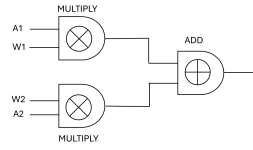
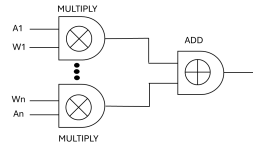
I think that, for a given TOPS or EMACs, Akida uses fewer MACs than other systems. As you can see Ethos U85 uses from 128 to 2048. I haven't seen the actual circuit diagram showing how Akida uses MACs, but Akida does not use MACs as the primary NPU engine, whereas Ethos uses MACs as the primary NP engine. I guess they are used in Akida to knit the multi-bit NPU outputs together.
As you say, the use of the terminology lacks consistency. The Arvix abstract uses the term MACs to refer to the number of transistor operations to perform 1 Multiply Accumulate calculation, while AC refer to a simple Accumulate operation which employs only 2 transistor switching operations compared to the MAC operation's 3 transistor switching operations.
But MAC is also used to refer to an electronic circuit:
The term Spiking Neural Network would have originally (before Akida) referred to an analog circuit in which voltages/currents were added, and could theoretically produce a continuous range of values, but manufacturing variations makes this inaccurate, whereas Akida uses discrete digital "bits" with a high tolerance for manufacturing variations, so Akida does not actually use "spikes" in the original sense, nor, as the analog purists would have it, is considered it truly "neuromorphic".
I think Ella expresses it best "'Tain't what you do, it's the way that you do it."
Attachments
Last edited:

Frangipani
Top 20
Please find below some of my thoughts surrounding Jonathan Tapson’s recent trip to Washington, DC and the Beltway; while they’re based on factual observations, they remain speculative - at least for now.
If you dislike long posts, I’m afraid I’ve got bad news for you (partly owing to all the supporting evidence) and would advise you to just scroll on… and on… and on… and on…
The Colorado “Coincidence”
I’ve actually been wondering whether our Chief Development Officer was possibly acquainted with someone from Spartan Group prior to engaging with them for their support in facilitating his meetings with legislators in Washington, DC. It remains unclear to me whether or not Spartan Group was equally involved in organising Jonathan Tapson’s visits to potential defense industry partners of BrainChip in the Beltway. Strikingly, the official BrainChip LinkedIn post doesn’t mention Spartan Group at all.

 www.linkedin.com
Spartan Group aka Spartan Group LLC aka Spartan Group Consulting aka Spartan Group Consulting Group was “founded by members of the U.S. Special Operations Community” (https://spartangroup.us) and is “a service disabled veteran-owned and operated risk management, security consulting and training company” headquartered in New Jersey.
https://www.linkedin.com/company/spartan-group/

Spartan Group’s LinkedIn company profile is outdated, though, given their homepage has since migrated to https://spartangroup.us - the domain name www.spartangroup.com is up for sale. Also, according to HigherGov, the company is currently headquartered in Brielle, NJ, and no longer in Randolph, NJ. Anyway, still in the New York City Metropolitan Area.
Spartan Group’s company account on X links to the correct website, though. Their “Washington, DC Office” is (or was?) registered in Rockville, MD, about 10 miles north of the capital (see also on LinkedIn under Locations).
https://x.com/spartangroup

While Spartan Group have staff in various locations across the United States, I was rather puzzled when I thought I had discovered their CEO’s LinkedIn profile, given Sam Lentz lives in Cape Town, South Africa! And yet, the company logo was identical and also connected to the above LinkedIn company account.
https://www.linkedin.com/in/sam-lentz-b5750553/

In addition, a South Africa connection seemed to make sense with regards to Jonathan Tapson, as Cape Town happens to be the city where his alma mater UCT (University Of Cape Town) is located, the same uni, at which he subsequently served as a professor for almost 15 years before moving to Sydney.
However, I’ve meanwhile come to the conclusion that - as weird as this may sound, given we are talking about a CEO who ought to be familiar with their company’s own logo - there must have been some sort of mix-up with the logo in Sam Lentz’s LinkedIn profile, as nothing tangible appears to connect the person behind this account residing near the Cape of Good Hope to the New Jersey-headquartered company “founded by members of the U.S. Special Operations Community” that Jonathan Tapson recently thanked for their “organizational and logistic support” relating to his July 2025 business trip to the East Coast.
Instead, a Google search revealed that Sam Lentz’s “other” Spartan Group is (or rather was, by the looks) an entertainment company and concert promoter headquartered in South Africa https://www.ghafla.co.ke/6-things-y...inment-company-bringing-chris-brown-to-kenya/, and their Facebook page (that hasn’t been updated since 2012) verifiably shows a different logo with another stylised Spartan helmet (https://www.facebook.com/SpartanGroupLtd/ ). This also aligns with the multiple LinkedIn endorsements, many of which are from Kenya, where the Spartan Group Sam Lentz represents (or represented) also has (or had) a branch.
So it appears that seeming clue is most likely a false lead.
Nevertheless, I believe I may have found another, more realistic potential connection:
The Director of Innovation at Spartan Group is called Austin Cleek and happens to live in Telluride, Colorado, of all places - the same town in the Rocky Mountains that Jonathan Tapson nowadays calls home. While Telluride is best known for its world-class alpine skiing in winter, the global neuromorphic community associates it with the annual three-week Telluride Neuromorphic Workshop each summer.
It appears entirely plausible to me that two gentlemen living in the same community of only about 2600 permanent residents would have crossed paths and got acquainted at some point, especially given that their professional interests overlap.
So my gut feeling is that Jonathan Tapson already personally knew Austin Cleek before engaging Spartan Group to help open doors in (and around?) the nation’s capital.
And just to be clear, there’s nothing wrong with that as such.
But irrespective of whether or not that conjecture of mine is correct, the following observations hold true:
For some reason, Spartan Group Director of Innovation Austin Cleek appears to have two LinkedIn accounts, an older one created in August 2012 and a newer one (though much less informative) created in January 2025, which was the one he used in order to give Jonathan Tapson’s post about his recent visit to Capitol Hill a .
.
https://www.linkedin.com/in/austin-cleek-97a149348/ (created in January 2025)

https://www.linkedin.com/in/austin-cleek-7a658356/ (created in August 2012)

Austin Cleek, who holds a Bachelor of Applied Science in Chemistry from Tennessee Technological University, has years of work experience in programming and web development as well as in teaching programming to school kids. According to his LinkedIn profile, he has been working for Spartan Group in Jackson, MS in a hybrid setting since May 2024.
This brings me to my next point:
The Mississippi Connection
Interestingly, Austin Cleek is not the only person with that surname affiliated with the Spartan Group’s presence in Mississippi.
Drew Cleek (whose full name is Philip Andrew Cleek) is the registered agent for the company that was established in Mississippi’s state capital Jackson on 31 January 2022.
https://www.mississippicompanyregistry.com/companies/spartan-group-consulting-llc/
According to his LinkedIn profile, he is a Managing Partner at Spartan Group and is also listed as the contact person on the company website (dcleek@spartangroup.us).
While his LinkedIn profile doesn’t specify whether or not Drew Cleek is also a co-founder of Spartan Group Consulting, it reveals he has been with the company since 2009 (which is listed as its year of founding on HigherGov, but contradicts the info provided by the company itself on LinkedIn) and has a former US Army background that includes a decade of service in the Special Forces, from which he retired in May 2024 - 5 years into being Spartan Group’s Managing Partner.
As a Mississippi State University (MSU) alumnus, he already had prior ties to the Magnolia State (which is its official nickname) before moving (back) to Mississippi and registering Spartan Group LLC in the state capital Jackson.
https://www.linkedin.com/in/drew-cleek-bb6a1360

I’m a bit confused here, though, as I understood “Managing Partner” to be his job title, with decision-making authority to act on behalf of the company, whereas below his profile pic and name it says “Managing Partners at Spartan Group Consulting” as if it were describing his role as that of someone overseeing a partner ecosystem… Maybe just a typo?
Another Managing Partner at Spartan Group since 2009 is Francesco ‘Frank‘ Nicholas Rossi, who is based near the company’s New Jersey headquarters and describes himself as “President and Director of Applied Training and Consulting at Spartan Group”. Just like Drew Cleek, he has a US Army Special Operation Forces background. More details about his SOF deployments - stretching over three decades - can be found on https://spartangroup.us/about-spartan-group/
https://www.linkedin.com/in/francesco-nicholas-rossi-a9101015/

While we can only speculate as to whether Austin Cleek and Drew Cleek are somehow related*, it’s a verifiable fact they now both work for Spartan Group LLC (Limited Liability Company) registered in Jackson, MS.
*An obituary I came across during my Google search gives me reason to believe they aren’t brothers, but maybe cousins? Not sure how common that surname is in Tennessee, where they both apparently hail from…
During his years with the US Army Special Forces, Drew Cleek used to be stationed in Fort Bragg, NC, one of the largest military bases in the world by population (formerly called Fort Liberty from 2023 to 2025, until it was renamed Fort Bragg under the current Trump Administration). It seems quite plausible to me that this is where he might have got to know James Norton, a Sergeant in the US Army and Army National Guard, who joined Spartan Group in April of this year as Director of Business Development, a job he performs remotely.
(Nope, he hasn’t updated the About section in his LinkedIn profile for more than a year…)
https://www.linkedin.com/in/james-nortonjpn/


The services Spartan Group offer on their website (https://spartangroup.us) primarily revolve around advanced tactical training (hostage rescue, counterterrorism, dignitary and executive protection, military skills, law enforcement and prison operations, self-defense), risk assessment, operational solutions etc, which seems logical given the company founders’ SOF background.

As I have now run out of space to upload more images, I will cross the bridge between The Magnolia State and The District in a new post …
If you dislike long posts, I’m afraid I’ve got bad news for you (partly owing to all the supporting evidence) and would advise you to just scroll on… and on… and on… and on…
The Colorado “Coincidence”
I’ve actually been wondering whether our Chief Development Officer was possibly acquainted with someone from Spartan Group prior to engaging with them for their support in facilitating his meetings with legislators in Washington, DC. It remains unclear to me whether or not Spartan Group was equally involved in organising Jonathan Tapson’s visits to potential defense industry partners of BrainChip in the Beltway. Strikingly, the official BrainChip LinkedIn post doesn’t mention Spartan Group at all.
#ai #neuromorphiccomputing #defensetech #capitolhill #brainchip #akida #edgeai #innovation #publicpolicy #congress #davemin #rogerwicker #cindyhydesmith | BrainChip
Chief Development Officer Jonathan Tapson had the opportunity to represent BrainChip on Capitol Hill last week to introduce our neuromorphic AI technology and highlight our growing role in defense applications. Highlights of his visit include: · Presenting BrainChip’s capabilities to House...
Spartan Group aka Spartan Group LLC aka Spartan Group Consulting aka Spartan Group Consulting Group was “founded by members of the U.S. Special Operations Community” (https://spartangroup.us) and is “a service disabled veteran-owned and operated risk management, security consulting and training company” headquartered in New Jersey.
https://www.linkedin.com/company/spartan-group/
Spartan Group’s LinkedIn company profile is outdated, though, given their homepage has since migrated to https://spartangroup.us - the domain name www.spartangroup.com is up for sale. Also, according to HigherGov, the company is currently headquartered in Brielle, NJ, and no longer in Randolph, NJ. Anyway, still in the New York City Metropolitan Area.
Spartan Group’s company account on X links to the correct website, though. Their “Washington, DC Office” is (or was?) registered in Rockville, MD, about 10 miles north of the capital (see also on LinkedIn under Locations).
https://x.com/spartangroup
While Spartan Group have staff in various locations across the United States, I was rather puzzled when I thought I had discovered their CEO’s LinkedIn profile, given Sam Lentz lives in Cape Town, South Africa! And yet, the company logo was identical and also connected to the above LinkedIn company account.
https://www.linkedin.com/in/sam-lentz-b5750553/
In addition, a South Africa connection seemed to make sense with regards to Jonathan Tapson, as Cape Town happens to be the city where his alma mater UCT (University Of Cape Town) is located, the same uni, at which he subsequently served as a professor for almost 15 years before moving to Sydney.
However, I’ve meanwhile come to the conclusion that - as weird as this may sound, given we are talking about a CEO who ought to be familiar with their company’s own logo - there must have been some sort of mix-up with the logo in Sam Lentz’s LinkedIn profile, as nothing tangible appears to connect the person behind this account residing near the Cape of Good Hope to the New Jersey-headquartered company “founded by members of the U.S. Special Operations Community” that Jonathan Tapson recently thanked for their “organizational and logistic support” relating to his July 2025 business trip to the East Coast.
Instead, a Google search revealed that Sam Lentz’s “other” Spartan Group is (or rather was, by the looks) an entertainment company and concert promoter headquartered in South Africa https://www.ghafla.co.ke/6-things-y...inment-company-bringing-chris-brown-to-kenya/, and their Facebook page (that hasn’t been updated since 2012) verifiably shows a different logo with another stylised Spartan helmet (https://www.facebook.com/SpartanGroupLtd/ ). This also aligns with the multiple LinkedIn endorsements, many of which are from Kenya, where the Spartan Group Sam Lentz represents (or represented) also has (or had) a branch.
So it appears that seeming clue is most likely a false lead.
Nevertheless, I believe I may have found another, more realistic potential connection:
The Director of Innovation at Spartan Group is called Austin Cleek and happens to live in Telluride, Colorado, of all places - the same town in the Rocky Mountains that Jonathan Tapson nowadays calls home. While Telluride is best known for its world-class alpine skiing in winter, the global neuromorphic community associates it with the annual three-week Telluride Neuromorphic Workshop each summer.
It appears entirely plausible to me that two gentlemen living in the same community of only about 2600 permanent residents would have crossed paths and got acquainted at some point, especially given that their professional interests overlap.
So my gut feeling is that Jonathan Tapson already personally knew Austin Cleek before engaging Spartan Group to help open doors in (and around?) the nation’s capital.
And just to be clear, there’s nothing wrong with that as such.
But irrespective of whether or not that conjecture of mine is correct, the following observations hold true:
For some reason, Spartan Group Director of Innovation Austin Cleek appears to have two LinkedIn accounts, an older one created in August 2012 and a newer one (though much less informative) created in January 2025, which was the one he used in order to give Jonathan Tapson’s post about his recent visit to Capitol Hill a
.https://www.linkedin.com/in/austin-cleek-97a149348/ (created in January 2025)
https://www.linkedin.com/in/austin-cleek-7a658356/ (created in August 2012)
Austin Cleek, who holds a Bachelor of Applied Science in Chemistry from Tennessee Technological University, has years of work experience in programming and web development as well as in teaching programming to school kids. According to his LinkedIn profile, he has been working for Spartan Group in Jackson, MS in a hybrid setting since May 2024.
This brings me to my next point:
The Mississippi Connection
Interestingly, Austin Cleek is not the only person with that surname affiliated with the Spartan Group’s presence in Mississippi.
Drew Cleek (whose full name is Philip Andrew Cleek) is the registered agent for the company that was established in Mississippi’s state capital Jackson on 31 January 2022.
https://www.mississippicompanyregistry.com/companies/spartan-group-consulting-llc/
According to his LinkedIn profile, he is a Managing Partner at Spartan Group and is also listed as the contact person on the company website (dcleek@spartangroup.us).
While his LinkedIn profile doesn’t specify whether or not Drew Cleek is also a co-founder of Spartan Group Consulting, it reveals he has been with the company since 2009 (which is listed as its year of founding on HigherGov, but contradicts the info provided by the company itself on LinkedIn) and has a former US Army background that includes a decade of service in the Special Forces, from which he retired in May 2024 - 5 years into being Spartan Group’s Managing Partner.
As a Mississippi State University (MSU) alumnus, he already had prior ties to the Magnolia State (which is its official nickname) before moving (back) to Mississippi and registering Spartan Group LLC in the state capital Jackson.
https://www.linkedin.com/in/drew-cleek-bb6a1360
I’m a bit confused here, though, as I understood “Managing Partner” to be his job title, with decision-making authority to act on behalf of the company, whereas below his profile pic and name it says “Managing Partners at Spartan Group Consulting” as if it were describing his role as that of someone overseeing a partner ecosystem…
Maybe just a typo?Another Managing Partner at Spartan Group since 2009 is Francesco ‘Frank‘ Nicholas Rossi, who is based near the company’s New Jersey headquarters and describes himself as “President and Director of Applied Training and Consulting at Spartan Group”. Just like Drew Cleek, he has a US Army Special Operation Forces background. More details about his SOF deployments - stretching over three decades - can be found on https://spartangroup.us/about-spartan-group/
https://www.linkedin.com/in/francesco-nicholas-rossi-a9101015/
While we can only speculate as to whether Austin Cleek and Drew Cleek are somehow related*, it’s a verifiable fact they now both work for Spartan Group LLC (Limited Liability Company) registered in Jackson, MS.
*An obituary I came across during my Google search gives me reason to believe they aren’t brothers, but maybe cousins? Not sure how common that surname is in Tennessee, where they both apparently hail from…
During his years with the US Army Special Forces, Drew Cleek used to be stationed in Fort Bragg, NC, one of the largest military bases in the world by population (formerly called Fort Liberty from 2023 to 2025, until it was renamed Fort Bragg under the current Trump Administration). It seems quite plausible to me that this is where he might have got to know James Norton, a Sergeant in the US Army and Army National Guard, who joined Spartan Group in April of this year as Director of Business Development, a job he performs remotely.
(Nope, he hasn’t updated the About section in his LinkedIn profile for more than a year…)
https://www.linkedin.com/in/james-nortonjpn/
The services Spartan Group offer on their website (https://spartangroup.us) primarily revolve around advanced tactical training (hostage rescue, counterterrorism, dignitary and executive protection, military skills, law enforcement and prison operations, self-defense), risk assessment, operational solutions etc, which seems logical given the company founders’ SOF background.
As I have now run out of space to upload more images, I will cross the bridge between The Magnolia State and The District in a new post …
Frangipani
Top 20
Please find below some of my thoughts surrounding Jonathan Tapson’s recent trip to Washington, DC and the Beltway; while they’re based on factual observations, they remain speculative - at least for now.
If you dislike long posts, I’m afraid I’ve got bad news for you (partly owing to all the supporting evidence) and would advise you to just scroll on… and on… and on… and on…
The Colorado “Coincidence”
I’ve actually been wondering whether our Chief Development Officer was possibly acquainted with someone from Spartan Group prior to engaging with them for their support in facilitating his meetings with legislators in Washington, DC. It remains unclear to me whether or not Spartan Group was equally involved in organising Jonathan Tapson’s visits to potential defense industry partners of BrainChip in the Beltway. Strikingly, the official BrainChip LinkedIn post doesn’t mention Spartan Group at all.
#ai #neuromorphiccomputing #defensetech #capitolhill #brainchip #akida #edgeai #innovation #publicpolicy #congress #davemin #rogerwicker #cindyhydesmith | BrainChip
Chief Development Officer Jonathan Tapson had the opportunity to represent BrainChip on Capitol Hill last week to introduce our neuromorphic AI technology and highlight our growing role in defense applications. Highlights of his visit include: · Presenting BrainChip’s capabilities to House...
Spartan Group aka Spartan Group LLC aka Spartan Group Consulting aka Spartan Group Consulting Group was “founded by members of the U.S. Special Operations Community” (https://spartangroup.us) and is “a service disabled veteran-owned and operated risk management, security consulting and training company” headquartered in New Jersey.
https://www.linkedin.com/company/spartan-group/
View attachment 90438
Spartan Group’s LinkedIn company profile is outdated, though, given their homepage has since migrated to https://spartangroup.us - the domain name www.spartangroup.com is up for sale. Also, according to HigherGov, the company is currently headquartered in Brielle, NJ, and no longer in Randolph, NJ. Anyway, still in the New York City Metropolitan Area.
Spartan Group’s company account on X links to the correct website, though. Their “Washington, DC Office” is (or was?) registered in Rockville, MD, about 10 miles north of the capital (see also on LinkedIn under Locations).
https://x.com/spartangroup
View attachment 90441
While Spartan Group have staff in various locations across the United States, I was rather puzzled when I thought I had discovered their CEO’s LinkedIn profile, given Sam Lentz lives in Cape Town, South Africa! And yet, the company logo was identical and also connected to the above LinkedIn company account.
https://www.linkedin.com/in/sam-lentz-b5750553/
View attachment 90443
In addition, a South Africa connection seemed to make sense with regards to Jonathan Tapson, as Cape Town happens to be the city where his alma mater UCT (University Of Cape Town) is located, the same uni, at which he subsequently served as a professor for almost 15 years before moving to Sydney.
However, I’ve meanwhile come to the conclusion that - as weird as this may sound, given we are talking about a CEO who ought to be familiar with their company’s own logo - there must have been some sort of mix-up with the logo in Sam Lentz’s LinkedIn profile, as nothing tangible appears to connect the person behind this account residing near the Cape of Good Hope to the New Jersey-headquartered company “founded by members of the U.S. Special Operations Community” that Jonathan Tapson recently thanked for their “organizational and logistic support” relating to his July 2025 business trip to the East Coast.
Instead, a Google search revealed that Sam Lentz’s “other” Spartan Group is (or rather was, by the looks) an entertainment company and concert promoter headquartered in South Africa https://www.ghafla.co.ke/6-things-y...inment-company-bringing-chris-brown-to-kenya/, and their Facebook page (that hasn’t been updated since 2012) verifiably shows a different logo with another stylised Spartan helmet (https://www.facebook.com/SpartanGroupLtd/ ). This also aligns with the multiple LinkedIn endorsements, many of which are from Kenya, where the Spartan Group Sam Lentz represents (or represented) also has (or had) a branch.
So it appears that seeming clue is most likely a false lead.
Nevertheless, I believe I may have found another, more realistic potential connection:
The Director of Innovation at Spartan Group is called Austin Cleek and happens to live in Telluride, Colorado, of all places - the same town in the Rocky Mountains that Jonathan Tapson nowadays calls home. While Telluride is best known for its world-class alpine skiing in winter, the global neuromorphic community associates it with the annual three-week Telluride Neuromorphic Workshop each summer.
It appears entirely plausible to me that two gentlemen living in the same community of only about 2600 permanent residents would have crossed paths and got acquainted at some point, especially given that their professional interests overlap.
So my gut feeling is that Jonathan Tapson already personally knew Austin Cleek before engaging Spartan Group to help open doors in (and around?) the nation’s capital.
And just to be clear, there’s nothing wrong with that as such.
But irrespective of whether or not that conjecture of mine is correct, the following observations hold true:
For some reason, Spartan Group Director of Innovation Austin Cleek appears to have two LinkedIn accounts, an older one created in August 2012 and a newer one (though much less informative) created in January 2025, which was the one he used in order to give Jonathan Tapson’s post about his recent visit to Capitol Hill a
https://www.linkedin.com/in/austin-cleek-97a149348/ (created in January 2025)
View attachment 90445
https://www.linkedin.com/in/austin-cleek-7a658356/ (created in August 2012)
View attachment 90444
Austin Cleek, who holds a Bachelor of Applied Science in Chemistry from Tennessee Technological University, has years of work experience in programming and web development as well as in teaching programming to school kids. According to his LinkedIn profile, he has been working for Spartan Group in Jackson, MS in a hybrid setting since May 2024.
This brings me to my next point:
The Mississippi Connection
Interestingly, Austin Cleek is not the only person with that surname affiliated with the Spartan Group’s presence in Mississippi.
Drew Cleek (whose full name is Philip Andrew Cleek) is the registered agent for the company that was established in Mississippi’s state capital Jackson on 31 January 2022.
https://www.mississippicompanyregistry.com/companies/spartan-group-consulting-llc/
According to his LinkedIn profile, he is a Managing Partner at Spartan Group and is also listed as the contact person on the company website (dcleek@spartangroup.us).
While his LinkedIn profile doesn’t specify whether or not Drew Cleek is also a co-founder of Spartan Group Consulting, it reveals he has been with the company since 2009 (which is listed as its year of founding on HigherGov, but contradicts the info provided by the company itself on LinkedIn) and has a former US Army background that includes a decade of service in the Special Forces, from which he retired in May 2024 - 5 years into being Spartan Group’s Managing Partner.
As a Mississippi State University (MSU) alumnus, he already had prior ties to the Magnolia State (which is its official nickname) before moving (back) to Mississippi and registering Spartan Group LLC in the state capital Jackson.
https://www.linkedin.com/in/drew-cleek-bb6a1360
View attachment 90446
I’m a bit confused here, though, as I understood “Managing Partner” to be his job title, with decision-making authority to act on behalf of the company, whereas below his profile pic and name it says “Managing Partners at Spartan Group Consulting” as if it were describing his role as that of someone overseeing a partner ecosystem…
Another Managing Partner at Spartan Group since 2009 is Francesco ‘Frank‘ Nicholas Rossi, who is based near the company’s New Jersey headquarters and describes himself as “President and Director of Applied Training and Consulting at Spartan Group”. Just like Drew Cleek, he has a US Army Special Operation Forces background. More details about his SOF deployments - stretching over three decades - can be found on https://spartangroup.us/about-spartan-group/
https://www.linkedin.com/in/francesco-nicholas-rossi-a9101015/
View attachment 90447
While we can only speculate as to whether Austin Cleek and Drew Cleek are somehow related*, it’s a verifiable fact they now both work for Spartan Group LLC (Limited Liability Company) registered in Jackson, MS.
*An obituary I came across during my Google search gives me reason to believe they aren’t brothers, but maybe cousins? Not sure how common that surname is in Tennessee, where they both apparently hail from…
During his years with the US Army Special Forces, Drew Cleek used to be stationed in Fort Bragg, NC, one of the largest military bases in the world by population (formerly called Fort Liberty from 2023 to 2025, until it was renamed Fort Bragg under the current Trump Administration). It seems quite plausible to me that this is where he might have got to know James Norton, a Sergeant in the US Army and Army National Guard, who joined Spartan Group in April of this year as Director of Business Development, a job he performs remotely.
(Nope, he hasn’t updated the About section in his LinkedIn profile for more than a year…)
https://www.linkedin.com/in/james-nortonjpn/
View attachment 90448
View attachment 90449
The services Spartan Group offer on their website (https://spartangroup.us) primarily revolve around advanced tactical training (hostage rescue, counterterrorism, dignitary and executive protection, military skills, law enforcement and prison operations, self-defense), risk assessment, operational solutions etc, which seems logical given the company founders’ SOF background.
View attachment 90450
As I have now run out of space to upload more images, I will cross the bridge between The Magnolia State and The District in a new post …
Part II
According to HigherGov, Spartan Group have only been awarded two federal government agency contracts so far, namely a Prime Contract Award by the Iowa National Guard (which is a subagency of the Department of the Army) that started in September 2022 as well as an IDV (Indefinite Delivery Vehicle) Award by the Space Force that commenced in December 2024 - with a total of US$ 293.5K awarded to date.
In other words, Spartan Group do not appear to be nearly as established in the field of federal contracting as other forum users have made them out to be.
https://www.highergov.com/awardee/spartan-group-consulting-limited-liability-company-13295416/
Besides, Spartan Group do not explicitly state on their website that they offer federal government contracting consulting services or that they assist small businesses in setting up meetings with Capitol Hill policymakers for lobbying purposes.
But James Norton looks like the man who is now in charge of expanding this (new?) field of consulting for Spartan Group since joining them less than five months ago.
In May of this year, one month into his new job with Spartan Group, James Norton got some assistance in form of a summer intern called Wilson Cotten, a University of Mississippi student pursuing a Bachelor of Business Management and a Double Minor in Military Science & Global Security Studies, who is also a Cadet in the Army National Guard (possibly their point of contact?).
The former intern has since been given a new job title and describes his Executive Assistant role as follows: “From opportunity assessment through final submission, I oversee the full lifecycle of Department of Defense (DoD) proposals—writing proposals, creating management plans, and building cost models that align with agency criteria and deliver innovative solutions. At Spartan Group, I accelerate innovation by integrating emerging technologies into DoD solutions.”
https://www.linkedin.com/in/wilson-cotten/
Around that same time in May 2025, a fresh Mississippi State University graduate with a Bachelor degree in Biomedical Engineering named Reed Hooks (whose full name is James Reed Hooks) also joined Spartan Group.
In his LinkedIn profile, he describes his ongoing role within the company as “Partnership Development". Given he started a new job as Capital Associate with Nashville-based LaunchTN (a Tennessee public-private startup hub) earlier this month, his continued affiliation with Spartan Group is presumably on a part-time or contract basis.
https://www.linkedin.com/in/reed-hooks-7344621b7/
Regular forum readers would likely be aware that Reed Hooks was the Spartan Group representative who on 6 August (US time) shared on LinkedIn that he had accompanied Jonathan Tapson to Washington, DC, where he joined him “on Capitol Hill to brief offices on Akida® neuromorphic edge-AI.”
Note that he did not specify whether he also accompanied him to visit what Jonathan Tapson had referred to (in his 5 August LinkedIn post) as “potential partners in the Beltway” in order to “explore collaboration opportunities” (cf. BrainChip’s 6 August LinkedIn post).
Now let’s recall which specific Members of Congress Jonathan Tapson and Reed Hooks had appointments with:
Dave Min, the Democrat who represents California’s 47th Congressional District (where BrainChip’s Laguna Hills office is located) in the US House of Representatives as well as Cindy Hyde-Smith and Roger Wicker, the two Republican Senators representing their home state Mississippi in the US Senate:
https://www.senate.gov/states/MS/intro.htm
Coincidence? I doubt it.
Instead I’d venture a guess that the primary reason Jonathan Tapson got to officially meet with Cindy Hyde-Smith and Roger Wicker out of all the 100 current Members of the US Senate is not that she sits on the Senate Committee of Appropriations and he is Chair of the Armed Services Committee, but because the assistance our CDO got in promoting his “Federal contracting agenda” (JT) came from the Mississippi-based company within the Spartan Group that was registered in the Magnolia State on 31 January 2022.
https://www.mississippicompanyregistry.com/companies/spartan-group-consulting-llc/
And as busy legislators are more inclined to set up a meeting with constituents (such as Mississippian Reed Hooks) and to listen to what lobbyists and advocacy groups have to say when the issue in question has something to do with their home state, I believe it to be quite likely that the discussions with the two Senators on Capitol Hill would have centred on Mississippi’s current and future role in national defense and what part BrainChip could play in it.
So I believe it was actually Miss Issippi who ultimately made these two specific meetings possible, although none of the three LinkedIn posts (JT, BRN & RH) gave her any credit for arranging our CDO’s appointments with Senators Cindy Hyde-Smith and Roger Wicker.
(It also caught my eye that Wilson Cotten seems to personally know two fellow University of Mississippi Bachelor students who recently completed resp. started internships with the Washington, DC Office of Senator Roger Wicker, but I have no idea whether that may have played any role in arranging those meetings).
While I don’t know for sure whether Reed Hooks himself had any hands-on experience with Akida during his Bachelor studies in Biomedical Engineering at MSU, I noticed he posted this
 in June:
https://www.linkedin.com/posts/reed-hooks-7344621b7_edgeai-akida-developers-activity-7341846047251386368-7mAZ?
“The new eye-tracking and gesture-recognition models run on ultra low-power hardware, opening doors for future classroom demos, field-gear trials, and next-gen wearables we’re evaluating in Mississippi” - interesting comment, isn’t it?
When searching online for potentially already existing connections between BrainChip and Mississippi, I came across Mississippi State University (MSU) Master student, new PhD Candidate and DoD Cyber Service Academy Scholar Toby Davis who evaluated Akida for cybersecurity for his Master thesis - I later noticed @Fullmoonfever had already posted about him in February (https://thestockexchange.com.au/threads/brn-discussion-ongoing.1/post-450812).
Toby Davis seems to have since added some more info in his LinkedIn profile, which now also says: “Masters Research Thesis: Demonstrated the superior performance capabilities of the Akida Neuromorphic processor manufactured by BrainChip for cybersecurity applications in environments similar to low earth orbit.”
https://www.linkedin.com/in/toby-davis-017734264/
Part III in next post…
Attachments

Frangipani
Top 20
Part II
According to HigherGov, Spartan Group have only been awarded two federal government agency contracts so far, namely a Prime Contract Award by the Iowa National Guard (which is a subagency of the Department of the Army) that started in September 2022 as well as an IDV (Indefinite Delivery Vehicle) Award by the Space Force that commenced in December 2024 - with a total of US$ 293.5K awarded to date.
In other words, Spartan Group do not appear to be nearly as established in the field of federal contracting as other forum users have made them out to be.
https://www.highergov.com/awardee/spartan-group-consulting-limited-liability-company-13295416/

Besides, Spartan Group do not explicitly state on their website that they offer federal government contracting consulting services or that they assist small businesses in setting up meetings with Capitol Hill policymakers for lobbying purposes.
But James Norton looks like the man who is now in charge of expanding this (new?) field of consulting for Spartan Group since joining them less than five months ago.
In May of this year, one month into his new job with Spartan Group, James Norton got some assistance in form of a summer intern called Wilson Cotten, a University of Mississippi student pursuing a Bachelor of Business Management and a Double Minor in Military Science & Global Security Studies, who is also a Cadet in the Army National Guard (possibly their point of contact?).
The former intern has since been given a new job title and describes his Executive Assistant role as follows: “From opportunity assessment through final submission, I oversee the full lifecycle of Department of Defense (DoD) proposals—writing proposals, creating management plans, and building cost models that align with agency criteria and deliver innovative solutions. At Spartan Group, I accelerate innovation by integrating emerging technologies into DoD solutions.”
https://www.linkedin.com/in/wilson-cotten/
View attachment 90454
View attachment 90455
View attachment 90462
Around that same time in May 2025, a fresh Mississippi State University graduate with a Bachelor degree in Biomedical Engineering named Reed Hooks (whose full name is James Reed Hooks) also joined Spartan Group.
In his LinkedIn profile, he describes his ongoing role within the company as “Partnership Development". Given he started a new job as Capital Associate with Nashville-based LaunchTN (a Tennessee public-private startup hub) earlier this month, his continued affiliation with Spartan Group is presumably on a part-time or contract basis.
https://www.linkedin.com/in/reed-hooks-7344621b7/
View attachment 90458
View attachment 90459
Regular forum readers would likely be aware that Reed Hooks was the Spartan Group representative who on 6 August (US time) shared on LinkedIn that he had accompanied Jonathan Tapson to Washington, DC, where he joined him “on Capitol Hill to brief offices on Akida® neuromorphic edge-AI.”
Note that he did not specify whether he also accompanied him to visit what Jonathan Tapson had referred to (in his 5 August LinkedIn post) as “potential partners in the Beltway” in order to “explore collaboration opportunities” (cf. BrainChip’s 6 August LinkedIn post).
Now let’s recall which specific Members of Congress Jonathan Tapson and Reed Hooks had appointments with:
Dave Min, the Democrat who represents California’s 47th Congressional District (where BrainChip’s Laguna Hills office is located) in the US House of Representatives as well as Cindy Hyde-Smith and Roger Wicker, the two Republican Senators representing their home state Mississippi in the US Senate:
https://www.senate.gov/states/MS/intro.htm
View attachment 90463
Coincidence? I doubt it.
Instead I’d venture a guess that the primary reason Jonathan Tapson got to officially meet with Cindy Hyde-Smith and Roger Wicker out of all the 100 current Members of the US Senate is not that she sits on the Senate Committee of Appropriations and he is Chair of the Armed Services Committee, but because the assistance our CDO got in promoting his “Federal contracting agenda” (JT) came from the Mississippi-based company within the Spartan Group that was registered in the Magnolia State on 31 January 2022.
https://www.mississippicompanyregistry.com/companies/spartan-group-consulting-llc/
And as busy legislators are more inclined to set up a meeting with constituents (such as Mississippian Reed Hooks) and to listen to what lobbyists and advocacy groups have to say when the issue in question has something to do with their home state, I believe it to be quite likely that the discussions with the two Senators on Capitol Hill would have centred on Mississippi’s current and future role in national defense and what part BrainChip could play in it.
So I believe it was actually Miss Issippi who ultimately made these two specific meetings possible, although none of the three LinkedIn posts (JT, BRN & RH) gave her any credit for arranging our CDO’s appointments with Senators Cindy Hyde-Smith and Roger Wicker.
(It also caught my eye that Wilson Cotten seems to personally know two fellow University of Mississippi Bachelor students who recently completed resp. started internships with the Washington, DC Office of Senator Roger Wicker, but I have no idea whether that may have played any role in arranging those meetings).
While I don’t know for sure whether Reed Hooks himself had any hands-on experience with Akida during his Bachelor studies in Biomedical Engineering at MSU, I noticed he posted this
https://www.linkedin.com/posts/reed-hooks-7344621b7_edgeai-akida-developers-activity-7341846047251386368-7mAZ?
View attachment 90464
“The new eye-tracking and gesture-recognition models run on ultra low-power hardware, opening doors for future classroom demos, field-gear trials, and next-gen wearables we’re evaluating in Mississippi” - interesting comment, isn’t it?
When searching online for potentially already existing connections between BrainChip and Mississippi, I came across Mississippi State University (MSU) Master student, new PhD Candidate and DoD Cyber Service Academy Scholar Toby Davis who evaluated Akida for cybersecurity for his Master thesis - I later noticed @Fullmoonfever had already posted about him in February (https://thestockexchange.com.au/threads/brn-discussion-ongoing.1/post-450812).
Toby Davis seems to have since added some more info in his LinkedIn profile, which now also says: “Masters Research Thesis: Demonstrated the superior performance capabilities of the Akida Neuromorphic processor manufactured by BrainChip for cybersecurity applications in environments similar to low earth orbit.”
https://www.linkedin.com/in/toby-davis-017734264/
View attachment 90466
View attachment 90467
Part III in next post…
Part III
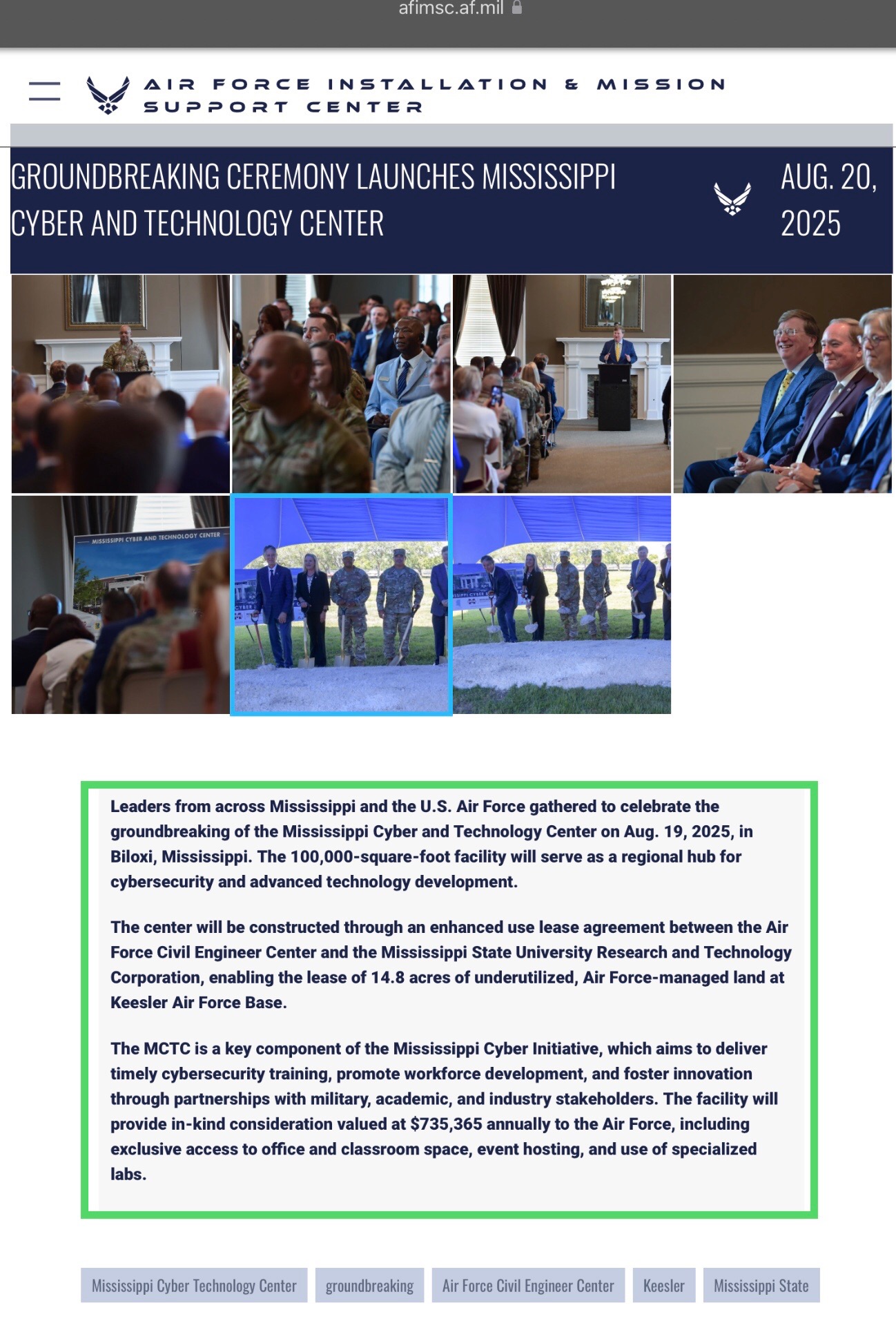
In this context it may be of heightened interest to note that last week saw the the groundbreaking ceremony to launch the Mississippi Cyber and Technology Center, a collaboration between MSU and the Air Force:
https://www.afimsc.af.mil/News/Arti...ches-mississippi-cyber-and-technology-center/
And Akida-enamoured Toby Davis “can’t wait to work there” one day:
https://www.linkedin.com/posts/mississippi-cyber-initiative_a-new-era-begins-for-cybersecurity-in-mississippi-ugcPost-7363694697803849729-9dh5?
Besides Akida already being evaluated in cybersecurity at Mississippi State University, MSU’s Raspet Flight Research Laboratory - that boasts “the nation’s largest UAS fleet in academia” - may possibly be interested in testing out BrainChip’s neuromorphic technology for use onboard their Unmanned Aircraft Systems, some of which have already proven helpful in emergency and disaster response, eg in the aftermath of Hurricane Helene (2024).
I noticed that their Interim Director Bryan Farrell liked Reed Hooks’ recent LinkedIn post about accompanying our CDO to Capitol Hill.
https://www.linkedin.com/company/raspet/
https://www.raspet.msstate.edu/news...ility-support-femas-hurricane-helene-response
STARKVILLE, Miss.—Mississippi State University uncrewed aircraft systems are providing real-time data in support of the Federal Emergency Management Agency’s response to Hurricane Helene.
Supported by the Department of Homeland Security Science and Technology Directorate’s Project JUSTICE, MSU’s pilots, engineers and scientists from the Raspet Flight Research Laboratory and the Northern Gulf Institute deployed to Georgia Sept. 29 for UAS flights over impacted areas in the Southeast. By outfitting Raspet’s large uncrewed aircraft with sophisticated sensors and cameras, MSU personnel provide real-time data and visuals on where floodwaters are moving to partners like FEMA Region 4 and the National Oceanic and Atmospheric Administration.
“I am extremely proud that MSU’s UAS capabilities are supporting our federal partners as they carry out critical missions to protect lives and property,” said Bryan Farrell, interim director of the Raspet Flight Research Lab. “This deployment comes after years of collaboration and successful training exercises. These efforts highlight the many ways large UAS can support emergency response, and how our research centers here at MSU work together to deliver new capabilities to our stakeholders. The effort not only provides immediate data for decision-makers, but the lessons learned influences future research directions.” (…)
https://homeland.house.gov/hearing/...d-aircraft-systems-across-the-dhs-enterprise/
https://www.raspet.msstate.edu/news...omous-soaring-federal-darpa-albatross-program
The official websites for the two US Senators from Mississippi each have a subpage titled "National Security":
Have a look at some of their recent press releases revolving around national security and defense, in which they highlight the role Mississippi already plays and (they claim) will continue to play in the future. As you would expect, of course. After all, as US Senators they were elected to represent their entire home state on Capitol Hill, unlike their colleagues in the other chamber of the US Congress, the House of Representatives, who primarily represent their individual congressional districts.
https://www.wicker.senate.gov/2025/7/wicker-introduces-congress-annual-defense-bill
https://www.hydesmith.senate.gov/hyde-smith-votes-advance-2026-defense-appropriations-bill
Part IV in next post…
Attachments
Frangipani
Top 20
Part III
In this context it may be of heightened interest to note that last week saw the the groundbreaking ceremony to launch the Mississippi Cyber and Technology Center, a collaboration between MSU and the Air Force:
https://www.afimsc.af.mil/News/Arti...ches-mississippi-cyber-and-technology-center/
And Akida-enamoured Toby Davis “can’t wait to work there” one day:
https://www.linkedin.com/posts/mississippi-cyber-initiative_a-new-era-begins-for-cybersecurity-in-mississippi-ugcPost-7363694697803849729-9dh5?
View attachment 90471
Besides Akida already being evaluated in cybersecurity at Mississippi State University, MSU’s Raspet Flight Research Laboratory - that boasts “the nation’s largest UAS fleet in academia” - may possibly be interested in testing out BrainChip’s neuromorphic technology for use onboard their Unmanned Aircraft Systems, some of which have already proven helpful in emergency and disaster response, eg in the aftermath of Hurricane Helene (2024).
I noticed that their Interim Director Bryan Farrell liked Reed Hooks’ recent LinkedIn post about accompanying our CDO to Capitol Hill.
https://www.linkedin.com/company/raspet/
View attachment 90470
View attachment 90473
https://www.raspet.msstate.edu/news...ility-support-femas-hurricane-helene-response
STARKVILLE, Miss.—Mississippi State University uncrewed aircraft systems are providing real-time data in support of the Federal Emergency Management Agency’s response to Hurricane Helene.
Supported by the Department of Homeland Security Science and Technology Directorate’s Project JUSTICE, MSU’s pilots, engineers and scientists from the Raspet Flight Research Laboratory and the Northern Gulf Institute deployed to Georgia Sept. 29 for UAS flights over impacted areas in the Southeast. By outfitting Raspet’s large uncrewed aircraft with sophisticated sensors and cameras, MSU personnel provide real-time data and visuals on where floodwaters are moving to partners like FEMA Region 4 and the National Oceanic and Atmospheric Administration.
“I am extremely proud that MSU’s UAS capabilities are supporting our federal partners as they carry out critical missions to protect lives and property,” said Bryan Farrell, interim director of the Raspet Flight Research Lab. “This deployment comes after years of collaboration and successful training exercises. These efforts highlight the many ways large UAS can support emergency response, and how our research centers here at MSU work together to deliver new capabilities to our stakeholders. The effort not only provides immediate data for decision-makers, but the lessons learned influences future research directions.” (…)
https://homeland.house.gov/hearing/...d-aircraft-systems-across-the-dhs-enterprise/
https://www.raspet.msstate.edu/news...omous-soaring-federal-darpa-albatross-program
The official websites for the two US Senators from Mississippi each have a subpage titled "National Security":
View attachment 90474
View attachment 90476
Have a look at some of their recent press releases revolving around national security and defense, in which they highlight the role Mississippi already plays and (they claim) will continue to play in the future. As you would expect, of course. After all, as US Senators they were elected to represent their entire home state on Capitol Hill, unlike their colleagues in the other chamber of the US Congress, the House of Representatives, who primarily represent their individual congressional districts.
https://www.wicker.senate.gov/2025/7/wicker-introduces-congress-annual-defense-bill
View attachment 90475
View attachment 90477
View attachment 90478
https://www.hydesmith.senate.gov/hyde-smith-votes-advance-2026-defense-appropriations-bill
View attachment 90479
Part IV in next post…
Part IV:
Imagine yourself on a nostalgic paddlewheel steamboat, cruising along the mighty Mississippi River near Natchez, MS, past grand antebellum mansions…
Now throw overboard all the stereotypes about the state of Mississippi and its inhabitants for a moment and have a look at the following compilation of links that are testament to the Magnolia State’s existing and growing role in the US aerospace and defence industry, which I bet hadn’t been on the radar of many a TSE forum reader (me included):
https://aerospacealliance.com/app/wp-content/uploads/2024/08/Mississippi-Industry-Profile.pdf
https://www.nasa.gov/centers-and-facilities/stennis/an-ideal-setting-for-range-operations/
“Think of NASA’s Stennis Space Center, and one likely thinks of rocket propulsion testing. The site has a long history of testing to support the nation’s space efforts, including the current Artemis program to send astronauts to the Moon to prepare for future human exploration of Mars.
However, NASA Stennis also is working to become a key supporter of more terrestrial exploration. Indeed, in terms of unmanned range operations, NASA Stennis has it all – layers of restricted airspace, a closed canal system, and acres upon acres of protected terrain.
The NASA site near Bay St. Louis, Mississippi, is an ideal location for all types of air, marine, and ground testing, said Range Operations Manager Jason Peterson. “My job is to understand the customer, and their requirements and limitations, to help them succeed,” he added. “What makes NASA Stennis unique is our federally protected area for users to operate.”
The need to learn about unmanned systems, such as drones or underwater vehicles, in a safe environment is growing as technology advances. Think of it like learning to drive a car in a parking lot before hitting the road.
(…)
NASA Stennis leaders are keenly aware of the opportunity such unique capabilities afford. The center’s 2024-2028 strategic plan states NASA Stennis will leverage these unique capabilities to support testing and operation of uncrewed systems.
Leaders are working to identify opportunities to maximize site capabilities and develop an effective business model. “NASA Stennis is open for business, and we want to provide a user-friendly range for operators to test vehicles by creating an environment that is safe, cost-effective, and focused on mission success,” Peterson said.”
https://www.mississippipower.com/co...pdfs/business/target-industries/aerospace.pdf
Aerospace and defence contractors already present in Mississippi are investing more money to open new facilities:
Earlier this week, Northrop Grumman, Mississippi Governor Tate Reeves, and Northeast Mississippi Community College (NEMCC) announced the future location of the Northrop Grumman Aerospace Lab, which will be built on NEMCC’s Corinth campus. The lab is expected to open in 2026 and “will become an epicentre of advanced manufacturing training, equipping students with the in-demand skills needed for Mississippi’s growing aerospace and defence industry.”
https://news.northropgrumman.com/pa...Mississippis-Advanced-Manufacturing-Workforce
Anduril recently officially opened “a full rate SRM manufacturing facility in McHenry, Mississippi” (SRM = Solid Rocket Motors) - “Made in Mississippi, Mobilized for the Modern Battlefield” (https://www.anduril.com/article/enter-anduril-the-united-states-third-supplier-of-solid-rocket-motors/)
And last but not least, here is an interesting white paper titled “South Mississippi Defense Strategy Mission Attraction Study” published a year ago (so still during the Biden Administration) that stresses the importance of advocacy work at the federal level with policymakers in Washington and suggests several initiatives worthy to pursue that would also benefit the Magnolia State economically:
http://smpdd.com/wp-content/uploads/2024/08/South-MS-Defense-Strategy-Mission-Attraction-Study.pdf
(…)
Now that even readers with dyslexia will have well and truly memorised how to correctly spell MISSISSIPPI, I would really appreciate if the MS Tourism Board could shout me a trip to the Magnolia State (which I’ve never been to)…

While I wait for them to contact me, I will write down some further - but less extensive, I promise! - observations relating to “Dr Tapson goes to Washington” (which I took to be a humorous reference to the 1939 movie “Mr. Smith Goes To Washington”, by the way)…
Last edited:
darrynivanex
Emerged
How to Recover Stolen Cryptocurrency: Hire a Genuine Recovery Expert META TECH RECOVERY PRO
The adage "all that glitters is not gold" proved a harsh reality I recently encountered. The digital realm of cryptocurrency investments and exchange platforms is not immune to deception. My pursuit of cryptocurrency investments led me to a seemingly legitimate site, complete with convincing investor testimonials touting successful withdrawals. Unbeknownst to me, it was an elaborate scheme. I invested $210,000.00 worth of cryptocurrency across multiple wallets, as directed by the scammers. Initially, the process mirrored typical modern investments, but my withdrawal requests were met with evasiveness and silence. This represented my entire life savings, accumulated through years of dedicated work, now vanished in an instant. Refusing to accept defeat, I sought assistance from METATECH-RECOVERYPRO, which facilitated a successful recovery. Their process was remarkably efficient. They meticulously traced my lost funds back to the perpetrators, and within a short timeframe, the recovered assets were returned to my bank account. Without this exceptional recovery team, which offered support when all hope seemed lost, my situation would have been dire. To initiate your recovery, I strongly advise sending a detailed email (Metatech@Writeme.Com) of your task, outlining your specific circumstances via W/S +1 (469) 692 8049. Thank you.
The adage "all that glitters is not gold" proved a harsh reality I recently encountered. The digital realm of cryptocurrency investments and exchange platforms is not immune to deception. My pursuit of cryptocurrency investments led me to a seemingly legitimate site, complete with convincing investor testimonials touting successful withdrawals. Unbeknownst to me, it was an elaborate scheme. I invested $210,000.00 worth of cryptocurrency across multiple wallets, as directed by the scammers. Initially, the process mirrored typical modern investments, but my withdrawal requests were met with evasiveness and silence. This represented my entire life savings, accumulated through years of dedicated work, now vanished in an instant. Refusing to accept defeat, I sought assistance from METATECH-RECOVERYPRO, which facilitated a successful recovery. Their process was remarkably efficient. They meticulously traced my lost funds back to the perpetrators, and within a short timeframe, the recovered assets were returned to my bank account. Without this exceptional recovery team, which offered support when all hope seemed lost, my situation would have been dire. To initiate your recovery, I strongly advise sending a detailed email (Metatech@Writeme.Com) of your task, outlining your specific circumstances via W/S +1 (469) 692 8049. Thank you.
Attachments

darrynivanex
Emerged
How to Recover Stolen Cryptocurrency: Hire a Genuine Recovery Expert META TECH RECOVERY PRO
The adage "all that glitters is not gold" proved a harsh reality I recently encountered. The digital realm of cryptocurrency investments and exchange platforms is not immune to deception. My pursuit of cryptocurrency investments led me to a seemingly legitimate site, complete with convincing investor testimonials touting successful withdrawals. Unbeknownst to me, it was an elaborate scheme. I invested $210,000.00 worth of cryptocurrency across multiple wallets, as directed by the scammers. Initially, the process mirrored typical modern investments, but my withdrawal requests were met with evasiveness and silence. This represented my entire life savings, accumulated through years of dedicated work, now vanished in an instant. Refusing to accept defeat, I sought assistance from METATECH-RECOVERYPRO, which facilitated a successful recovery. Their process was remarkably efficient. They meticulously traced my lost funds back to the perpetrators, and within a short timeframe, the recovered assets were returned to my bank account. Without this exceptional recovery team, which offered support when all hope seemed lost, my situation would have been dire. To initiate your recovery, I strongly advise sending a detailed email (Metatech@Writeme.Com) of your task, outlining your specific circumstances via W/S +1 (469) 692 8049. Thank you.
The adage "all that glitters is not gold" proved a harsh reality I recently encountered. The digital realm of cryptocurrency investments and exchange platforms is not immune to deception. My pursuit of cryptocurrency investments led me to a seemingly legitimate site, complete with convincing investor testimonials touting successful withdrawals. Unbeknownst to me, it was an elaborate scheme. I invested $210,000.00 worth of cryptocurrency across multiple wallets, as directed by the scammers. Initially, the process mirrored typical modern investments, but my withdrawal requests were met with evasiveness and silence. This represented my entire life savings, accumulated through years of dedicated work, now vanished in an instant. Refusing to accept defeat, I sought assistance from METATECH-RECOVERYPRO, which facilitated a successful recovery. Their process was remarkably efficient. They meticulously traced my lost funds back to the perpetrators, and within a short timeframe, the recovered assets were returned to my bank account. Without this exceptional recovery team, which offered support when all hope seemed lost, my situation would have been dire. To initiate your recovery, I strongly advise sending a detailed email (Metatech@Writeme.Com) of your task, outlining your specific circumstances via W/S +1 (469) 692 8049. Thank you.
Attachments


Food4 thought
Regular
You are an amazing humanPart II
According to HigherGov, Spartan Group have only been awarded two federal government agency contracts so far, namely a Prime Contract Award by the Iowa National Guard (which is a subagency of the Department of the Army) that started in September 2022 as well as an IDV (Indefinite Delivery Vehicle) Award by the Space Force that commenced in December 2024 - with a total of US$ 293.5K awarded to date.
In other words, Spartan Group do not appear to be nearly as established in the field of federal contracting as other forum users have made them out to be.
https://www.highergov.com/awardee/spartan-group-consulting-limited-liability-company-13295416/
Besides, Spartan Group do not explicitly state on their website that they offer federal government contracting consulting services or that they assist small businesses in setting up meetings with Capitol Hill policymakers for lobbying purposes.
But James Norton looks like the man who is now in charge of expanding this (new?) field of consulting for Spartan Group since joining them less than five months ago.
In May of this year, one month into his new job with Spartan Group, James Norton got some assistance in form of a summer intern called Wilson Cotten, a University of Mississippi student pursuing a Bachelor of Business Management and a Double Minor in Military Science & Global Security Studies, who is also a Cadet in the Army National Guard (possibly their point of contact?).
The former intern has since been given a new job title and describes his Executive Assistant role as follows: “From opportunity assessment through final submission, I oversee the full lifecycle of Department of Defense (DoD) proposals—writing proposals, creating management plans, and building cost models that align with agency criteria and deliver innovative solutions. At Spartan Group, I accelerate innovation by integrating emerging technologies into DoD solutions.”
https://www.linkedin.com/in/wilson-cotten/
View attachment 90454
View attachment 90455
View attachment 90462
Around that same time in May 2025, a fresh Mississippi State University graduate with a Bachelor degree in Biomedical Engineering named Reed Hooks (whose full name is James Reed Hooks) also joined Spartan Group.
In his LinkedIn profile, he describes his ongoing role within the company as “Partnership Development". Given he started a new job as Capital Associate with Nashville-based LaunchTN (a Tennessee public-private startup hub) earlier this month, his continued affiliation with Spartan Group is presumably on a part-time or contract basis.
https://www.linkedin.com/in/reed-hooks-7344621b7/
View attachment 90458
View attachment 90459
Regular forum readers would likely be aware that Reed Hooks was the Spartan Group representative who on 6 August (US time) shared on LinkedIn that he had accompanied Jonathan Tapson to Washington, DC, where he joined him “on Capitol Hill to brief offices on Akida® neuromorphic edge-AI.”
Note that he did not specify whether he also accompanied him to visit what Jonathan Tapson had referred to (in his 5 August LinkedIn post) as “potential partners in the Beltway” in order to “explore collaboration opportunities” (cf. BrainChip’s 6 August LinkedIn post).
Now let’s recall which specific Members of Congress Jonathan Tapson and Reed Hooks had appointments with:
Dave Min, the Democrat who represents California’s 47th Congressional District (where BrainChip’s Laguna Hills office is located) in the US House of Representatives as well as Cindy Hyde-Smith and Roger Wicker, the two Republican Senators representing their home state Mississippi in the US Senate:
https://www.senate.gov/states/MS/intro.htm
View attachment 90463
Coincidence? I doubt it.
Instead I’d venture a guess that the primary reason Jonathan Tapson got to officially meet with Cindy Hyde-Smith and Roger Wicker out of all the 100 current Members of the US Senate is not that she sits on the Senate Committee of Appropriations and he is Chair of the Armed Services Committee, but because the assistance our CDO got in promoting his “Federal contracting agenda” (JT) came from the Mississippi-based company within the Spartan Group that was registered in the Magnolia State on 31 January 2022.
https://www.mississippicompanyregistry.com/companies/spartan-group-consulting-llc/
And as busy legislators are more inclined to set up a meeting with constituents (such as Mississippian Reed Hooks) and to listen to what lobbyists and advocacy groups have to say when the issue in question has something to do with their home state, I believe it to be quite likely that the discussions with the two Senators on Capitol Hill would have centred on Mississippi’s current and future role in national defense and what part BrainChip could play in it.
So I believe it was actually Miss Issippi who ultimately made these two specific meetings possible, although none of the three LinkedIn posts (JT, BRN & RH) gave her any credit for arranging our CDO’s appointments with Senators Cindy Hyde-Smith and Roger Wicker.
(It also caught my eye that Wilson Cotten seems to personally know two fellow University of Mississippi Bachelor students who recently completed resp. started internships with the Washington, DC Office of Senator Roger Wicker, but I have no idea whether that may have played any role in arranging those meetings).
While I don’t know for sure whether Reed Hooks himself had any hands-on experience with Akida during his Bachelor studies in Biomedical Engineering at MSU, I noticed he posted this
https://www.linkedin.com/posts/reed-hooks-7344621b7_edgeai-akida-developers-activity-7341846047251386368-7mAZ?
View attachment 90464
“The new eye-tracking and gesture-recognition models run on ultra low-power hardware, opening doors for future classroom demos, field-gear trials, and next-gen wearables we’re evaluating in Mississippi” - interesting comment, isn’t it?
When searching online for potentially already existing connections between BrainChip and Mississippi, I came across Mississippi State University (MSU) Master student, new PhD Candidate and DoD Cyber Service Academy Scholar Toby Davis who evaluated Akida for cybersecurity for his Master thesis - I later noticed @Fullmoonfever had already posted about him in February (https://thestockexchange.com.au/threads/brn-discussion-ongoing.1/post-450812).
Toby Davis seems to have since added some more info in his LinkedIn profile, which now also says: “Masters Research Thesis: Demonstrated the superior performance capabilities of the Akida Neuromorphic processor manufactured by BrainChip for cybersecurity applications in environments similar to low earth orbit.”
https://www.linkedin.com/in/toby-davis-017734264/
View attachment 90466
View attachment 90467
Part III in next post…
Are people in here just ignoring this? For me it seems like they didnt picked BrainChip from the R/D phase. If thats the case it blows. Further thoughts on this?
GStocks123
Regular
Here you go. The Onsor CEO also stated that they planned on releasing this product containing Akida as early as 2026. Cheers.Are people in here just ignoring this? For me it seems like they didnt picked BrainChip from the R/D phase. If thats the case it blows. Further thoughts on this?

BrainChip Joins Intel Foundry Services IP Alliance to Advance Neuromorphic AI at the Edge
BrainChip joins with Intel Foundry Services to advance edge-based neuromorphic AI, revolutionizing the field of artificial intelligence.
 brainchip.com
D
Deleted member 3781
Guest
Chippers every Monday morning and Friday evening waiting for a price sensitive announcement


Shadow59
Regular
Chippers every Monday morning and Friday evening waiting for a price sensitive announcement

Similar threads

- Replies
- 3
- Views
- 12K
D

- Replies
- 0
- Views
- 5K
- Replies
- 9
- Views
- 6K
- Replies
- 0
- Views
- 3K