BRN Discussion Ongoing

  • Like
  • Love
  • Fire
Reactions: 8 users

manny100

Top 20
The power of AKIDA is way underestimated. It could easily have been adatpted as a 2nd level check for the new legislation preventing social media access to under 16's
Age estimation (regression) example — Akida Examples documentation
" It uses the UTKFace dataset, which includes images of faces and age labels, to showcase how well akida compatible model can predict the ages of individuals based on their facial features."
 
  • Like
Reactions: 8 users

JDelekto

Regular
As we head into the holiday season, I would like to wish everyone a Merry Christmas and a Happy New Year!

In the past, I had stated that I would wait until 2025 and reassess my investment in BrainChip to see where things stand. On paper, I had a considerable loss, so throughout the year, I averaged down as much as I could until I reached the maximum number of shares I had set as my goal. After that goal was met, I began investing my retirement savings into other aggressive growth funds to attempt to balance things out.

While I still hold BrainChip at a loss on paper, I don't plan on realizing that loss any time soon, given the amount of news that has surfaced. That being said, I'll proffer my opinion on where I see things heading as we move into 2026.

Generative AI is a huge business right now, and while very profitable for companies, I think I see a bubble forming. In my experience, it saves a considerable amount of time (I use it more in my everyday work); however, it's not a panacea. It can definitely make those using it more productive, while opening up other avenues of development opportunities for data analysis, training models, and creating AI agents that work in tandem to carry out more complex tasks.

While TENNs (which I understand will work with first-generation Akida, but run optimally on Akida's second and third generation designs) can provide performant generative AI capabilities, they do so with much smaller and more specific trained models. Generative AI is a subset of AI in general that focuses on generating new content, whether it be text or images. However, AI inference can make decisions, predictions, classifications, recommendations, and complex real-time analysis, which are included in Akida's capabilities.

To me, BrainChip is at least addressing the hype train regarding Generative AI. From the other uses I've seen partners apply Akida, such as Raytheon and Onsor, it is obvious that their use of Akida is one of the other aforementioned inferencing capabilities, for which it performs extremely well.

BrainChip decided to tape out the AKD1500 for volume production. I think this is a smart move, as there is market demand for silicon that uses the Akida IP. Smaller players in the space that want neuromorphic technology to achieve their vision will now have access. Trying to cater only its IP to larger suppliers in the space was probably a harder sell, as I'm sure they want to see it in action before such a perceived risky commitment. People may view this pivot as a negative; however, I believe it will be necessary to help establish the brand quickly and ensure survival amongst competitors that provide off-the-shelf silicon to companies incorporating AI into their hardware. These companies will reap the benefits of neuromorphic inferencing, which may be disruptive to those competitors not using a neuromorphic design.

I certainly approve of their pivotal decision and the inroads being made in the military, space, and medical applications, right where they need to be. Once Akida has proven itself in these fields concerning efficiency, power, speed, and latency, the IP deals may eventually follow for hardware designs that are more efficient and cost-effective for large-scale production. More than likely, Akida will be used in chiplets that become part of a larger SoC design in the future.

I still believe in the technology, and while I can't say what 2026 will bring to the table, it will hopefully be more announcements around the AKD1500 large-scale tape-out and production, as well as success stories from partners who are wrapping up their projects using the technology. Some of these engagements, years in the making, are coming to fruition. I am looking forward to seeing what new applications emerge, outside of the realm of Generative AI, that we haven't yet imagined. Let's hope that by the second quarter, it will be the year of price-moving announcements, hopefully bringing it a gradual rise to where it should rightfully be. I don't want to see another "Mercedes" boom in the share price, which did the long-term investor no favors and made several people uncomfortable with their choice after the CES announcement hype subsided. Short-term traders made out like bandits; non-traders like me, seeking a viable long-term investment in a technology I believe in, missed an opportunity to sell and buy back in later, increasing holdings substantially. As they say, though, hindsight is 20/20.

For those like me who are still holding onto BrainChip, good luck to you all! For those who are taking a loss and moving on, I certainly empathize with the frustration of owning this stock. However, I still believe in the technology, and I am looking past the Generative AI hype on which BrainChip is cleverly marketing, but just one of the many applications of Akida's true capabilities.
 
  • Like
  • Love
  • Fire
Reactions: 51 users

Bravo

If ARM was an arm, BRN would be its biceps💪!
Approved watching techniques - Just have a look out your window:


View attachment 93846 View attachment 93847 View attachment 93848 View attachment 93849

I really appreciate the guidance, Dodgy-Knees!

I must have completely misunderstood the watching protocol because my technique was like this.


7f0bdd7b-474d-469a-b1f6-e188f52466f3_372x278.gif


But I’ll adopt your technique in future and report back.
 
  • Haha
  • Like
  • Love
Reactions: 12 users

Hmmm, what’s next Luca ………

IMG_0055.jpeg
 
  • Like
  • Wow
  • Thinking
Reactions: 13 users

genyl

Regular
For me the question is how low will the SP go before mid/late next year. It is pretty clear they most likely won't annonce a big contract before the Parsons deal. We will probably get some partnership news before then but those won't move the SP north.
Holding - since my average is around 0.29 which i thought at some point was a very good entry point..
 

Attachments

  • Screenshot_20251222_091820_LinkedIn.jpg
    Screenshot_20251222_091820_LinkedIn.jpg
    305.2 KB · Views: 95
  • Like
  • Fire
Reactions: 5 users

Diogenese

Top 20
I really appreciate the guidance, Dodgy-Knees!

I must have completely misunderstood the watching protocol because my technique was like this.


View attachment 93853


But I’ll adopt your technique in future and report back.
Ditch the bubble gum and you've got it to a T.
 
  • Haha
Reactions: 5 users

Tothemoon24

Top 20
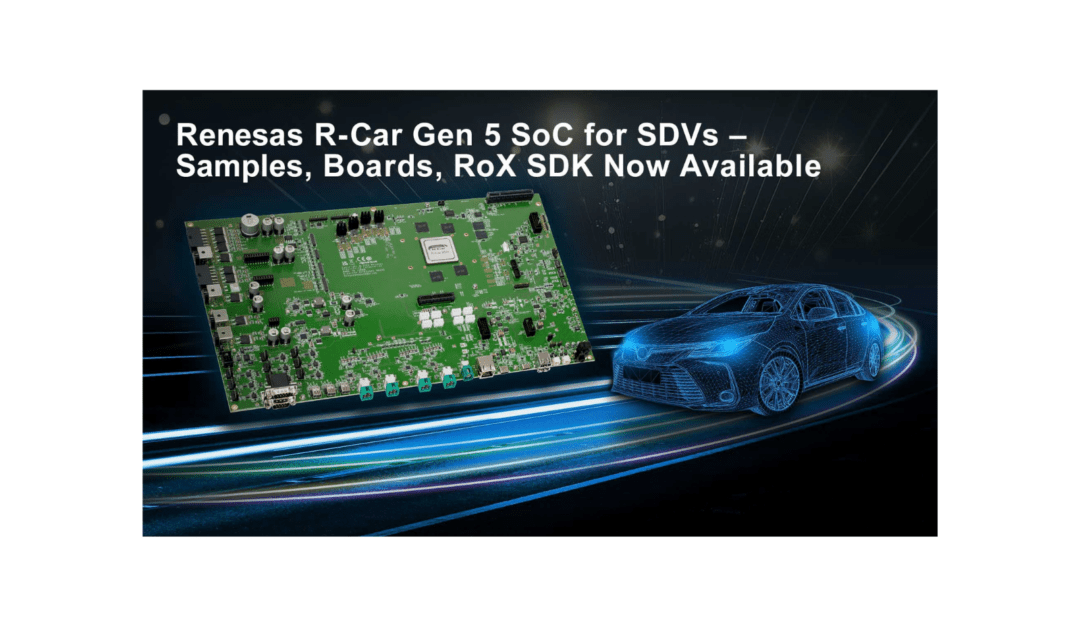
Renesas has begun shipping R-Car X5H silicon samples, evaluation boards, and the RoX Whitebox SDK to selected customers and partners. The company noted that it plans to showcase AI-powered multi-domain demonstrations of the platform at CES 2026.

Renesas advances SDV roadmap with 3nm R-Car Gen 5 platform​

New Products | December 22, 2025
By eeNews Europe
AUTOMOTIVE SDV RENESASEMBEDDED DESIGN


Renesas Electronics has taken another step in its software-defined vehicle (SDV) strategy with the expansion of its fifth-generation R-Car platform, built around a new multi-domain automotive SoC and a broader end-to-end development environment. According to the company, the move is aimed squarely at accelerating the design of highly integrated, AI-driven vehicle architectures.


For eeNews Europe readers, the announcement is relevant because it highlights how leading silicon vendors are converging ADAS, infotainment, and gateway workloads onto a single, safety-capable compute platform. It also offers insight into how open software stacks and early silicon access are being used to shorten automotive development cycles.

3nm multi-domain compute for SDVs​

At the core of the platform is the R-Car X5H, the latest device in the Gen 5 R-Car family. According to Renesas, it is the industry’s first multi-domain automotive SoC manufactured on a 3nm process. The company indicates that the device is designed to run advanced driver assistance systems (ADAS), in-vehicle infotainment (IVI), and gateway functions concurrently on a single chip.

The company says the move to an advanced process node delivers up to 35% lower power consumption compared with previous 5nm solutions, while significantly increasing compute density. The SoC targets centralized SDV architectures, combining high performance with mixed-criticality support so that safety-related and non-safety workloads can coexist without compromise.


The R-Car X5H delivers up to 400 TOPS of AI performance, with the option to scale further using chiplet-based accelerators that can boost AI throughput by four times or more. Graphics performance reaches the equivalent of 4 TFLOPS, supported by a CPU complex of 32 Arm Cortex-A720AE cores and six Cortex-R52 lockstep cores with ASIL D capability, providing more than 1,000k DMIPS.

RoX Whitebox SDK targets faster development​

Alongside the new silicon, Renesas says it is expanding its R-Car Open Access (RoX) development platform with the RoX Whitebox Software Development Kit. The SDK is positioned as an open, scalable environment that integrates hardware, operating systems, middleware, and tools needed for next-generation SDV development.

The Whitebox SDK is built on Linux, Android and the XEN hypervisor, with additional support for AUTOSAR, EB corbos Linux, QNX, Red Hat and SafeRTOS through partners. Out of the box, developers can begin work on ADAS, L3/L4 autonomy, intelligent cockpit and gateway applications.

An integrated AI and ADAS software stack supports real-time perception and sensor fusion, while generative AI and large language models are intended to enable more advanced human–machine interfaces in future AI-driven cockpits, the company notes. The SDK also incorporates production-grade software from partners including Candera, DSP Concepts, Nullmax, Smart Eye, STRADVISION and ThunderSoft.

Sampling and demos

Renesas has begun shipping R-Car X5H silicon samples, evaluation boards, and the RoX Whitebox SDK to selected customers and partners. The company noted that it plans to showcase AI-powered multi-domain demonstrations of the platform at CES 2026.


eenews-europe.png
I
 
  • Like
  • Fire
  • Thinking
Reactions: 12 users

manny100

Top 20
This might be a silly question, but when Sean said "watch us now", I'm curious to know what it is we're supposed to be watching? How are we meant to watch what it is we're watching and what do you think constitutes acceptable watching?

I’m concerned I may be non-compliant. There is a distinct possibility I’ve been watching the wrong thing, or the correct thing in an unapproved manner. What if my watching technique itself is flawed?

Are we supposed to watch each other? Are we meant to glance occasionally sideways or stare intensely at it for extended periods without blinking? Are you allowed to watch it when you're hiding behind a pot plant?

Is anyone else just pretending to watch while actually looking at nothing and hoping it still counts? (Not saying I've been doing that. I think my migraine proves that I've been watching to the best of my focal abilities).

Any guidance on watching standards, thresholds, or escalation procedures would be appreciated so I can continue watching in accordance with expectations.

TIA.

View attachment 93842
I think we need to look at the recent videos by Steve Brightfield and Sean for their use of the key words - watch and now. The 'now' word Sean used caused an absolute meltdown and fear amongst downrampers over on the crapper.
Steve only used the 'now' word once from memory but went he straight for the adoption throat.
At the 35.20/25 Steve uttered in his video " I think we are seeing rapid adoption now". That is what we are looking/watching for.
In the AUSXBUS video Sean said " And so when does revenue really start to hit its stride? We believe right about now is the right time."
A little later Sean used the 'plenty of now and a couple of watch ' words in an exchange with the interviewer.
" So we think right about now, so you can look for some activity over the coming quarters and years, starting right about now, because there has been some criticism, if I'm fair in the market, the brain chip, it's volatile stock that it's sort of a story right now rather than an actual business. What do you say to that? I say to that, that watch us now. Just watch us now."
According to both Steve and Sean we are getting pretty close to some good things.
I recall Steve in an interview months prior to the Onsor news saying that wearable glasses were being looked at.
In his recent interview he stated rapid adoption for off the shelf Ear Buds/hearing aids and dropped a hint concerning Migraine wearables.
 
  • Like
  • Love
  • Fire
Reactions: 31 users

Flenton

Regular
I think we need to look at the recent videos by Steve Brightfield and Sean for their use of the key words - watch and now. The 'now' word Sean used caused an absolute meltdown and fear amongst downrampers over on the crapper.
Steve only used the 'now' word once from memory but went he straight for the adoption throat.
At the 35.20/25 Steve uttered in his video " I think we are seeing rapid adoption now". That is what we are looking/watching for.
In the AUSXBUS video Sean said " And so when does revenue really start to hit its stride? We believe right about now is the right time."
A little later Sean used the 'plenty of now and a couple of watch ' words in an exchange with the interviewer.
" So we think right about now, so you can look for some activity over the coming quarters and years, starting right about now, because there has been some criticism, if I'm fair in the market, the brain chip, it's volatile stock that it's sort of a story right now rather than an actual business. What do you say to that? I say to that, that watch us now. Just watch us now."
According to both Steve and Sean we are getting pretty close to some good things.
I recall Steve in an interview months prior to the Onsor news saying that wearable glasses were being looked at.
In his recent interview he stated rapid adoption for off the shelf Ear Buds/hearing aids and dropped a hint concerning Migraine wearables.
Don't forget this comment at 16:40... and you were saying that one day everyone will have a brainchip in their pocket.

 
  • Like
  • Fire
Reactions: 14 users

TECH

Regular
At the 25 minute mark of Steve Brightfields interview he said Ear buds will become medically certified hearing aids off the shelf. That is potentially huge.
Disaster for hearing aid producers and sellers?
At 28 min on he says we have a customer with smart glasses and they can detect from brainwave activity whether it be migraine, in this case detecting Epileptic seizures before it happens.
That looks a giveaway that Migraine prediction is being worked on at least - another Onsor project?
Migraine detecton would be huge.


That was a great podcast, I really like Steve, he communicates very clearly, he knows his stuff and presents to me as a great ambassador for Brainchip.

Clearly, Sean's IP approach solely was wrong, a combined IP/Chip approach has now proven to be the best path forward, who told us that, that's correct, our partners and early customers, they recognised that the financial risk in outlying tens of millions of dollars in IP blocks within their own products at this early stage in neuromorphic chip technology was and still is too greater a risk... hence AKD 1000 and AKD 1500 are very, very relevant.

I see this acknowledgement by the company as a positive step, no arrogance here, fantastic!!

If we wish to succeed, we must always be open in our thinking, willing to adapt at short notice, like I and a number of other long termers mentioned at the time, AKD 1000 was too narrow, was absolute bullshit..yes we were short on funding, BUT, the movement to an ARM business model was premature and has potentially cost us a few years in progress....purely my self-centred opinion and my bais support for Peter and Anil, AKD 1000 was and will always be the masterstroke that set Brainchip on the road to success, despite taking 4 years longer than I had quietly hoped for.

Thanks for your input Manny over the last year, have a nice Christmas mate, God bless.
Tech/Chris 🎄🎄👍
 
  • Like
  • Love
  • Fire
Reactions: 21 users

manny100

Top 20
That was a great podcast, I really like Steve, he communicates very clearly, he knows his stuff and presents to me as a great ambassador for Brainchip.

Clearly, Sean's IP approach solely was wrong, a combined IP/Chip approach has now proven to be the best path forward, who told us that, that's correct, our partners and early customers, they recognised that the financial risk in outlying tens of millions of dollars in IP blocks within their own products at this early stage in neuromorphic chip technology was and still is too greater a risk... hence AKD 1000 and AKD 1500 are very, very relevant.

I see this acknowledgement by the company as a positive step, no arrogance here, fantastic!!

If we wish to succeed, we must always be open in our thinking, willing to adapt at short notice, like I and a number of other long termers mentioned at the time, AKD 1000 was too narrow, was absolute bullshit..yes we were short on funding, BUT, the movement to an ARM business model was premature and has potentially cost us a few years in progress....purely my self-centred opinion and my bais support for Peter and Anil, AKD 1000 was and will always be the masterstroke that set Brainchip on the road to success, despite taking 4 years longer than I had quietly hoped for.

Thanks for your input Manny over the last year, have a nice Christmas mate, God bless.
Tech/Chris 🎄🎄👍
Thanks Tech/Chris, much appreciated and a great Xmas and new year to yourself.It has been a long haul for us longer term holders but that is in IMO in hindsight a reflection of just how disruptive and powerful AKIDA/TENNs is.
IMO the BRN team has done a great job in continuing to improve and develop our product while maintaining faith that the 'adoption' penny will drop - and that seems to be getting closer.
I admire the the way the BRN team ploughs straight through the doubters and just keeps building the business.
My personal positive view/spin on the delays is that they have just given me an opportunity to accumulate without a cent of debt. Each to their own though.
Cheers, Manny
 
  • Like
  • Love
  • Fire
Reactions: 14 users

IloveLamp

Top 20

1000015453.jpg
1000015456.jpg
1000015464.jpg
1000015467.jpg
1000015470.jpg
 

Attachments

  • 859a96f5-bc99-4e59-b81c-2ae42bd4358f-1_all_27407.jpg
    859a96f5-bc99-4e59-b81c-2ae42bd4358f-1_all_27407.jpg
    431.6 KB · Views: 33
  • 859a96f5-bc99-4e59-b81c-2ae42bd4358f-1_all_27402.jpg
    859a96f5-bc99-4e59-b81c-2ae42bd4358f-1_all_27402.jpg
    435 KB · Views: 34
  • Like
  • Fire
  • Love
Reactions: 36 users

suss

Regular

View attachment 93859 View attachment 93860 View attachment 93862 View attachment 93864 View attachment 93865
The first paragraph... they forgot to edit their copy paste from the LLM tool :LOL:
 
  • Haha
Reactions: 5 users
FF

✅ Andes Technology + BrainChip

  • Andes Technology (a major RISC-V CPU IP provider) and BrainChip have integrated BrainChip’s Akida AI IP with Andes’ RISC-V cores on development boards and platforms, such as the Andes QiLai Voyager Board with a RISC-V multicore CPU and the Akida AKD1500 accelerator. This shows practical use of both technologies together for edge AI compute solutions. Andestech+1

✅ SiFive + BrainChip (industry collaboration)

  • SiFive (a leading RISC-V semiconductor company) has partnered with BrainChip to combine SiFive’s RISC-V processors with BrainChip’s Akida AI engine for edge AI/ML acceleration. Although this partnership is from 2022, it reflects a real industry effort to build combined RISC-V + neuromorphic AI solutions. BrainChip

✅ Frontgrade Gaisler (space SoC project)

  • Frontgrade Gaisler is reportedly developing a space-grade SoC that integrates BrainChip’s Akida IP with a RISC-V processor (NOEL-V) for radiation-tolerant AI processing in space applications. This is a specific product application combining both architectures. BrainChip
 
  • Like
  • Fire
  • Love
Reactions: 13 users
I do hope Sean has his finger on the pulse with the chiplet market place as it is heading north in a big way. I remember Tech saying many moons ago that he didn't think they were considering this market for what ever reason iam unsure.
I hope he is wrong on this one as chiplets are the new design for automotive from what iam reading everyday.
 
  • Like
Reactions: 3 users
I do hope Sean has his finger on the pulse with the chiplet market place as it is heading north in a big way. I remember Tech saying many moons ago that he didn't think they were considering this market for what ever reason iam unsure.
I hope he is wrong on this one as chiplets are the new design for automotive from what iam reading everyday.
What would tech know
 
  • Like
  • Thinking
Reactions: 4 users
Renesas has begun shipping R-Car X5H silicon samples, evaluation boards, and the RoX Whitebox SDK to selected customers and partners. The company noted that it plans to showcase AI-powered multi-domain demonstrations of the platform at CES 2026.

Renesas advances SDV roadmap with 3nm R-Car Gen 5 platform​

New Products | December 22, 2025
By eeNews Europe
AUTOMOTIVE SDV RENESASEMBEDDED DESIGN


Renesas Electronics has taken another step in its software-defined vehicle (SDV) strategy with the expansion of its fifth-generation R-Car platform, built around a new multi-domain automotive SoC and a broader end-to-end development environment. According to the company, the move is aimed squarely at accelerating the design of highly integrated, AI-driven vehicle architectures.


For eeNews Europe readers, the announcement is relevant because it highlights how leading silicon vendors are converging ADAS, infotainment, and gateway workloads onto a single, safety-capable compute platform. It also offers insight into how open software stacks and early silicon access are being used to shorten automotive development cycles.

3nm multi-domain compute for SDVs​

At the core of the platform is the R-Car X5H, the latest device in the Gen 5 R-Car family. According to Renesas, it is the industry’s first multi-domain automotive SoC manufactured on a 3nm process. The company indicates that the device is designed to run advanced driver assistance systems (ADAS), in-vehicle infotainment (IVI), and gateway functions concurrently on a single chip.

The company says the move to an advanced process node delivers up to 35% lower power consumption compared with previous 5nm solutions, while significantly increasing compute density. The SoC targets centralized SDV architectures, combining high performance with mixed-criticality support so that safety-related and non-safety workloads can coexist without compromise.


The R-Car X5H delivers up to 400 TOPS of AI performance, with the option to scale further using chiplet-based accelerators that can boost AI throughput by four times or more. Graphics performance reaches the equivalent of 4 TFLOPS, supported by a CPU complex of 32 Arm Cortex-A720AE cores and six Cortex-R52 lockstep cores with ASIL D capability, providing more than 1,000k DMIPS.

RoX Whitebox SDK targets faster development​

Alongside the new silicon, Renesas says it is expanding its R-Car Open Access (RoX) development platform with the RoX Whitebox Software Development Kit. The SDK is positioned as an open, scalable environment that integrates hardware, operating systems, middleware, and tools needed for next-generation SDV development.

The Whitebox SDK is built on Linux, Android and the XEN hypervisor, with additional support for AUTOSAR, EB corbos Linux, QNX, Red Hat and SafeRTOS through partners. Out of the box, developers can begin work on ADAS, L3/L4 autonomy, intelligent cockpit and gateway applications.

An integrated AI and ADAS software stack supports real-time perception and sensor fusion, while generative AI and large language models are intended to enable more advanced human–machine interfaces in future AI-driven cockpits, the company notes. The SDK also incorporates production-grade software from partners including Candera, DSP Concepts, Nullmax, Smart Eye, STRADVISION and ThunderSoft.

Sampling and demos

Renesas has begun shipping R-Car X5H silicon samples, evaluation boards, and the RoX Whitebox SDK to selected customers and partners. The company noted that it plans to showcase AI-powered multi-domain demonstrations of the platform at CES 2026.


eenews-europe.png
I
It is 100% certain that BrainChip is not explicitly mentioned as being involved in the Renesas R-Car X5H based on the provided authoritative sources as of December 23, 2025
 
  • Like
Reactions: 2 users

Diogenese

Top 20
I do hope Sean has his finger on the pulse with the chiplet market place as it is heading north in a big way. I remember Tech saying many moons ago that he didn't think they were considering this market for what ever reason iam unsure.
I hope he is wrong on this one as chiplets are the new design for automotive from what iam reading everyday.
If memory serves, PvdM was unenthused when Mark Kennis asked about chiplets. However a lot of water under the bridge since then.

It is always open to the customer to use Akida IP in chiplets.
 
  • Like
  • Love
  • Fire
Reactions: 6 users

Bossman

Gentleman
What would tech know
Mate have you got a mirror at your house? You might want to go and have a good look at yourself.
 
  • Like
  • Haha
Reactions: 3 users
Top Bottom