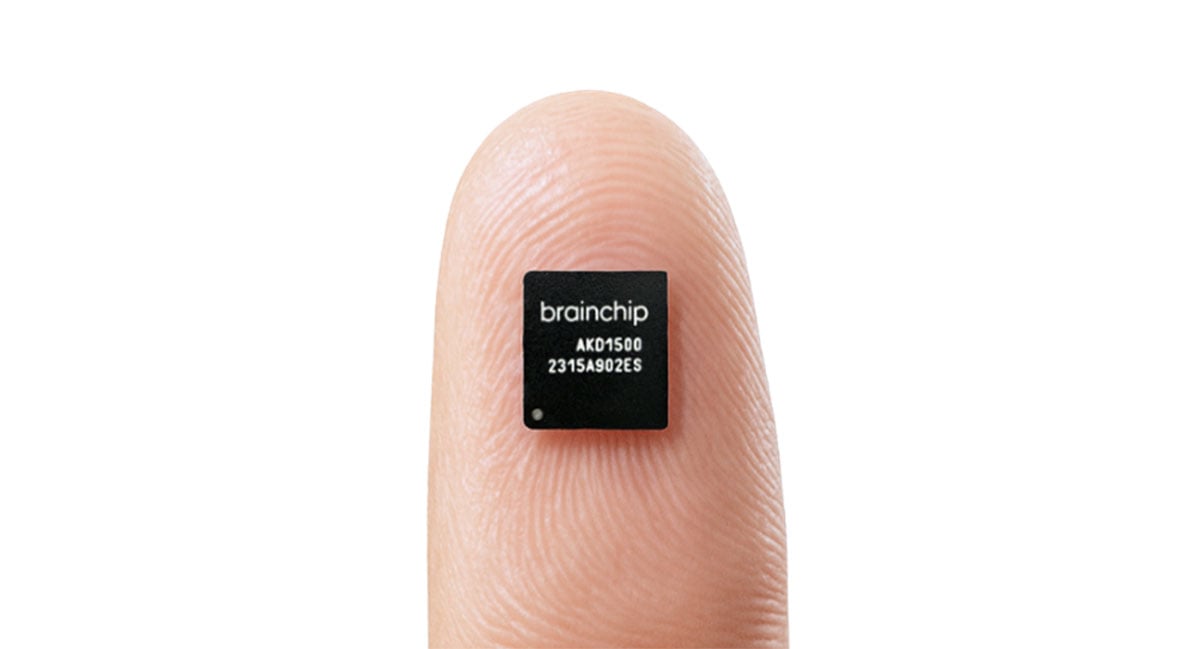
An NVIDIA Jetson needs 10 watts minimum. The AKD1500 can operate at under 100mW and wake the larger Jetson platform only when something actually needs heavy processing. That's not a minor efficiency gain. That's a completely different approach to edge AI. Electronic Specifier Ltd sat down...

www.linkedin.com
Links to the 18 March Electronic Specifier article
@ChrisBRN already shared a week ago:
https://thestockexchange.com.au/threads/brn-discussion-ongoing.1/post-484868
Here's the full-length article:
The AKD1500 is a neuromorphic Edge AI accelerator co-processor chip designed to deliver performance with minimal power consumption

www.electronicspecifier.com
BrainChip launches AKD1500 Edge AI co-processor
18 March 2026
byNews Desk
The AKD1500 is a neuromorphic Edge AI accelerator co-processor chip designed to deliver exceptional performance with minimal power consumption, achieving 800 giga operations per second (GOPS) while operating under 300 milliwatts.
The new AI co-processor is optimised for battery-powered wearables and smart remote sensors, providing essential efficiency for heat-constrained environments.
By upgrading SoCs and microcontrollers without a total redesign, the AKD1500 provides an efficient AI path for industrial, consumer, and medical applications.
In an exclusive interview for
Electronic Specifier, Steven Brightfield, CMO at BrainChip, emphasised that the MetaTF environment enables easy conversion, quantisation, and compilation of industry-standard models that accelerates AKD1500 integration for faster time-to-market.
Steven Brightfield, CMO at BrainChip
Outstanding features for performance and efficiency
The AKD1500 achieves a breakthrough in efficiency for low power Edge applications by delivering slightly under 1 tera operations per second (TOPS) while consuming less than 200mW of power in serial mode and 300mW in PCIe mode.
“Its outstanding performance is driven by a purely digital, event-based neuromorphic architecture that processes data only when ‘spikes’ or events occur, avoiding the wasteful energy consumption of always-on compute cycles found in traditional AI accelerators,” Brightfield said.
By processing layers directly on the Akida fabric, it also minimoses data movement to off-chip memory, which is a primary source of power drain in Edge devices.
Ideal use cases: battery and thermal constraints
The AKD1500 is specifically designed for environments where battery life and thermal limits are critical, such as:
- Battery-powered wearables: devices that must monitor health vitals or detect seizures continuously on a single charge
- Smart sensors: Industrial IoT sensors for predictive maintenance in heat-sensitive or remote locations
- Austere defence environments: tactical Edge devices where fan-less cooling and minimal power draw (SWaP requirements) are essential for operational success
- Industrial sensing applications that are remote and battery powered, such as detecting presence or anomaly detection before equipment fails that must be operational 24/7
Integration with x86, ARM, and RISC-V
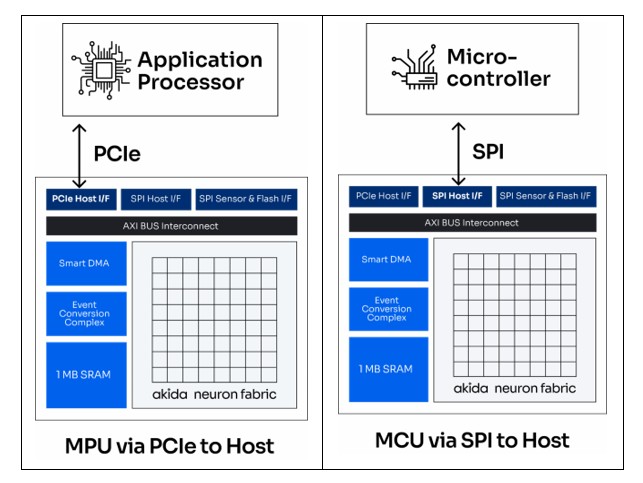
This Edge AI co-processor offers seamless integration across all major host processing platforms via standard PCIe or low-power Serial (SPI) interfaces.
Brightfield added: “This flexibility allows developers to add neuromorphic processing to existing x86, ARM, or RISC-V systems without requiring a complete hardware platform overhaul, enabling a rapid path to market for intelligent Edge applications.”
On the software side, plug-n-play drivers and ONNX execution run-times that can be hosted on any ISA supports simple software migration and support.
Two popular configurations for the AKD1500 co-processor
Upgrading multiprocessor SoCs in professional environments
In defence, industrial, and enterprise settings, the AKD1500 acts as a specialised “offload engine” for multiprocessor SoCs. By handling real-time pattern recognition and adaptive signal analysis locally, it upgrades the overall system capability without a redesign.
“This allows larger system processors to remain in low-power states or focus on high-level mission logic, significantly improving the overall energy efficiency of the platform,” Brightfield explained.
Even with multi-processor SoCs that contain neural processor units, these often are deeply integrated and require the entire platform to be powered up, even for a simple detection. For example, a NVIDIA Jetson platform may need over 10 watts just to stay active with minimal processing.
The AKD1500 can act as an Edge “sentry-mode” device that is always-on and can wake-up the larger SoC platform after identifying a detection event simply by adding a low cost M.2 card to the system.
Contribution to healthcare and consumer microcontrollers
For lower end systems, the AKD1500 significantly enhances embedded microcontrollers (MCUs) by providing them with the intelligence of a high-end AI processor at a fraction of the power.
“In healthcare and wearables, it off-loads simple MCUs to perform complex tasks like real-time seizure prediction in medical or anomaly detection in industrial PCs, often done today in the Cloud due to power and area constraints,” Brightfield said.
The MCU can easily integrate the AKD1500 using a standard serial port and operate without any heat sinks or temperature issues in a wearable or remotely deployed device.
AI-enabled sensing in medical and defence
The AKD1500 has already been designed into and delivered for high-stakes solutions, including:
- Defence: partnerships with Parsons and Bascom Hunter for real-time signal analysis and adaptive defence platforms
- Medical: integration into Nexa smart glasses by Onsor Technologies for the low-power prediction of epileptic seizures, directly improving patient quality of life
The next wave of smart AIoT devices
As a catalyst for the next generation of AIoT, the AKD1500 enables “sovereign AI” – intelligence that is completely independent of the Cloud.
“Its compact, cost-effective package ensures that AI can be embedded in everything from smart doorbells and appliances to industrial factory sensors, making intelligent decision-making ubiquitous in everyday objects,” Brightfield commented.
BrainChip’s AKD1500 Edge AI co-processor
Advantages of adaptive learning at the Edge
Developers gain a major competitive advantage through on-chip learning, which allows devices to adapt to new data patterns or personalise themselves for a specific user in real time.
Brightfield added: “Unlike conventional AI that requires retraining in the cloud and expensive data transfers, the AKD1500 learns locally, which drastically reduces latency and ensures absolute data privacy for the end-user.”
GlobalFoundries 22FDX integration
The integration of BrainChip’s neuromorphic architecture into the GlobalFoundries 22FDX platform creates a solution with superior compute and memory efficiency.
“The 22nm FD-SOI process is known for its ultra-low leakage, which complements the AKD1500’s event-based architecture to provide an ideal performance-per-watt envelope for the smallest edge devices,” Brightfield explained.
Leveraging MetaTF for machine learning
Machine learning engineers utilise the MetaTF software environment to bridge the gap between traditional AI development and neuromorphic hardware.
“It allows them to easily convert, quantise, and compile models created in standard frameworks like TensorFlow/Keras and PyTorch, reducing development costs and ensuring that existing AI expertise can be immediately applied to Akida-based hardware,” Brightfield underlined.
Benefits of neuromorphic on-chip learning
The Akida neuromorphic architecture mimics the human brain’s efficiency by mimicking Spiking Neural Networks (SNNs) in digital logic.
Brightfield added: “This allows the AKD1500 to perform “one-shot” or incremental learning, enabling the chip to recognise a new signature or face after seeing it only a few times – a feat that traditional AI accelerators require a full, Cloud-based retraining cycle.”
The road ahead
To round out the article, it is worth noting that volume production for the AKD1500 is scheduled for Q3 2026, marking a critical transition from research and development to large-scale commercial availability.
“The low power and cost will enable many consumer and industrial products that have eBOM and power limitations to add AI to their legacy designs without a complete platform redesign,” Brightfield explained.
The AKD1500 will be complemented with a roadmap of new chips that will further the performance, accuracy, and power efficiency of Akida.
“Additionally, BrainChip continues to expand its reach through partnerships with companies like Nex Novus and Unigen (OEM hardware), AILabs, BeEmotion, Digirum, Vedya, MultiCoreWare (AI models), Spanidea (firmware) and EdgeImpulse (AI Tools) ensuring that the AKD1500 ecosystem is robust and ready for global deployment,” Brightfield concluded.
About the author:
Diego de Azcuénaga, Contributing Writer