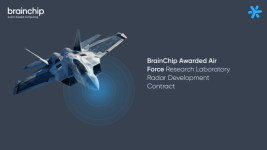
In Decembar 2024, BRN announced an SBIR for AFRL for radar, to be developed with an unnamed sub-contractor, who, in 20250401 turned out to the RTX/Raytheon. I guess BRN was named as the prime contractor because the SBIR had an employee limit of 500.
In the interim RTX announced the demonstration of AI/ML with 4th gen fighter, but this was not BRN AI/ML:
https://www.rtx.com/news/news-cente...er-ai-ml-powered-radar-warning-receiver-for-4
GOLETA, Calif., Feb. 24, 2025 /PRNewswire/ -- Raytheon, an RTX business (NYSE: RTX), has successfully completed flight testing on the first-ever AI/ML-powered Radar Warning Receiver (RWR) system for a fourth-generation aircraft.
The Cognitive Algorithm Deployment System, known as CADS, combines the latest Embedded Graphics Processing Unit with Deepwave Digital's computing stack, enabling AI models to be integrated into Raytheon's legacy RWR systems for AI/ML processing at the sensor. This integration allows CADS to employ cognitive methods to sense, identify and prioritize threats. With the CADS capability, the enhanced RWR will increase aircrew survivability while facilitating the rapid and cost-effective mass deployment of modern AI/ML capabilities.
"The advantages of AI in defense systems are extensive, and our recent CADS test demonstrates how commercially available products, paired with advanced algorithms and cognitive methods, can help the U.S. and its allies outpace peer threats," said Bryan Rosselli, president of Advanced Products and Solutions at Raytheon. "CADS' ability to quickly process data and run third-party algorithms that prioritize threats, with almost no latency will significantly enhance survivability for military personnel."
Initial CADS hardware and cognitive radar processing capabilities were tested on Raytheon's flight test aircraft. CADS performed successfully during additional flight testing and demonstrations on an F-16 at the Air National Guard's test range near Tucson, Arizona in December. The flight tests incorporate containerized AI/ML techniques from the Georgia Tech Research Institute, Vadum, Inc., and Raytheon's cognitive electronic warfare team.
CADS is expected to begin being procured across multiple platforms in early 2025.
Our SBIR was:
 www.highergov.com
Mapping Complex Sensor Signal Processing Algorithms onto Neuromorphic Chips
OBJECTIVE: Develop an efficient workflow and approach for mapping complex RF and radar signal processing algorithms onto neuromorphic hardware. The neuromorphic hardware can be a limited research prototype or a commercial product. The signal processing algorithms encompass processing of RF signals to decode communication waveforms, Multiple-Input Multiple-Output (MIMO) adaptive beamforming, Space-Time Adaptive Processing (STAP), Ground Moving Target Indicator radar, and generating Synthetic Aperture Radar (SAR) images from raw in-phase and quadrature data. The goal is to outline a versatile approach that can translate algorithms as specified in the Matlab or Python software environment into a neuromorphic model implemented in physical hardware.
Rather than being competition for BRN, the Raytheon/Georgia Tech demonstration could be thought of as a proof of concept for AI/ML, using Raytheon's legacy hardware. The SBIR clearly recognizes the benefits of neuromorphic hardware, and AI/ML is right in Akida's sweet spot.
In the interim RTX announced the demonstration of AI/ML with 4th gen fighter, but this was not BRN AI/ML:
https://www.rtx.com/news/news-cente...er-ai-ml-powered-radar-warning-receiver-for-4
GOLETA, Calif., Feb. 24, 2025 /PRNewswire/ -- Raytheon, an RTX business (NYSE: RTX), has successfully completed flight testing on the first-ever AI/ML-powered Radar Warning Receiver (RWR) system for a fourth-generation aircraft.
The Cognitive Algorithm Deployment System, known as CADS, combines the latest Embedded Graphics Processing Unit with Deepwave Digital's computing stack, enabling AI models to be integrated into Raytheon's legacy RWR systems for AI/ML processing at the sensor. This integration allows CADS to employ cognitive methods to sense, identify and prioritize threats. With the CADS capability, the enhanced RWR will increase aircrew survivability while facilitating the rapid and cost-effective mass deployment of modern AI/ML capabilities.
"The advantages of AI in defense systems are extensive, and our recent CADS test demonstrates how commercially available products, paired with advanced algorithms and cognitive methods, can help the U.S. and its allies outpace peer threats," said Bryan Rosselli, president of Advanced Products and Solutions at Raytheon. "CADS' ability to quickly process data and run third-party algorithms that prioritize threats, with almost no latency will significantly enhance survivability for military personnel."
Initial CADS hardware and cognitive radar processing capabilities were tested on Raytheon's flight test aircraft. CADS performed successfully during additional flight testing and demonstrations on an F-16 at the Air National Guard's test range near Tucson, Arizona in December. The flight tests incorporate containerized AI/ML techniques from the Georgia Tech Research Institute, Vadum, Inc., and Raytheon's cognitive electronic warfare team.
CADS is expected to begin being procured across multiple platforms in early 2025.
Our SBIR was:
Mapping Complex Sensor Signal Processing Algorithms onto Neuromorphic Chips
On 4/17/24 Department of the Air Force issued SBIR / STTR Topic AF242-D015 for Mapping Complex Sensor Signal Processing Algorithms onto Neuromorphic Chips due 6/12/24
Mapping Complex Sensor Signal Processing Algorithms onto Neuromorphic Chips
OBJECTIVE: Develop an efficient workflow and approach for mapping complex RF and radar signal processing algorithms onto neuromorphic hardware. The neuromorphic hardware can be a limited research prototype or a commercial product. The signal processing algorithms encompass processing of RF signals to decode communication waveforms, Multiple-Input Multiple-Output (MIMO) adaptive beamforming, Space-Time Adaptive Processing (STAP), Ground Moving Target Indicator radar, and generating Synthetic Aperture Radar (SAR) images from raw in-phase and quadrature data. The goal is to outline a versatile approach that can translate algorithms as specified in the Matlab or Python software environment into a neuromorphic model implemented in physical hardware.
Rather than being competition for BRN, the Raytheon/Georgia Tech demonstration could be thought of as a proof of concept for AI/ML, using Raytheon's legacy hardware. The SBIR clearly recognizes the benefits of neuromorphic hardware, and AI/ML is right in Akida's sweet spot.
Last edited:


 United States rescinds export restrictions on chip software to China, CNBC reports.