
Pom down under
Top 20
As it seems like a hot topic here and and over at the crapper even FF has opened a page for it, I thought I would start one here.
This is my contribution and the link below is where you can keep up with his blogs directly.

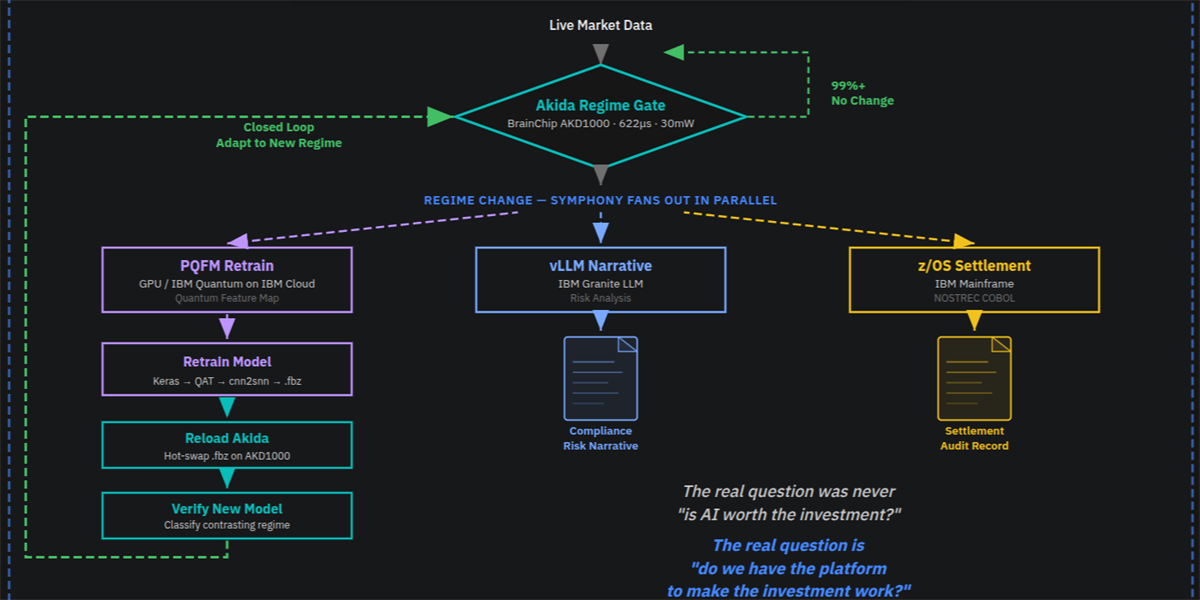
I built a closed loop demo that uses IBM Quantum to train a model, Akida monitors, IBM Granite and vLLM report on it, and Z/OS settles the trades.
Several platforms become one. Four different cadences matched together.
Symphony makes it possible to route each task to the right platform automatically. What that unlocks is a closed-loop architecture where quantum trains the model, a neuromorphic chip runs inference on every market tick, a GPU generates compliance narratives and a mainframe settles trades. Seeming disparate elements join together to form a single platform.
But the real question is: when does each tier fire? Not on a schedule, only when the market says so.
Quantum Training
The Parametrized Quantum Feature Map runs on historical market data, months or years of historical trading. In this demo, IBM Quantum transforms 14 classical features into 48 quantum-encoded features using a 16-qubit Heisenberg ansatz. IBM and HSBC demonstrated this approach on real production bond data yielding a 34% AUC improvement over classical features alone.
That model gets quantized and compiled to a binary deployed on a BrainChip's Akida neuromorphic chip. The advantage is encoded in the weights. No quantum hardware or platform needed for inference.
Neuromorphic Handles the Real-Time Volume
The Akida chip classifies every market tick in a portfolio. 622 microseconds per classification. Mere milliwatts or less. 99%+ of events produce no regime change. The chip consumes almost no power doing continuous monitoring.
But when the regime does change (low volatility to high or trending to mean-reverting) that detection fires in under a millisecond.
A market regime change triggers everything in parallel.
A regime change means the model was trained on data from the previous regime. It can be retrained on the new one. So Symphony fans out to all three downstream tiers simultaneously:
The PQFM service retrains the model on recent data. The vLLM service generates a compliance-grade risk narrative. The z/OS mainframe settles any resulting trades through NOSTREC COBOL in 280 milliseconds. Not the 8 hours a batch job would take.
No tier waits for another. When retraining finishes in seconds, the new model deploys to Akida atomically. The chip is now tuned to current market conditions and goes back to watching every tick.
The Closed Loop
Through Symphony, Akida's neuromorphic chip triggers its own retraining. IBM Quantum improves the model the chip runs. An IBM Granite model on vLLM explains it for compliance/regulatory reporting. Then, z/OS settles outstanding trades.
No tier sits idle. No tier does work that belongs to another. The model never drifts until someone notices. It adapts the moment market conditions change.
Symphony Manages the Complexity
All of these environments are managed as SOAM services through one orchestration layer. The right task goes to the right place automatically.
That's what a platform looks like when it closes the loop.
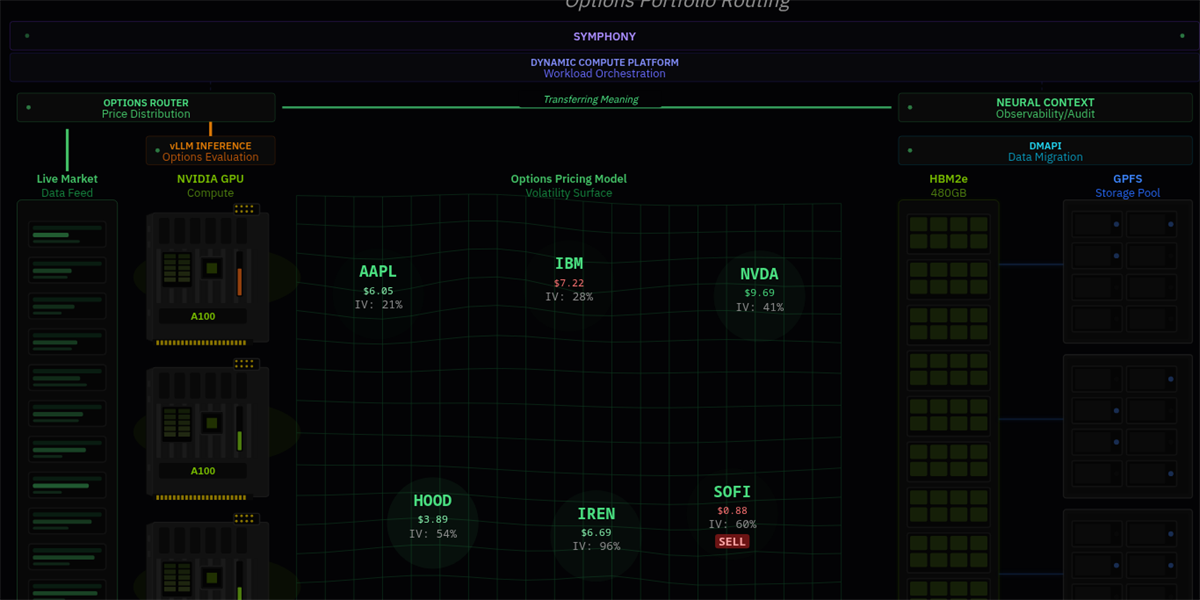
I've built out the neuromorphic demo with IBM Spectrum Symphony and GPFS. Like the KNN semantic routing I demonstrated a couple of weeks ago Symphony routes meaning, not merely bits and bytes.
Now, I've built a Spiking Neural Network (SNN) service on Symphony that runs on six A100 GPUs on IBM Cloud extending the intelligent routing project I did originally to identify patterns for small, medium and large queries. But, what you choose to route is really up to you. Let me give you another way we could route this. How about options portfolio optimization?
I presented Symphony's neuromorphic engine with live options pricing routed after training with five years of options data. When constraints are violated or opportunities emerge, neurons fire. Each spike is a decision: buy, sell, rebalance. The Norse LIF spiking implementation achieved 92% of traditional convex optimizer performance with just an 8% gap that likely closes with a little tuning that I didn't do.
But, the communication pattern matters more than the benchmark. Traditional optimizers move continuous gradients. The SNN averaged 43 spikes per optimization. Meaning moves. Silent neurons stay silent.
GPFS/GPU HBM as Computational Storage
The tensor state originates in GPU HBM where the spiking neural network runs. GPFS provides the framing that makes this computational storage possible: 480GB of A100 HBM across six GPUs becomes the hot tier, with GPFS as a warm tier for observability and audit. In other words, we flip a traditional HSM capability on its head. When tensor state needs to be tracked or checkpointed, DMAPI manages the migration to GPFS and creates a durable record without any code changes. The spike logs, neuron states, and portfolio weights flow to /gpfs/fs1/neuromorphic where they become observable, auditable, and recoverable.
DMAPI automatically intercepts file events and maintains extended attributes linking GPFS files back to their GPU HBM origins. ILM policies control when hot data cools to GPFS and when warm data recalls back to the GPU's HBM. The storage system participates in a computation lifecycle and not just persistence.
This is computational storage: GPU memory as the execution tier, GPFS as the observability and checkpoint tier, DMAPI as the event fabric connecting them, all guided by Symphony and the neuromorphic design it makes possible.
One final note: Spiking neural nets are popular in edge deployments because they use less power than a traditional GPU. One of the easily missed points here is that Symphony can be used in edge computing as well. I'll also demo that in the coming weeks. Stay tuned!
This is my contribution and the link below is where you can keep up with his blogs directly.
High Performance Computing - IBM TechXchange Community
Lists all of the the blog entries
community.ibm.com
Four-Tier Heterogeneous Compute on Symphony: Quantum, Neomorphic, AI, and z/OS
 By Kevin D. Johnson posted 5 days ago
I built a closed loop demo that uses IBM Quantum to train a model, Akida monitors, IBM Granite and vLLM report on it, and Z/OS settles the trades.
Several platforms become one. Four different cadences matched together.
Symphony makes it possible to route each task to the right platform automatically. What that unlocks is a closed-loop architecture where quantum trains the model, a neuromorphic chip runs inference on every market tick, a GPU generates compliance narratives and a mainframe settles trades. Seeming disparate elements join together to form a single platform.
But the real question is: when does each tier fire? Not on a schedule, only when the market says so.
Quantum Training
The Parametrized Quantum Feature Map runs on historical market data, months or years of historical trading. In this demo, IBM Quantum transforms 14 classical features into 48 quantum-encoded features using a 16-qubit Heisenberg ansatz. IBM and HSBC demonstrated this approach on real production bond data yielding a 34% AUC improvement over classical features alone.
That model gets quantized and compiled to a binary deployed on a BrainChip's Akida neuromorphic chip. The advantage is encoded in the weights. No quantum hardware or platform needed for inference.
Neuromorphic Handles the Real-Time Volume
The Akida chip classifies every market tick in a portfolio. 622 microseconds per classification. Mere milliwatts or less. 99%+ of events produce no regime change. The chip consumes almost no power doing continuous monitoring.
But when the regime does change (low volatility to high or trending to mean-reverting) that detection fires in under a millisecond.
A market regime change triggers everything in parallel.
A regime change means the model was trained on data from the previous regime. It can be retrained on the new one. So Symphony fans out to all three downstream tiers simultaneously:
The PQFM service retrains the model on recent data. The vLLM service generates a compliance-grade risk narrative. The z/OS mainframe settles any resulting trades through NOSTREC COBOL in 280 milliseconds. Not the 8 hours a batch job would take.
No tier waits for another. When retraining finishes in seconds, the new model deploys to Akida atomically. The chip is now tuned to current market conditions and goes back to watching every tick.
The Closed Loop
Through Symphony, Akida's neuromorphic chip triggers its own retraining. IBM Quantum improves the model the chip runs. An IBM Granite model on vLLM explains it for compliance/regulatory reporting. Then, z/OS settles outstanding trades.
No tier sits idle. No tier does work that belongs to another. The model never drifts until someone notices. It adapts the moment market conditions change.
Symphony Manages the Complexity
All of these environments are managed as SOAM services through one orchestration layer. The right task goes to the right place automatically.
That's what a platform looks like when it closes the loop.
Building Event-Driven HPC/AI Infrastructure with IBM Spectrum Symphony
By Kevin D. Johnson posted 24 days ago
I've built out the neuromorphic demo with IBM Spectrum Symphony and GPFS. Like the KNN semantic routing I demonstrated a couple of weeks ago Symphony routes meaning, not merely bits and bytes.
Now, I've built a Spiking Neural Network (SNN) service on Symphony that runs on six A100 GPUs on IBM Cloud extending the intelligent routing project I did originally to identify patterns for small, medium and large queries. But, what you choose to route is really up to you. Let me give you another way we could route this. How about options portfolio optimization?
I presented Symphony's neuromorphic engine with live options pricing routed after training with five years of options data. When constraints are violated or opportunities emerge, neurons fire. Each spike is a decision: buy, sell, rebalance. The Norse LIF spiking implementation achieved 92% of traditional convex optimizer performance with just an 8% gap that likely closes with a little tuning that I didn't do.
But, the communication pattern matters more than the benchmark. Traditional optimizers move continuous gradients. The SNN averaged 43 spikes per optimization. Meaning moves. Silent neurons stay silent.
GPFS/GPU HBM as Computational Storage
The tensor state originates in GPU HBM where the spiking neural network runs. GPFS provides the framing that makes this computational storage possible: 480GB of A100 HBM across six GPUs becomes the hot tier, with GPFS as a warm tier for observability and audit. In other words, we flip a traditional HSM capability on its head. When tensor state needs to be tracked or checkpointed, DMAPI manages the migration to GPFS and creates a durable record without any code changes. The spike logs, neuron states, and portfolio weights flow to /gpfs/fs1/neuromorphic where they become observable, auditable, and recoverable.
DMAPI automatically intercepts file events and maintains extended attributes linking GPFS files back to their GPU HBM origins. ILM policies control when hot data cools to GPFS and when warm data recalls back to the GPU's HBM. The storage system participates in a computation lifecycle and not just persistence.
This is computational storage: GPU memory as the execution tier, GPFS as the observability and checkpoint tier, DMAPI as the event fabric connecting them, all guided by Symphony and the neuromorphic design it makes possible.
One final note: Spiking neural nets are popular in edge deployments because they use less power than a traditional GPU. One of the easily missed points here is that Symphony can be used in edge computing as well. I'll also demo that in the coming weeks. Stay tuned!
Last edited: