100% agree but a snakes belly cant get lower......SP holding up pretty well compared to what’s happening outside

You are using an out of date browser. It may not display this or other websites correctly.
You should upgrade or use an alternative browser.
You should upgrade or use an alternative browser.
BRN Discussion Ongoing
- Thread starter TechGirl
- Start date
EDGX

 www.linkedin.com

 brainchip.com
Starion incorporates new AI technology into RF spectrum monitoring SmallSat - Starion | EDGX
Proud to support Starion on the European RF Spectrum Monitoring Service (ESMS) SmallSat mission. Our STERNA data processing unit brings high-performance AI compute directly into orbit, enabling real-time RF spectrum analysis while drastically reducing downlink needs. This marks a significant...
EDGX Partners with BrainChip on Disruptive Data Processing for Space
BrainChip and EDGX collaborate to create breakthrough data processing solutions for space, advancing neuromorphic AI and efficient on-orbit intelligence.
brainchip.com
Hi Rach,EDGX
Starion incorporates new AI technology into RF spectrum monitoring SmallSat - Starion | EDGX
Proud to support Starion on the European RF Spectrum Monitoring Service (ESMS) SmallSat mission. Our STERNA data processing unit brings high-performance AI compute directly into orbit, enabling real-time RF spectrum analysis while drastically reducing downlink needs. This marks a significant...
EDGX Partners with BrainChip on Disruptive Data Processing for Space
BrainChip and EDGX collaborate to create breakthrough data processing solutions for space, advancing neuromorphic AI and efficient on-orbit intelligence.
I downloaded the EdgeX Sterna datasheet. It's only Nvidia with Nvidia NPUs- no Akida., which explains the 10 to 40 Watts.
https://www.edgx.space/product/sterna#downloads

Fiendish
Regular
ShutupYes you’re right… compared to the last few years

Fiendish
Regular
ShutupYes you’re right… compared to the last few years
smoothsailing18
Regular
Curlednoodles
Curiouser and curiouser.
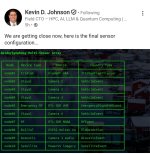
It would appear that all of Kevins previous tests were actually precursors for todays build of a multi modal sensor fusion edge system, which is what he was likely working on from the start.
*This is where the earlier tests suddenly make sense:
Always-on inference (finance demo) → trust gating (voice recognition) → anomaly detection (cybersecurity) → orchestration (Symphony) → scaling across multiple Akida devices/nodes (~10) → multi-sensor fusion (today).
Individually, they looked like:
finance analytics
voice authentication
emotion recognition
cybersecurity
And they could absolutely function as standalone applications.
But when viewed together, they resemble a testbed for today’s system, bringing multiple sensing domains together:
video
audio
BLE device detection
RF spectrum sensing
satellite signals
All fused into a single platform, with Akida providing the inference layer and Symphony coordinating the system.
What once looked like separate applications now appears to be a single edge architecture assembled step by step, with each test validating the capabilities needed for a multi-modal sensor fusion system.
The inclusion of SDR spectrum sensing, LoRa, satellite signals, and Doppler-derived positioning is particularly telling, suggesting the system is intended to operate in GPS-constrained or disconnected environments — a capability rarely demonstrated in typical edge AI systems.
Another subtle and often missed clue appears in Kevin’s screenshots:
the presence of /dev/akida0 alongside orchestration and multiple sensor pipelines. In Linux systems, anything that appears under /dev/ is treated as a system device.
This means the Akida chip isn’t being accessed as a one-off library call for a specific application.
Instead it is exposed as a persistent system-level compute device.
That is precisely how hardware behaves when it is intended to act as shared infrastructure for multiple workloads — exactly what you would want for a multi-modal sensor fusion node.
This leads to a more interesting conclusion:
Akida isn’t simply acting as an accelerator for a single task. It appears to be operating as the shared intelligence layer tying multiple sensing domains together. A substrate.
The latest multi-modal sensor fusion system brings those capabilities together into a single platform, making it feel less like a new experiment and more like the integration stage of something he has been building toward all along
Curiouser and curiouser.
It would appear that all of Kevins previous tests were actually precursors for todays build of a multi modal sensor fusion edge system, which is what he was likely working on from the start.
*This is where the earlier tests suddenly make sense:
Always-on inference (finance demo) → trust gating (voice recognition) → anomaly detection (cybersecurity) → orchestration (Symphony) → scaling across multiple Akida devices/nodes (~10) → multi-sensor fusion (today).
Individually, they looked like:
finance analytics
voice authentication
emotion recognition
cybersecurity
And they could absolutely function as standalone applications.
But when viewed together, they resemble a testbed for today’s system, bringing multiple sensing domains together:
video
audio
BLE device detection
RF spectrum sensing
satellite signals
All fused into a single platform, with Akida providing the inference layer and Symphony coordinating the system.
What once looked like separate applications now appears to be a single edge architecture assembled step by step, with each test validating the capabilities needed for a multi-modal sensor fusion system.
The inclusion of SDR spectrum sensing, LoRa, satellite signals, and Doppler-derived positioning is particularly telling, suggesting the system is intended to operate in GPS-constrained or disconnected environments — a capability rarely demonstrated in typical edge AI systems.
Another subtle and often missed clue appears in Kevin’s screenshots:
the presence of /dev/akida0 alongside orchestration and multiple sensor pipelines. In Linux systems, anything that appears under /dev/ is treated as a system device.
This means the Akida chip isn’t being accessed as a one-off library call for a specific application.
Instead it is exposed as a persistent system-level compute device.
That is precisely how hardware behaves when it is intended to act as shared infrastructure for multiple workloads — exactly what you would want for a multi-modal sensor fusion node.
This leads to a more interesting conclusion:
Akida isn’t simply acting as an accelerator for a single task. It appears to be operating as the shared intelligence layer tying multiple sensing domains together. A substrate.
The latest multi-modal sensor fusion system brings those capabilities together into a single platform, making it feel less like a new experiment and more like the integration stage of something he has been building toward all along
smoothsailing18
Regular
Asking AI....
Given IBM’s scale in the industrial sector, an "all-verticals" deal could involve millions of sensor nodes. If we apply standard semiconductor IP royalty rates—typically ranging from
0.50
to
2.00
USD per chip for high-volume specialized AI silicon—and consider IBM’s vast footprint in the Fortune 500, the annual royalty revenue alone could reach mid-to-high eight-figure sums.[9] Furthermore, the "Symphony" integration implies a deep software-hardware synergy, potentially valuing the partnership in the hundreds of millions over a multi-year lifecycle, considering the strategic importance of neuromorphic tech in the global AI chip market, which is projected to grow exponentially.
IBM has a massive, expanding ecosystem with over 9,000 partners actively engaged in learning and development through the IBM Partner Plus program. Furthermore, IBM maintains relationships with tens of thousands of resellers and technology partners globally, including major collaborations with industry leaders
Given IBM’s scale in the industrial sector, an "all-verticals" deal could involve millions of sensor nodes. If we apply standard semiconductor IP royalty rates—typically ranging from
0.50
to
2.00
USD per chip for high-volume specialized AI silicon—and consider IBM’s vast footprint in the Fortune 500, the annual royalty revenue alone could reach mid-to-high eight-figure sums.[9] Furthermore, the "Symphony" integration implies a deep software-hardware synergy, potentially valuing the partnership in the hundreds of millions over a multi-year lifecycle, considering the strategic importance of neuromorphic tech in the global AI chip market, which is projected to grow exponentially.
IBM has a massive, expanding ecosystem with over 9,000 partners actively engaged in learning and development through the IBM Partner Plus program. Furthermore, IBM maintains relationships with tens of thousands of resellers and technology partners globally, including major collaborations with industry leaders
Last edited:
So, 9 out of 10 wondering if he finished the test or….at least a explanation what that means…hope for a follow up like he promised the other guy

 www.linkedin.com
www.linkedin.com

wondering if he finished the test or….at least a explanation what that means…hope for a follow up like he promised the other guySign Up | LinkedIn
500 million+ members | Manage your professional identity. Build and engage with your professional network. Access knowledge, insights and opportunities.
Sign Up | LinkedIn
500 million+ members | Manage your professional identity. Build and engage with your professional network. Access knowledge, insights and opportunities.
smoothsailing18
Regular

Terroni2105
Founding Member
Pitt Street Research Semiconductor Conference 2026
I wonder who will be presenting for BrainChip.

I wonder who will be presenting for BrainChip.
Here a list of some important semiconductor conferences
 qubika.com
List of Semiconductor Conferences in 2026 - Qubika
Discover the top semiconductor events in 2026. Stay ahead of industry trends, connect with leaders, and explore opportunities in AI, and energy-efficient chips. Don’t miss key conferences!
qubika.com
Similar threads


- Replies
- 0
- Views
- 5K
- Replies
- 9
- Views
- 6K
- Replies
- 0
- Views
- 3K