
You are using an out of date browser. It may not display this or other websites correctly.
You should upgrade or use an alternative browser.
You should upgrade or use an alternative browser.
BRN Discussion Ongoing
- Thread starter TechGirl
- Start date
I hadn’t considered that this could be paid marketing. Could it be? I’d be really disappointed if it was…
Sorry but why should it? Please think seriously… Kevin is not working for a promotion company… do you know what this would mean for him if he would take money to promote a Product of a other company especially when they are working on a similar product? That’s again BS of some people who want to make things up… ridiculous
this “paid campaign” theory says more about some users IQ and level of understanding than it does about Kevin’s post. They can’t even process a basic point and immediately jump to conspiracies. If you’re going to make claims like that, bring evidence… otherwise it’s just noise.
Last edited:
I don't care as long as it helps.I hadn’t considered that this could be paid marketing. Could it be? I’d be really disappointed if it was…

HopalongPetrovski
I'm Spartacus!
Don't let the FUDster's either over on the crapper, or here, into your head.I hadn’t considered that this could be paid marketing. Could it be? I’d be really disappointed if it was…
This is the sort of stuff we come to these forums for. This is the gravy.
The info we get to consider before the ASX announcements land and it all gets much easier, but less profitable.
All the other wise words of wisdom, gif's and banter is just the cream.
Not financial advise of course, but I'm taking it as a huge confirmation of our product and the opening up of potential applications previously undreamt of.
Last edited:
HopalongPetrovski
I'm Spartacus!
Also, over 10 million in prop bids have disappeared from the buy side over the last few days, mainly from today.
The Kevin effect?
Hopefully the share price tide is turning our way at last.
Early signs perhaps?
The Kevin effect?
Hopefully the share price tide is turning our way at last.
Early signs perhaps?
HopalongPetrovski
I'm Spartacus!
It's all good brother. It's been a long hard ride for all of us.Sorry everyone. Ive been in 8 years… and that was a small moment of weakness. Forgive me!

Soon, soon, perhaps we'll all get a nice soaping up and soak in Bravo's hot tub.
smoothsailing18
Regular
Sorry everyone. Ive been in 8 years… and that was a small moment of weakness. Forgive me!
I seem to remember this question being asked before to kevin and he said no he wasn't being paid by brn .
Actually - I think you’re right about that. I recall it too. As you were.I seem to remember this question being asked before to kevin and he said no he wasn't being paid by brn .
Also, over 10 million in prop bids have disappeared from the buy side over the last few days, mainly from today.
The Kevin effect?
Hopefully the share price tide is turning our way at last.
Early signs perhaps?
Not fluent English here… but isn’t it negative at first place if the buy side disappears?
HopalongPetrovski
I'm Spartacus!
Not when they're just prop bids placed to distort and manipulate the market.Not fluent English here… but isn’t it negative at first place if the buy side disappears?
Not when they're just prop bids placed to distort and manipulate the market.
Ah I got you! Thanks that makes sense! Sorry
So it means paid by IBM and approved by IBMI seem to remember this question being asked before to kevin and he said no he wasn't being paid by brn .

Hi mia,So it means paid by IBM and approved by IBM
It is Kevin's job to investigate "neighbouring" technologies. Here's his IBM blog:
https://community.ibm.com/community/user/blogs/kevin-d-johnson
This one from 20260125 is a good example pre Akida:
https://community.ibm.com/community...unityKey=74d589b7-7276-4d70-acf5-0fc26430c6c0
Building Event-Driven HPC/AI Infrastructure with IBM Spectrum Symphony
 By Kevin D. Johnson posted Wed January 21, 2026 10:16 AM
I've built out the neuromorphic demo with IBM Spectrum Symphony and GPFS. Like the KNN semantic routing I demonstrated a couple of weeks ago Symphony routes meaning, not merely bits and bytes.
Now, I've built a Spiking Neural Network (SNN) service on Symphony that runs on six A100 GPUs on IBM Cloud extending the intelligent routing project I did originally to identify patterns for small, medium and large queries. But, what you choose to route is really up to you. Let me give you another way we could route this. How about options portfolio optimization?
I presented Symphony's neuromorphic engine with live options pricing routed after training with five years of options data. When constraints are violated or opportunities emerge, neurons fire. Each spike is a decision: buy, sell, rebalance. The Norse LIF spiking implementation achieved 92% of traditional convex optimizer performance with just an 8% gap that likely closes with a little tuning that I didn't do.
But, the communication pattern matters more than the benchmark. Traditional optimizers move continuous gradients. The SNN averaged 43 spikes per optimization. Meaning moves. Silent neurons stay silent.
GPFS/GPU HBM as Computational Storage
The tensor state originates in GPU HBM where the spiking neural network runs. GPFS provides the framing that makes this computational storage possible: 480GB of A100 HBM across six GPUs becomes the hot tier, with GPFS as a warm tier for observability and audit. In other words, we flip a traditional HSM capability on its head. When tensor state needs to be tracked or checkpointed, DMAPI manages the migration to GPFS and creates a durable record without any code changes. The spike logs, neuron states, and portfolio weights flow to /gpfs/fs1/neuromorphic where they become observable, auditable, and recoverable.
DMAPI automatically intercepts file events and maintains extended attributes linking GPFS files back to their GPU HBM origins. ILM policies control when hot data cools to GPFS and when warm data recalls back to the GPU's HBM. The storage system participates in a computation lifecycle and not just persistence.
This is computational storage: GPU memory as the execution tier, GPFS as the observability and checkpoint tier, DMAPI as the event fabric connecting them, all guided by Symphony and the neuromorphic design it makes possible.
One final note: Spiking neural nets are popular in edge deployments because they use less power than a traditional GPU. One of the easily missed points here is that Symphony can be used in edge computing as well. I'll also demo that in the coming weeks. Stay tuned!
Last edited:
smoothsailing18
Regular
Actually - I think you’re right about that. I recall it too. As you were.
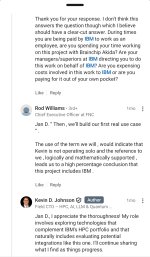
I found linkden notes it's nothing to do with payment from brainchip, all at IBM requests.
Attachments

Hi mia,
It is Kevin's job to investigate "neighbouring" technologies. Here's his IBM blog:
https://community.ibm.com/community/user/blogs/kevin-d-johnson
This one from 20260125 is a good example pre Akida:
https://community.ibm.com/community...unityKey=74d589b7-7276-4d70-acf5-0fc26430c6c0
Building Event-Driven HPC/AI Infrastructure with IBM Spectrum Symphony
I've built out the neuromorphic demo with IBM Spectrum Symphony and GPFS. Like the KNN semantic routing I demonstrated a couple of weeks ago Symphony routes meaning, not merely bits and bytes.
Now, I've built a Spiking Neural Network (SNN) service on Symphony that runs on six A100 GPUs on IBM Cloud extending the intelligent routing project I did originally to identify patterns for small, medium and large queries. But, what you choose to route is really up to you. Let me give you another way we could route this. How about options portfolio optimization?
I presented Symphony's neuromorphic engine with live options pricing routed after training with five years of options data. When constraints are violated or opportunities emerge, neurons fire. Each spike is a decision: buy, sell, rebalance. The Norse LIF spiking implementation achieved 92% of traditional convex optimizer performance with just an 8% gap that likely closes with a little tuning that I didn't do.
But, the communication pattern matters more than the benchmark. Traditional optimizers move continuous gradients. The SNN averaged 43 spikes per optimization. Meaning moves. Silent neurons stay silent.
GPFS/GPU HBM as Computational Storage
The tensor state originates in GPU HBM where the spiking neural network runs. GPFS provides the framing that makes this computational storage possible: 480GB of A100 HBM across six GPUs becomes the hot tier, with GPFS as a warm tier for observability and audit. In other words, we flip a traditional HSM capability on its head. When tensor state needs to be tracked or checkpointed, DMAPI manages the migration to GPFS and creates a durable record without any code changes. The spike logs, neuron states, and portfolio weights flow to /gpfs/fs1/neuromorphic where they become observable, auditable, and recoverable.
DMAPI automatically intercepts file events and maintains extended attributes linking GPFS files back to their GPU HBM origins. ILM policies control when hot data cools to GPFS and when warm data recalls back to the GPU's HBM. The storage system participates in a computation lifecycle and not just persistence.
This is computational storage: GPU memory as the execution tier, GPFS as the observability and checkpoint tier, DMAPI as the event fabric connecting them, all guided by Symphony and the neuromorphic design it makes possible.
One final note: Spiking neural nets are popular in edge deployments because they use less power than a traditional GPU. One of the easily missed points here is that Symphony can be used in edge computing as well. I'll also demo that in the coming weeks. Stay tuned!
Kevin is well aware, as is his employer (IBM) of the potential trajectory all this testing and benchmarking results will have, publishing via Linkedin sends a very clear message, procrastinate and the bus will have left the station, we are in a very commanding position at the far edge, we have Intel, Nvidia and IBM as potential suitors, who will it be, my money is and has always been on Jensen.
Can our company explode on our own, we are continually refining our technology, we are finetuning it to specific customers' requirements (demands), the commitment to IP will come, but I believe that the company has finally come to the realization that the IP only business model may have well passed it's used by date, just ask ARM if they have or are refocusing their own business model to adjust to the times.
My only request is that the internal, ex employee's stop trying to cause unrest, you had your opportunity, you failed, Brainchip has continued to move forward, the technology has been expanded upon, you know it, so, swallow your pride, accept that you aren't the main players anymore, just sit back and enjoy the success that is coming, egos cannot only damage our future, but reflect your true character.
Your early contributions have always been acknowledged......move on.

Pom down under
Top 20
Last edited:
Hi mia,
It is Kevin's job to investigate "neighbouring" technologies. Here's his IBM blog:
https://community.ibm.com/community/user/blogs/kevin-d-johnson
This one from 20260125 is a good example pre Akida:
https://community.ibm.com/community...unityKey=74d589b7-7276-4d70-acf5-0fc26430c6c0
Building Event-Driven HPC/AI Infrastructure with IBM Spectrum Symphony
I've built out the neuromorphic demo with IBM Spectrum Symphony and GPFS. Like the KNN semantic routing I demonstrated a couple of weeks ago Symphony routes meaning, not merely bits and bytes.
Now, I've built a Spiking Neural Network (SNN) service on Symphony that runs on six A100 GPUs on IBM Cloud extending the intelligent routing project I did originally to identify patterns for small, medium and large queries. But, what you choose to route is really up to you. Let me give you another way we could route this. How about options portfolio optimization?
I presented Symphony's neuromorphic engine with live options pricing routed after training with five years of options data. When constraints are violated or opportunities emerge, neurons fire. Each spike is a decision: buy, sell, rebalance. The Norse LIF spiking implementation achieved 92% of traditional convex optimizer performance with just an 8% gap that likely closes with a little tuning that I didn't do.
But, the communication pattern matters more than the benchmark. Traditional optimizers move continuous gradients. The SNN averaged 43 spikes per optimization. Meaning moves. Silent neurons stay silent.
GPFS/GPU HBM as Computational Storage
The tensor state originates in GPU HBM where the spiking neural network runs. GPFS provides the framing that makes this computational storage possible: 480GB of A100 HBM across six GPUs becomes the hot tier, with GPFS as a warm tier for observability and audit. In other words, we flip a traditional HSM capability on its head. When tensor state needs to be tracked or checkpointed, DMAPI manages the migration to GPFS and creates a durable record without any code changes. The spike logs, neuron states, and portfolio weights flow to /gpfs/fs1/neuromorphic where they become observable, auditable, and recoverable.
DMAPI automatically intercepts file events and maintains extended attributes linking GPFS files back to their GPU HBM origins. ILM policies control when hot data cools to GPFS and when warm data recalls back to the GPU's HBM. The storage system participates in a computation lifecycle and not just persistence.
This is computational storage: GPU memory as the execution tier, GPFS as the observability and checkpoint tier, DMAPI as the event fabric connecting them, all guided by Symphony and the neuromorphic design it makes possible.
One final note: Spiking neural nets are popular in edge deployments because they use less power than a traditional GPU. One of the easily missed points here is that Symphony can be used in edge computing as well. I'll also demo that in the coming weeks. Stay tuned!
Not only has Kevin created 2 entirely different Akida implementations, but he has done it in no time flat. Obviously, having the databases fresh from the oven was essential for adaptation to create Akida models, but there is a hell of a lot of pre-baked datasets out there. The legacy market is an untapped gold mine.
Similar threads


- Replies
- 0
- Views
- 5K
- Replies
- 9
- Views
- 6K
- Replies
- 0
- Views
- 3K